
Back to Surveyor’s Headquarters
AREA 7 – ANTECHAMBER OF ARTIFACTS
A vault of white marble.
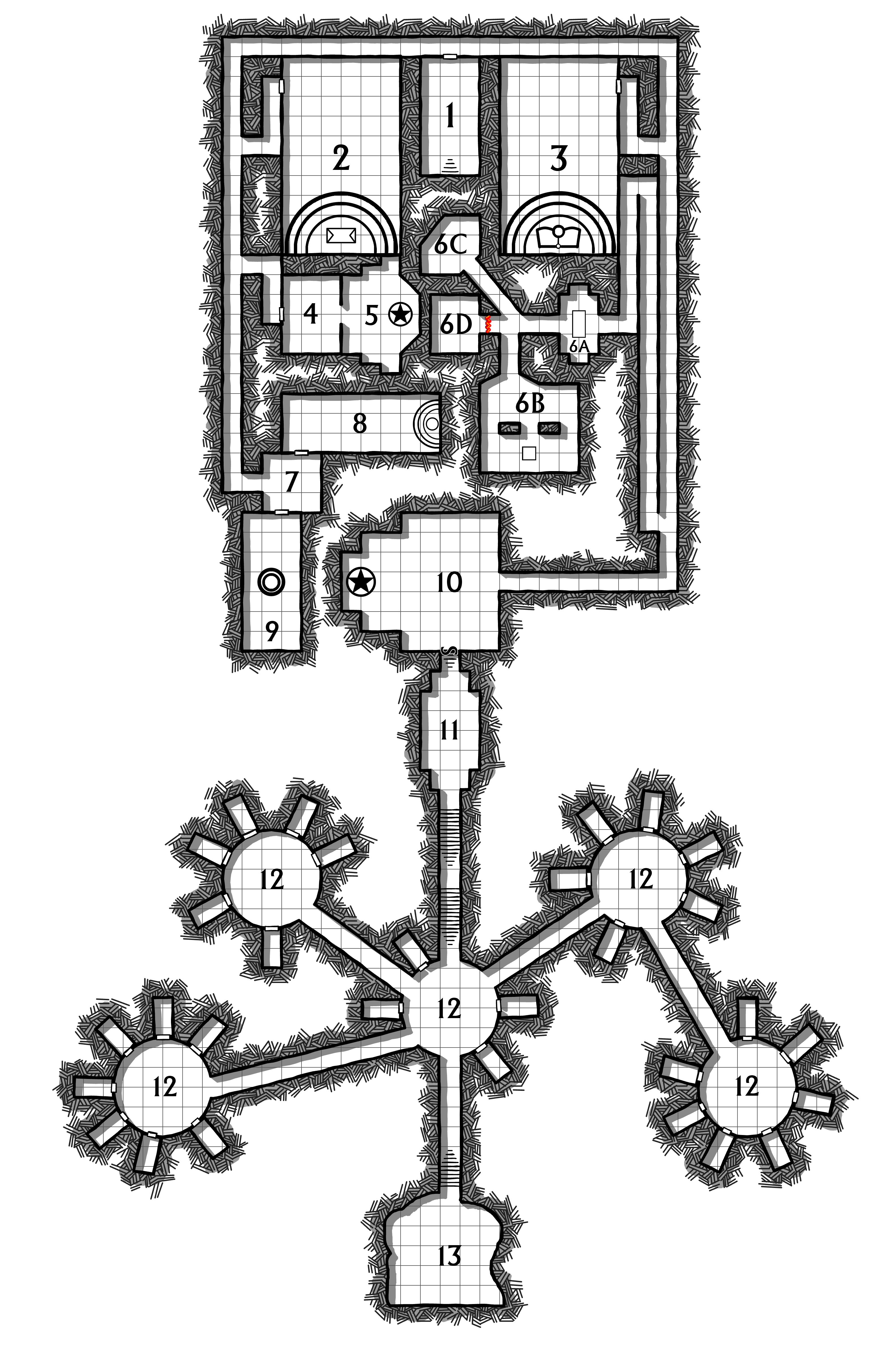
AREA 8 – BOOK OF INFINITE SPELLS
Scribal stalls line the long walls of this chamber to the right and left. At the far end of the room, there is a stand of bloodwood holding the Book of Arkath.
BOOK OF ARKATH: Each page of the Book of Arkath contains a random spell. Once a page is turned, it can never be flipped back – paging through the Book of Arkath is a one-way trip and, as far as anyone has been able to determine, once a spell has appeared, it does not reoccur. If the book is closed, it always opens to the page it was on before the book was closed.
Once per long rest, a reader attuned to the Book of Arkath can cast the spell to which the book is opened. If the reader is a spellcaster and the spell appears on their spell list, they can cast it up to four times per day. Each time a spell is cast, there is a 1 in 6 chance that the page of the book will automatically turn.
In addition, each time a page is turned (whether willingly or not), there is a 1 in 20 chance that the book vanishes.
The book currently displays protection from energy.
SCRIBAL STALLS: A number of freshly copied scrolls can be found among the scribal stalls.
- scroll of creation
- scroll of teleport
- scroll of control winds
- scroll of kin curse*
- scroll of call of the topaz*
- scroll of harroc adulese (hunter serpent)*
* Exotic spells, see The Spells of Arkath.
GM Background: Under Guildmaster Essetia’s guidance, arcane members of the Brotherhood copy the spell currently displayed in the Book of Arkath. The page of the book is then turned.
AREA 9 – NECROMANCER’S STONE
Upon a platform of substarrae within a bulging cylinder of transparent arenak, sits the Necromancer’s Stone.
CYLINDER: A small plaque written in Old Prustan read, “The Necromancer’s Stone, wielded by the Squirming Horde, cleaved by the vanguard of Nulara Aretari during the Ghulwar.”
- Substarrae: A purplish black metal. The secrets of its creation were lost long aeons ago, but it’s stronger than even adamantine.
- Transparent Arenak: A silvery-black metal with a hundred times the strength and durability of normal steel. It has been alchemically treated to become transparent, but retains all the properties of adamantine.
NECROMANCER’S STONE: The Necromancer’s Stone is one of the primal stones – like the alchemist’s Philosopher’s Stone, Sorcerer’s Stone, God’s Stone, Druid’s Stone, and so forth.
In game terms, the Stone has XX charges and regenerates 2d10+4 charges daily at dawn. While holding it, the wielder can use an action to expend 1 or more of its charges to cast one of the following spells from it, using their spell save DC + 10: animate dead, blight, command undead*, create undead, death knell*, gentle repose, halt undead*, and soul bind* (trapping the soul within the Necromancer’s Stone). For spells that can be cast with higher spell slots, the wielder chooses which “slot” to use and spends a number of charges each equal to the “slot” level.
The wielder can also cast raise dead (5 charges) – whether the normal time limit has expired or the soul resists.
The Stone can also be used to create an undead hallow (4 charges) for 24 hours. An area 60 feet around the wielder is imbued with necromantic energy, although the spell fails if the radius includes an area already under the effects of a hallow spell. Undead creatures within the area are immune to turning and non-undead creatures (other than the wielder) cannot enter the area unless they succeed at a saving throw. For each additional charge expended, the wielder can also imbue the undead hallow with one effect:
- Courage. Undead cannot be frightened while in the area.
- Darkness. Darkness fills the area. Normal light, as well as magical light created by spells of a lower than 5th level, can’t illuminate the area.
- Energy Protection. Undead creatures have resistance to one damage type of the wielder’s choice, except for bludgeoning, piercing, or slashing.
- Fear. Non-undead creatures (other than the wielder) are frightened while in the area.
- Silence. No sound can emanate from within the area, and no sound can reach into it.
The wielder of the Stone is permanently under the effects of death ward and gains advantage on skill checks and saving throws related to necromantic spells or effects.
This particular Necromancer’s Stone was created during the Ghulwar and was wielded by the legions of Ghul before being captured by Nulara Aretari’s army in the Field of Moonsilver. It’s tainted and bestows two levels of exhaustion to any non-chaotic or non-evil character carrying it.
COMMAND UNDEAD
Level 3 Necromancy (Sorcerer, Wizard)Casting Time: 1 action
Range: 60 feet
Components: VYou speak a one-word command to all undead creatures you can see within range. Any target must succeed on a Wisdom saving throw or follow the command on its next turn. The spell has no effect if the target is living, if it doesn’t understand your language, or if your command is directly harmful to it.
Using a Higher-Level Spell Slot. The range of the spell can be increased by an additional 10 feet for each additional spell slot level.
DEATH KNELL
Necromancy Cantrip (Cleric)Casting Time: 1 action
Range: Touch
Components: V, S
Duration: InstantaneousYou draw forth the ebbing life force of a creature and use it to fuel your own power. Upon casting this spell, you touch a living creature who is currently making death saving throws. If the subject fails a Constitution saving throw, it dies and you gain 2d4+4 temporary hit points.
HALT UNDEAD
Level 3 Necromancy (Sorcerer, Wizard)Casting Time: 1 action
Range: 120 feet
Components: V, S, M
Duration: Concentration, up to 1 minuteChoose up to three undead creatures you can see within range. Each creature must succeed on a Wisdom saving throw or be paralyzed for the duration of the spell. The effect on a creature is broken if it is attacked or takes damage.
Using a Higher-Level Spell Slot. You can affect an additional two undead for each additional spell slot level.
SOUL BIND
Level 9 Necromancy (Cleric, Sorcerer, Wizard)Casting Time: 1 action
Range: 60 feet
Components: V, S, M (a black sapphire gem)
Duration: PermanentYou draw the soul from a newly dead body and imprison it in a black sapphire gem worth at least 1,000 gp per level or CR of the creature whose soul is to be bound. The subject must have been dead no more than 1 minute and can attempt a Wisdom saving throw to avoid imprisonment.
The soul, once trapped in the gem, cannot be returned through raise dead, resurrection, or any similar spell or effect, not even a wish or miracle. Only by destroying the gem can one free the soul (which is then still dead).
Necromancer’s Stone is covered by the Open Game License.
AREA 10 – THE STATUE OF VLADAAM
A massive statue standing at one of this chamber depicts a hulking creature of black demon-flesh. Its skull seems to push out from the skin of its face, depicting a bone-white countenance with two flaming coals for eyes.
STATUE: The base of the statue is labeled in Old Prustan – VLADAAM, VESTED OF THE GALCHUTT.
- DC 24 Intelligence (Investigation): By pushing the V’s in both “VLADAAM” and “VESTED” simultaneously, a panel opens in the base of the statue. It contains The Ritual of Flessh (see handouts).
SEARCH – DC 18 Wisdom (Perception): To detect the secret door leading to Area 11.
GM Background: This statue depicts Vladaam, a Vested of the Galchutt and the founder of House Vladaam.
AREA 11 – DARKENING ENTRANCE
This area is affected by a darkness spell.
COMMAND PHRASE: Those speaking the command phrase (“let us hold and send forth the eye of all knowledge”), which can be found in the Oath of the Brotherhood, can perceive the room as if the darkness spell were not present.
CURSE: Anyone dispelling the darkness spell or passing through the room without speaking the command phrase must succeed on a DC 24 Wisdom saving throw or become cursed: Their shadow becomes animate. Although it remains attached to the victim, it dances wildly, causing the victim to suffer disadvantage on Hide checks unless they’re in an area of total darkness. The effect is permanent, although a remove curse spell ends the effect.
AREA 12 – CRYPTS OF THE BROTHERHOOD
Each of these crypts contain a former, high-placed member of the Brotherhood. This includes all of the guildmasters of the Red Company of Surveyors since the 7th century.
AREA 13 – FONT OF ASCENSION
This is a natural cavern. Carved stairs at the rear of the cave lead down to Area 12. The far side of the cavern opens out onto a cliff face on the edge of Oldtown, providing a breathtaking vista across Ptolus and down to the sea.
ILLUSION: The cave entrance is masked by an illusion from the outside.
FOUNTAIN: A burst of water from the wall softly falls in a burbling cascade through a complicated, multi-tiered fountain of gilded, glinting gold. Each tier of the fountain contains a small, golden sculpture depicting an animal with a rune or sigil on its chest: An eagle, a stag, a bear, a cat, an owl, a wolf, a dolphin, and a hawk.
- DC 15 Intelligence (Religion): These holy animals were associated with the Elder Gods before those strange deities vanished from the world.
- DC 25 Intelligence (Arcana): To recognize the runes as being an ancient antecedent of modern dreamspeaking notation. (Advantage on this check if the character is proficient in the Dreaming Arts.)
- DC 20 Intelligence (Investigation): There’s a hidden compartment at the base of the fountain. It contains The Passing of the Jewels of Parnaith (see handouts).
GOLDEN ANIMALS: The golden statuettes can be removed. Once removed, touching the sigils will cause them to glow. If all of the sigils are activated, each statuette will transform into a cunningly wrought piece of gold. These can be joined together to form an illitor (Ptolus, p. 485).
An illitor is a complex item encompassing a golden belt, armband, and bracelet, each connected to the others by thin golden chains.
GM Background: Only someone wearing an illitor can access the pergolas which lead to the Jewels of Parnaith.
Go to Part 14D: Inner Sanctum Handouts