
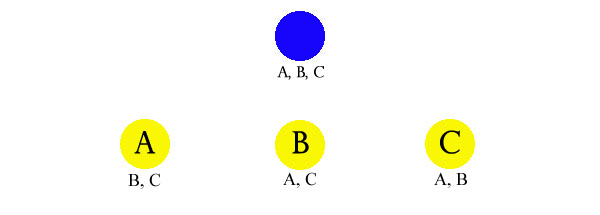
The PCs are playing agents in the Las Vegas branch of CTU. This mini-scenario begins when they receive an inter-agency intelligence report that a monitoring program established on a known terrorist operation’s bank account information has recorded payments being made on a storage unit in Las Vegas. The PCs have been authorized to execute a search warrant on the storage unit.
The scenario starts at the North Las Vegas Self-Storage on Lake Mead Boulevard (the BLUE NODE).
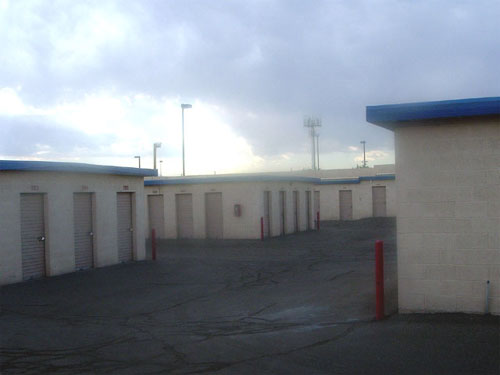
The storage space itself is stacked high with empty cardboard boxes. Anyone walking past the storage space when the door was open would see a bunch of boxes labeled “LIVING ROOM”, “DISHES”, and the like – but it’s all just for a show. There’s a large gap towards the back where several boxes have recently been removed: Something was being stored here and now it’s gone.
CLUE 1: Checking the rental records reveals that Yassif Mansoor signed the lease on the storage space. The address given on the lease agreement is a fake, but a routine database search turns up a Yassif Mansoor living in the Broadstone Indigo apartment complex on Azure Avenue (NODE A).
CLUE 2: The storage space contains a bellboy uniform belonging to the Bellagio hotel and casino (NODE B).
CLUE 3: There is also a disposable cell phone in the storage space. Checking the call log reveals several calls being placed to a number that can be traced to Officer Frank Nasser (NODE C).
ANCILLARY CLUE: Two detonation caps can be found behind the metal track of the storage space door. (They rolled back there and were lost.)
NODE A: YASSIF MANSOOR’S APARTMENT

Yassif Mansoor isn’t at his apartment, but there are eight terrorists hanging out. Four of them play cards in the living room; two are watching TV in one of the bedrooms; and two more are on the balcony smoking.

CLUE 1: A large metal trash can in the storage closet off the balcony contains the charcoaled remnants of a massive amount of documentary evidence (Mansoor was covering his tracks). Sifting through the ashes reveals a few partially preserved scraps of paper, including part of a Radio Shack shipping manifest including an order number. Tracking the order reveals several pieces of electronic equipment that could be useful in building bombs. More importantly, it also gives them a credit card number and one of the fake names Mansoor was using. If they track recent activity on the credit card, they’ll find that it was used to rent a room at the Bellagio (NODE B).
CLUE 2: If the PCs can get one of the terrorists to crack under questioning, they can tell them that Yassif Mansoor was at the apartment yesterday with a cop named Nasser (NODE C).
ANCILLARY CLUE: There are six suicide-bomb vests stored in the walk-in closet. After the big bomb went off at the Bellagio, these suicide bombers were going to deliver a second wave of terror throughout Vegas. (These bombers, however, do not know the actual target of the big bomb. That information was sequestered.)
NODE B: THE BELLAGIO

If the PCs tracked Mansoor’s credit card activity, then they know exactly which suite he’s rented at the Bellagio. If they only know that something might be happening at the Bellagio then the room can be tracked down in a number of ways: Bomb-sniffing dogs; questioning the staff; surveillance; room-by-room canvassing; reviewing security tapes; and so forth.
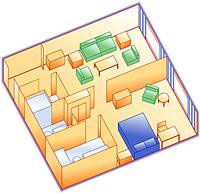
Mansoor and six nervous, heavily armed terrorists are waiting in the suite with the Big Bomb (which they snuck into the room on luggage trolleys using bellboy uniforms).
CLUE 1: Yassif Mansoor probably won’t break under questioning, but merely identifying him should allow the PCs to track down his home address (NODE A).
CLUE 2: Sewn into the lining of Mansoor’s jacket is a small packet of microfilm. These contain records indicating that Frank Nasser of the Las Vegas police department is guilty of embezzling from a fund used for undercover drug buys. Mansoor was using these records to blackmail Nasser. (NODE C)
NODE C: FRANK NASSER
Having been blackmailed by Mansoor, Nasser has been helping the terrorist in a number of different ways. (The C4 for the suicide bombers, for example, was taken from a police lock-up Nasser was responsible for. And Nasser intimidated a beat cop into dropping a speeding ticket issued on one of Mansoor’s men.)
CLUE 1: Nasser is more likely to crack under questioning than Mansoor (particularly if the PCs reveal that they have hard evidence of any of his wrong-doing). But he’s also aware of the consequences: If he can, he’ll try to cut a deal before answering their questions.
CLUE 2: Nasser can also be placed under surveillance. He will check in at both the Bellagio and Mansoor’s apartment before the bombings occur.












ARCHIVED HALOSCAN COMMENTS
Noumenon
They don’t find all the clues, but they are supposed to find all the locations, so you don’t waste prep. Right?
Wednesday, June 02, 2010, 8:54:44 AM
drnuncheon
Right – and even if they go to the Bellagio first and then decide they are done, you’re not wasting prep – you know there’s an apartment full of suicide bombers who are going to find out that the other half of their cell got busted. The CTU team is going to find out they are not done when the first one explodes and they are in a race against time to find the other five.
You also know there’s a crooked cop on the force. If they don’t follow up on that, then he’ll come back for future scenarios – the next time a crooked cop is needed.
But I think you’re working under a slight misapprehension – it’s OK to prep things you might not use (although it’s always good to prep with an eye towards recycling, like in the crooked cop example above). The waste is when you prep things you know you won’t use.
Wednesday, June 02, 2010, 10:19:29 PM
drnuncheon
I think the assumption is that the PCs don’t find all the clues – thus the need for multiple paths. If they find the phone or trace the rental and don’t bother to search all the boxes, for example, they have no reason to go to the Bellagio.
Wednesday, June 02, 2010, 6:22:34 AM
Noumenon
Does this example work? All the action is at the Bellagio. There’s no reason to visit nodes A or C if you get to B, so you’re not likely to get to use all your prep. if you want to introduce Frank Nasser, you’d be better off plotting Storage Locker -> Frank Nasser -> Bellagio.
I’m also curious about “D”. Where do you go from here? If only the Bellagio has clues to the Arab sheik sponsor, then you’re plotting again. If all three locations do, you have too many arrows, and you skip things.
Wednesday, June 02, 2010, 2:37:33 AM
Justin Alexander
Some of this is tripping over into what I’ll be discussing in the next couple installments of this series, but I’m curious why you don’t consider “room full of suicide bombers” to qualify as at least part of the action. 😉
Dr. Nuncheon is also correct: The flexibility of node-based prep means that sometimes your players will bypass material. In practice, however, I find that I use at least 90% of the material that I prep.
Part of the reason for that is the flexibility that proper node-based design gives you: You’ll note that none of my nodes in this little sample scenario presume “this is what the PCs are going to do here”. I’ve prepped situations instead of plots. Take the Bellagio, for example: That could result in a dragnet of the hotel. A fierce firefight with the terrorists. A Rainbow Six-like precision takedown. Or the PCs might call in the cops and have them evacuate the Bellagio. Or they might end up trying to negotiate with Mansoor. Or just trying to keep him on the line long enough to trace the call. Or the Big Bomb could detonate and create a major terrorist incident to stud the campaign.
Basically I’ve got a hotel, a room, a bunch of terrorists, and a huge bomb. What can I do with them? A lot of stuff. What can my players do with them? Even more.
Each node is both a destination and a tool.
Thursday, June 03, 2010, 4:40:47 AM
Noumenon
Perhaps it’s “situations not plots” that caused me to see it the way I did. There’s not much plot in “some suicide bombers live here, but are not doing anything at the moment.” When I imagine the players arriving at the location and interrogating people, or the DM using Dr. Nuncheon’s approach and using the terrorists for a plot hook, then there’s a lot going on there. But it didn’t read like a story the way a prepped plot does. The Bellagio one sounds like the plot of some hostage rescue movie, so I thought “Oh, there’s the point of the adventure.”
Thursday, June 03, 2010, 7:53:44 AM
Sir Wulf
The game master looks at the likely repercussions of the characters’ actions and describes subsequent events accordingly: This becomes the plot.
In some ways, it’s like a Rorshach inkblot. The players will scrutinize what they find, trying to see patterns. Some patterns will match the facts, while others will send them on false trails. If they head in the wrong direction, their antagonists will likely grow bolder, incidentally creating new clues as they act.
For example, say the PCs face down the terrorists in the Bellagio. A massive set-piece action scene ensues, but the characters have no interest in investigating further. The terrorists in the apartment then react, probably trying some ill-considered backup plan. The PCs can then be hooked back in with a little GM improv: The villains might get in a firefight with a couple of cop NPCs, escaping, but leaving clues to their new scheme. The evidence might be tampered with by the terrorists’ crooked cop ally as he searches confiscated materials for the blackmail material.
Any loose end potentially leaves a connection, something the GM can craft into a clue to expand on the adventure. In the example situation, the players might go from the “big set piece” to an unpleasant reveal as their evidence is tainted. They’re now more motivated to check the apartment or find the dirty cop. The GM builds a new climactic finale as the PCs run the remaining terrorists to ground in the midst of some new scheme. If there are holes in the villains’ plan, that’s not a bug, it’s a feature: The villains have been forced to improvise (…much like the GM!).
Thursday, June 03, 2010, 7:22:59 PM
Noumenon
I really like your idea of the cop tampering with the evidence; there’s finally something exciting about that node. More generally, it seems like what you want is not only clues that lead to each node, but consequences for missing each node. OTOH, this is really like designing four clues for each node — three normal and one to find it after it’s too late, by looking for clues after the suicide bombing spree/Bellagio explosion/tainted evidence consequence has occurred. That might be too much work, or might not be what Justin has in mind.
Sunday, June 06, 2010, 4:32:34 AM
I’m looking at the player options, & maybe thinking too much like a player (or a CTU SA ;p ), & wondering why the players wouldn’t thoroughly search the storage locker, then cover _all three_ nodes, no matter what. I have a sense you need a time element to be in play, forcing the players to have to choose which to investigate, because otherwise, they’ll blanket the field. (That’s just good investigative procedure. It’s how I’d do it.) Either that, or there’s the effect of a die roll limiting which nodes come into play based on how good a search gets done.
@rodneyzalenka why do you think its a problem for the players to “blanket the field”?
This example is showing how clues help players know what “the field” is, regardless of which order they approach it. When they are at the start node there are 3 clues they might find. They are not guaranteed to find them all but as long as they find one they have another node to go to, which in turn will lead them on to other nodes if they find at least one clue.
@ rodneyzalenka
What do you mean by “blanket the field”? Unless you’re suggesting that the players split the party, they can still only investigate one node at a time. So suppose they do find and correctly interpret all three clues at the Storage Locker. They then go to one of the nodes, say Node B. They find two additional clues, which corroborate the two they already had pointing to Nodes A and C. They now have extra confirmation that they interpreted the first two clues correctly.
And if they do split the party, that choice comes with its own consequences, since they will have less manpower at any one location and the person with the right skillset for Node A might be in Node C. And if they pull it off despite that, they’ll have a great story to tell. Any way it happens, you get a good result.
First of all, congratulations for what in my opinion is, plain and simple, the best source of information regarding gamemastery on the web. I have been following you for years and I cannot wait to buy your book as soon as it is available.
Regarding node based design I would like to ask one doubt I have.
One very common scenario that I am not sure if I undestardand how to reflect with this node structure is when the PCs need to find SEVERAL clues in order to advance to a certain node. There is a common mistery trope where suddenly the detective finds one clue that in conjuction with others found before sheds the final light that solves the mistery, that moment of enlightment when all the pieces of the puzzle fall into place.
The structure as shown seems to be under the assumption that the different clues leading to a node are basically offering redundancy in order to get to it. So if there are, let´s say, three different clues leading to Node A (let´s call them A1, A2 and A3), it would be enough for the players to get access and interpret correctly one of them in order to get to Node A (even though they can get some advantages if they get them all). This is, they need to get A1 OR A2 OR A3.
But it is be very common (specially in mistery scenarios) when you need to get, let´s say, both clue B1 and clue B2 to make some kind of deduction that open access to new node/s. This is, they need to get B1 AND B2 (and interpret them together).
I can imagine a way I could offer redundancy for each one of these clues. For example, having three different B1s clues (B11, B12 and B13) leading to a B1 pseudo-node where they basically just get the B1 clue information.
But ultimately, how can i reflect under this structure the necessity of getting several clues in order to access a node?
Am I missing something?
I discuss this in Making Clues (it’s in Part 2).
You can also see this in practice in my Eternal Lies Remix.
Short version: If you need to know both A and B to conclude X, then A and B are separate revelations and you should include three clues for each.
First of all, thank you for your prompt response.
I understand that what I was asking falls under the category of a multi-part clue, and what that post addresses is the necessity of offering redundancy for each part of the clue (essentially what I was calling B11, B12 and B13 would be three separate ways of knowing that the killer was wearing a green sweater).
What I still can´t see is how the fact that you need to know both B1 AND B2 (or using the letters in your response, that you need to know A AND B to reach X, and not A OR B) can be expressed using the node structure.
Maybe it´s me that’s fixating too much with the visual representation of the node structure.
If you could point me to the exact example in the Eternal Lies Remix that would be much appreciated.
You gonna want to read this: https://thealexandrian.net/wordpress/8202/roleplaying-games/advanced-node-based-design-part-5-the-two-prongs-of-mystery-design
@Rodrigo
There’s frankly not much point in visually representing nodes and their connections, aside from explaining how nodes work.
Also, I think you have a slight misapprehension of what a node is. Nodes are simply discrete pieces of content that it is useful to think of as a single entity. So “Bob is the killer!” is likely not a node at all. It’s not really “content” because the PCs can’t really interact with it; they can’t talk to it, investigate it, go to it, etc.
Conversely, “Bob’s House”—where the PCs are going to confront Bob after learning he’s the killer—likely is a node. Indeed, it’s likely a node that the PCs have already interacted with when they, for example, questioned Bob or snuck in to examine his financial records.
In prep, the best “visual representation” of ultimate revelations is a simple revelation list. That is, there’s no need to invent a “psuedo node” that is B1, just write down the header “Revelation B1,” and list the ways you can discover Revelation B1 under it, making sure there are at least three.
https://thealexandrian.net/wordpress/40978/roleplaying-games/random-gm-tip-using-revelation-lists
This still sounds like linear plotting to me, things are planned with the hopes the PC’s will take some sort of bait. This seems like the first examples you paint of linear railroading plots, minus, instead of doing it with a node after node approach, you take multiple nodes, and create mini linear paths for the story you set. It’s still an overarching linear pattern. You are just giving methodology for making it seem more open to movement within the linear pattern, not genuine change. We’ll we’re stressed and we just want to go to the bar, followed by move down a path of joining Mansoor, and taking a different path.
@Mike: If you squint hard enough, isn’t everything a railroad because we live in a causal universe and all of our decisions and the outcomes of our dice rolls are predetermined by the laws of physics?
Your self storage units look like the ones on Cheyanne and Rancho. I had to laugh when I read this the 1st time as I use to drive down Azure almost daily and I think I had a storage unit in the complex you pictured.
Good article, I am enjoying this series very much. This is the 2nd time I have read it, and as I am now doing some world building it is very poignant to me.