The Alexandrian

Posts tagged ‘rpgnet reviews’

Tagline: Possibly the best superhero setting ever created specifically for a roleplaying game. Inspired by works like Astro City, Marvels, and Kingdom Come this is a balanced, believable setting for the Champions game.
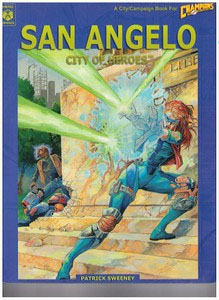
San Angelo: City of Heroes - Gold Rush GamesI knew I was picking up a high-quality product with San Angelo: City of Heroes when I turned to page five and saw the first proper illustration of the book (ignoring one which accompanies the table of contents): A boy looking up into the sky, his basketball laying forgotten on the ground next to him; behind him the shadow of a caped figure flying past. The first words of the book? “San Angelo is truly the City of Heroes.” Definitely.

STRENGTHS

Patrick Sweeney and the folks down at Gold Rush Games have really put together a gem. San Angelo, a fictional Californian city, takes the best elements of Astro City, Marvels, and Kingdom Come (projects all written by Kurt Busiek and Mark Waid who were, in turn, influenced by great comic book artisans of the past) and adds spice. In a little over 255 pages San Angelo: City of Heroes delivers the type of tantalizing hooks and richly textured background that is all too often lacking in your average sourcebook.

You will find that there is nothing lacking in this book. You get a finely detailed history of the city (dating back to its pre-colonial roots), a look at its current geography (in a neighborhood-by-neighborhood breakdown), an analysis of its major players (with holes deliberately left to be filled in and personalized by the GM), a look at its commercial development (from the biggest companies to the fast food joints your characters would probably find themselves hanging out at), and much more. You are left with the indelible impression that San Angelo is a living, breathing city. That’s worth the price of admission right there – far too many city supplements in the RPG industry fail to accomplish that, even when they’re based on real cities. For San Angelo to accomplish that, while being entirely fictional, is impressive feat.

Further, Sweeney has done an excellent job of making San Angelo a balanced, believable superhero world. He chooses not to include some of the more extreme staples of the superhero genre (such as aliens), but he does so in order to capture a feel of “pseudo-realism” which readers of Astro City will quickly recognize and everyone will appreciate.

In addition to the big stuff, the book also has all those nice little touches which turn a good product into a great product. The attention to detail is exquisite, but the most noticeable of these touches are the quotes from the citizens of San Angelo. These are both amusing and insightful and a prime example of the high quality his product offers.

Finally, although the book is designed with the Hero game system in mind, because the setting works so well as a setting it transcends its intended engine and could be successfully used in almost any superhero campaign. San Angelo is an inspirational product, and succeeds brilliantly because of that.

WEAKNESSES

Marring this relatively perfect picture are a few flaws. First, the lay-out is not always as keen as it might be (there’s one place where an inset causes a line of text to be reduced to less than six characters).

Second, the book lacks an index. The ultra-detailed Table of Contents typical of Hero products helps make up for that, but nothing is more annoying than trying to track down information without an index. Especially if time is of the essence (such as during the middle of a gaming session).

Finally, although the book is chock full of NPCs, not enough of those PCs are supers. It has been said that what makes one science fiction universe different from another is the aliens. That may or may not be true, but it is almost certainly true that what makes one superhero setting different from another are the superheroes themselves. The explanation for the lack of super NPCs is that the PCs are supposed to be the focus of the story. Well, yes, of course. But haven’t you ever heard of the word “crossover”? And who would want to adventure in the Marvel Universe if it wasn’t because they shared that universe with Spider-Man, the Fantastic Four, Captain America, and a host of others? I consider this lack to be the most serious problem the book possesses, but it is certainly not a crippling one.

CONCLUSION

If you have even the slightest interest in superhero roleplaying, buy this book. If you’re looking to start a new campaign there’s a good chance this will save you a lot of problems. If you have an established campaign then San Angelo would make an excellent addition to your world with a few modifications. The strengths of the book vastly outweigh the handful of weaknesses and what looks to be a strong line of support products are already on GRG’s production schedule. You won’t be disappointed.

Style: 4
Substance: 5

Writers: Patrick Sweeney
Publisher: Gold Rush Games
Price: $25.00
Page Count: 255
ISBN: 1-890305-03-0

Originally Posted: 1999/03/17

Although I have never managed to run an actual game session in San Angelo, my fond memories of this book still mark it as one my favorite city supplements of all time. It managed to make the city feel unique, believable, and unmistakably alive while also managing to capture the ineffable excitement of a world filled with superheroes.

For an explanation of where these reviews came from and why you can no longer find them at RPGNet, click here.
Tagline: If you’re the type that likes GM screens or interesting tidbits of knowledge concerning the World of Darkness, this product will probably be a satisfying purchase.

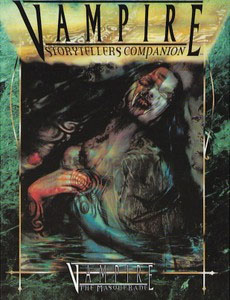
Vampire: Storyteller Companion/Screen - White WolfThe Storyteller’s Screen and the accompanying Storyteller’s Companion are both very good products for what they are, but there’s nothing particularly exciting or innovative about either – nor do I consider them crucial products to the gaming experience. Surely with the plethora of materials available for the Vampire game you should be able to find something else worth spending fifteen dollars for.

The Storyteller’s Screen is made up of four 8” x 11” panels. The GM’s side has: A list of the five traditions, the armor chart, a chart summarizing the thirteen generations, a summary of aura colors, a hierarchy of human sin, a blood pool chart, a combat maneuver chart, a chart for judging feats of strength, two weapons charts, a combat summary chart, an experience chart, a summary of difficulties, a summary of hunting, damage charts for fire and sunlight, plus a general health chart and a summary of various vehicle types. This is an impressive array of information, and I found it was generally useful. I was also impressed that White Wolf avoided the temptation of including a summary of character generation on the screen – something almost every GM’s screen seems to possess despite the very obvious fact that you will never, ever need to access that information in the course of actual gameplay.

The opposite side of the screen is a very nice mosaic comprised of various vampires looking either threateningly or seductively out at you. I found it be an excellent choice of art because the choice of colors meant that it wasn’t overly distracting, but at the same time it was not so monotonous as to become easily boring to look at after a short time. In general, if you’re into GM’s screens this one is extremely admirable.

The accompanying book – the Storyteller’s Companion — on the other hand, cannot be so lauded. This is your typical hodgepodge of material thrown together so that the GM’s screens doesn’t have to stand on its own. Included are three new bloodlines (the Daughters of Cacophony, the Salubri, and the Salmedi) along with their associated disciplines. There’s also an extensive list of new equipment and an expanded character sheet. All in all, fairly boring stuff in my opinion which could have been more effectively integrated into other products instead of being thrown together without any sense of clear purpose here.

The most useless section in the book, however, would be Secondary Abilities. These are a new set of rules meant to supplement the Primary Abilities found in the main rulebook. In general I saw little differential between these abilities and those in the rulebook (why, for example, they felt that Interrogation would be used less often (and therefore qualify as a secondary ability) than Performance (a primary ability from the main rulebook) is beyond me), but these secondary abilities are cheaper and subject to a slightly different set of rules. The net result, as the book itself says, is that these “Secondary Abilities add greater complexity to the game, but they also add greater complication” (you’ll note that the words “complexity” and “complication” can be seamlessly interchanged here). Nothing is really accomplished by their inclusion except unnecessary headaches. Personally if I were to use any of them I would treat them exactly as I treat Primary Abilities. It should also be noted that since the expanded character sheet takes these Secondary Abilities into account, the other nice features of the character sheet (an expanded background and history section) are rendered rather useless. Oh well.

In general I found the product uninspiring, although generally adequate for this type of thing.

Style: 4
Substance: 3

Author: Clayton Oliver
Company/Publisher: White Wolf
Cost: $14.95
Page count: 70
ISBN: 1-56504-259-9

Originally Posted: 1999/02/17

One of the weird things about getting comp material for review is the essentially random nature of what you end up reviewing. You also end up reviewing stuff that you would never have actually bought for yourself, which creates a strange dynamic in which it becomes difficult to accurately judge the value of the material for people who actually are the target market. (Of course, one of the skills of a good reviewer is the ability to step out of your own shoes to judge the material as objectively as possible… while remembering that objectivity doesn’t mean relativity.)

In other news: Landscape screens are awesome and I’m not sure how we ever endured the taller screens of yore. I have also just realized that it’s been over ten years since I last played Vampire. That makes me a little sad.

For an explanation of where these reviews came from and why you can no longer find them at RPGNet, click here.
Tagline: I’ve given my thumbs up to the Trinity Field Reports before, and this product is no exception.

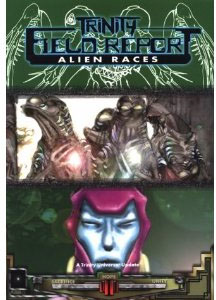
Trinity Field Report: Alien RacesI offered hearty compliments to the first Trinity Field Reports: Extrasolar Colonies for fixing almost everything I found to complain about the main Trinity rulebook in an elegant, creative, and engaging manner. Just so you’re warned, I’m going to rave about Alien Races.

First, this product possesses all the strengths of the first Field Report. It would be very difficult to produce a roleplaying supplement for $4.95 in which I could not find some scrap of information which would justify the purchase price – and these Field Reports come nowhere near that minimal threshold. The pages are all glossy, full-color affairs with high-quality artwork which is directly related to the text. The text itself is not only well written, but also tantalizing in that it says enough to begin working with what the subject matter is, but leaving everything you wish you knew unsaid (I literally finished reading these 25 pages and had an uncontrollable urge to pick up another Trinity supplement because the cliffhanger full of questions which this book left me with meant that I desperately wanted to fill in more of the picture). Finally, because the entire product is cleverly presented as a field report to Aeon Trinity operatives (as the title suggests), it is a handout you can safely give to your players.

Second, this product improves upon the example laid down in Extrasolar Colonies in a couple of ways. First, as mentioned above, the loose ends and half-answers are beautifully constructed to leave you begging for more. Second, this report provides oblique references to the Darkness Revealed series of adventures. If you didn’t use those adventures it doesn’t matter – the references aren’t all that important and are self-explanatory in the context of this product – but if you did the minor mention here provides an extra feeling of importance to your PCs. Because of the nature of the comments made the players can really feel as if the actions of their characters are having a long-term effect on the setting. Definite kudos.

There’s really nothing bad which can be said about this Field Reports : They’re a great read, they’re high-quality, they’re cheap, and they’re useful. Is there anything else you could possibly want in a roleplaying supplement?

Style: 4
Substance: 4

Author: Bryant Durrell
Company/Publisher: White Wolf
Cost: $4.95
Page count: 25
ISBN: 1-56504-772-9

Originally Posted: 1999/02/17

For an explanation of where these reviews came from and why you can no longer find them at RPGNet, click here.
Tagline: The classic dungeon crawl designed by the master of dungeon crawls, Gary Gygax.

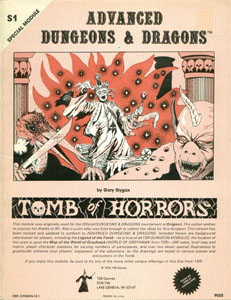
Tomb of Horrors - Gary GygaxThe Tomb of Horrors module is one of the great classics in our little industry. It would be truly surprising to me if someone who has been playing RPGs for more than a handful of years would not have heard of this module, if not played in it or run it themselves.

The Tomb of Horrors was first released in 1978, as one of the first modules available for the AD&D game, after being used for the Official D&D tournament at the very first Origins convention. Recently it has been re-released as part of The Return to the Tomb of Horrors boxed set and can be obtained there if you can’t track it down through the used section of your local game store.

At the time it was published this was a fairly innovative product. In addition to the “map and key” presentation which was standard at the time, Tomb of Horrors also came with a pamphlet of forty illustrations – each presenting some part of the module which could be shown to the players at the appropriate time. This was cutting edge stuff at the time. Honest.

By all merits this should be an absolutely awful product by current standards – substandard writing, sub-par art, and a linear plot. Okay, I take that last one back: There is no plot, just a bunch of rooms full of traps and monsters.

Despite all this, though, there’s something about the Tomb of Horrors which still tantalizes me. Part of it is the fact it’s a classic. Like Queen of the Demonweb Pits it’s one of those things which “every” gamer has experienced at some point. There’s a sense of history to it, which adds to the experience. The other part of this is that sometimes you just gotta kick up your heels and take a brief detour visit back to your youth. In other words: Hack ‘n slash can be fun if you’re looking for hack ‘n slash.

The Tomb of Horrors was and remains a classic not because it dots all the i’s and crosses all of the t’s of what the current popular consensus of roleplaying is (or even of the type of roleplaying I enjoy most of the time), but because it accomplishes exactly what it sets out to do.

So when you’re looking for a quick one-shot relax from your normally roleplay-intensive campaigns, you might want to look back at an old classic once in awhile. It can’t hurt anything. Actually, I’m thinking about adapting it to FUDGE for a quick run sometime real soon. See you there.

Style: 2
Substance: 3

Author: Gary Gygax
Company/Publisher: TSR / Wizards of the Coast
Cost: n/a
Page count: 50
ISBN: 0-935696-12-1
Originally Posted: 1999/02/17

This review is another example of how 3rd Edition and the OSR have rehabilitated first D&D and then old school D&D in the RPG community. There are, of course, still haters out there. (There are always haters.) But even I occasionally have difficulty appreciating just how much “D&D Sucks” was the received wisdom of the online RPG community pre-2000.

I was no exception (nor am I now): AD&D is a terrible game and there are many, many reasons why I stopped playing it. But I did recognize that there was a fun game hiding away inside of AD&D, and this review was basically an attempt on my part to say, “Hey! There’s fun to be had over here!”

Several years later, my own adaptation of Tomb of Horrors to 3rd Edition became one of the earliest additions to the website. Check it out. It’s still a ton of fun.

For an explanation of where these reviews came from and why you can no longer find them at RPGNet, click here.

Tagline: Final Fantasy VII is the best CRPG to have hit the market since the last installment of the Ultima series. Although the plot is railroaded, that’s not really the point – the story is excellent, the characters touch your heart, the gameplay is engaging, and the interface is intuitive and simple, but also powerful. This game is addictive.

Final Fantasy VIINormally I’m fairly skeptical concerning computer roleplaying games. Of all the games I have ever played only the Ultima series of games ever really succeeded. It succeeded because Richard Garriott, the creator of the Ultima series, designed a series of games which slowly became more and more adept at modeling the real world. Because people behaved the way real people do (with varying daily schedules, speech patterns, and personalities), because no problem possessed a single solution (with a set of rules behind world interactions, allowing you to blow a door up if you can’t find the key to it), because there was more than one course which could be followed (with a deep, intriguing plot with sundry subplots and side plots included), because you got to really care about your traveling companions. For all these reasons and more it is easy when playing the Ultima series of games to simply let yourself slip into the role of the Avatar. Does it allow the same breadth as face-to-face gaming? No. But it does allow roleplaying, and it does give you some things which face-to-face gaming cannot. The Ultima series acknowledges its weaknesses and exploits its strengths. It may not be better at what paper-and-pencil roleplaying can do, but it isn’t a paper-and-pencil roleplaying game so I respect these games for doing what they do – you can’t expect a computer game to do the same things a traditional RPG does; nor should you try.

Now, here comes the surprise. Final Fantasy VII is a highly successful game, despite the fact that it fails to do almost everything which the Ultima series does so well. The world of FF7 is contrived, the plot is almost completely linear, and multiple solutions do not exist in most cases. But FF7 does do one thing right: It presents characters who you can care about, characters with distinct (although sometimes cliched) personalities. As an almost direct result FF7 succeeds; and it helps that although the plot is linear, it is a very interesting and dynamic plot. You shouldn’t approach FF7 so much as a roleplaying game as a movie in which you have some partial control over the main character.

THE GOOD STUFF

I’ve already pointed out a couple of things. The main strengths of this game are, in my opinion, the plot and the characters – which are really intertwined with each other. There were points in this game where I felt genuine sadness and genuine joy as the plot and the characters developed. This, more than anything else, was what made the game very addictive to me.

Another major strength of the game lies in the graphic department. The visuals are highly anime-influenced, imaginative, and effective. Definitely a treat, especially the magic spells.

Finally, this game has a fantastic interface. It was originally designed for the Sony Playstation before being later translated onto the computer (which is where I played it). Everything is controlled through a series of intuitive menus which are accessed from the numeric keypad. A template to lay over the keypad comes with the game, but you won’t need it for long – the controls are easily learned and, once committed to memory, the entire system is easily memorized. Players will find the combat system, in particular, to be highly entertaining – it’s abstracted, but this allows for a great deal of strategic planning which I find difficult to obtain in other games where the chaos of the battlefield usually means I have no chance to control what my characters are doing.

This is a fairly powerful combination for a game to have: Intuitive, powerful gameplay; interesting characters; compelling plotline; and excellent graphics all in the same package? I should already have you sold. Why aren’t you out buying the game yet?

THE BAD STUFF

I’m a strong proponent of not judging a product on things which it is not attempting to do. Obviously you would never critique a hammer by saying “it’s not a screwdriver”, but in the area of creativity (such as novels, music, television, film, roleplaying games, or computer games) it is all too easy to slip into critiquing a product because it is not the type of product you happen to like. So, on that level, I don’t think FF7 has any serious weaknesses: It sets out to do exactly what it excels at accomplishing.

That being said, I should reiterate that this is not a “roleplaying game” in the sense that you are given a role which you are then allowed to control with broad parameters. In this game you are given a role, but the course along which you are allowed to guide that role is fairly proscribed when all is said and done. But saying “this game sucks because you aren’t allowed to control the characters” is similar to critiquing, say, Babylon 5 because you weren’t allowed to control the actions of Sheridan. FF7 resides somewhere between mediums (such as television or film) where you aren’t allowed any control over the characters and the mediums (such as roleplaying) where you are. Its important to judge the game on that ground, but I think it fair to warn off those who won’t find that type of entertainment, well, entertaining.

CONCLUSION

Buy this game. ‘Nuff said.

Style: 5
Substance: 5

Company/Publisher: Squaresoft / EIDOS
Originally Posted: 1999/02/17

This review was first published thirteen years ago almost to the day. That’s really kind of weirding me out. Interesting how times turn, though: I’ve actually been replaying FF7 on my PS3 the past couple of weeks.

I know it’s cliche for people to say SPOILER SPOILER SPOILER was the first time they cried because of a video game. It wasn’t mine (Ultima VII: Serpent Isle beat it by half a decade), but it remains one of the most memorable moments in any fictional medium for me. There is a very fine art to putting me on rails in a video game and yet getting me to completely invest myself in the character: The experience is more akin to acting than to roleplaying, but when it succeeds it can be very, very powerful. And in FF7 it succeeded brilliantly.

For an explanation of where these reviews came from and why you can no longer find them at RPGNet, click here.

Archives

Recent Posts

Recent Comments

Copyright © The Alexandrian. All rights reserved.