 Something I’ve spent literally years struggling with as a GM is transitioning from one scenario structure to another within a dungeoncrawl.
Let me see if I can clarify that:
I find it really easy to switch scenario structures at the same time that the venue of action is being switched: If the PCs enter the dungeon, we swap to dungeoncrawling. If they seek out a specific character in a tavern we roleplay that conversation; if they exit the tavern and then start hitting the streets looking for information we handle that a different way.
After a few false starts as a neophyte GM, I also eventually found it relatively easy to switch scenario structures within most venues: Renting rooms at a local tavern is handled at one level of abstraction, but when they wake up in the middle of the night to find the tavern haunted by ghosts we switch to a different structure.
These days, this sort of thing is pretty much automatic for me. But swapping structures in the dungeon still routinely thwarts me.
The type of structure I’m talking about is mainly the one found in adventures like Night Below or Thunderspire Labyrinth: A large, underground complex in which there are isolated pockets of “interest” which are designed to be run as a room-by-room crawl.
For awhile, I thought it was the difficulty of presenting meaningful navigation choices to the players in these environments. But once I came to think of them as “underground wildernesses”, this wasn’t a problem any more.
No, the primary problem was the transition from the room-by-room crawl to the underground wilderness (or vice versa): When the PCs enter a room with three exits and two of them lead to another room but the third leads to the more abstract labyrinths of the wider complex.
I mean, it’s relatively easy to just do it. But it’s more difficult to do it effectively.
Partly it’s the difficulty of finding a smooth narrative description of the shift. Mostly, however, it’s the damage to roleplaying and immersion caused by the imposition of the metagaming structure on the decision-making of the characters.
See, in most other circumstances it’s either the passage of time, the changing of circumstance, or the decision of the characters to do something different which smoothly transitions us from one game structure to another: But not so in this case. Circumstances remain unchanged and the PCs are making the exact same type of decision they’ve been making for the past twenty rooms… but suddenly the scenario structure is changing.
And, like I say, this can be handled pretty simply by saying to the players “we’re switching structures now” (or some equivalent thereof). But that has consequences on the decisions they’re making. (As a simple example, if I didn’t tell them “all the rooms beyond this point are empty, so we’re going to be switching to underworld exploration” then they might waste time searching those empty areas… which might have an impact when they return to the occupied rooms.)
In a lot of ways, this is all a mountain out of a molehill because it just doesn’t come up that often. But it’s something that my recent discussion of using multiple scenario structures has brought to mind.
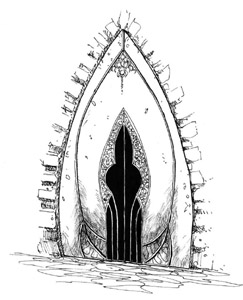
Recently, though, I had an interesting discovery in my Ptolus campaign. Part of the vast megadungeons beneath that city are immense labyrinths built by the warlord Ghul. Ghul’s Labyrinth is filled with a number of bluesteel doors which are extremely difficult to bypass (being resistant to knock and lacking any normal lock to pick).
And these doors have proven to be ideal transition points between dungeon scenario structures because they’re natural transition points within the game world: Not only do they require a significant decision on the part of the PCs in order to pass through them, but they were actually built by Ghul to logically divide his demesne.
All of this, of course, ties back into the larger issues of making sure that your players’ decision within a scenario structure are associated with the decisions of their characters: Something I not only aesthetically prefer, but which is absolutely necessary if the scenario structure is actually unknown to the players.