
The Alexandrian

Posts tagged ‘ptolus’

Ptolus - In the Shadow of the Spire

IN THE SHADOW OF THE SPIRE

SESSION 14C: THE TEMPLE OF EBONY

January 5th, 2008
The 5th Day of Kadal in the 790th Year of the Seyrunian Dynasty

Intrigued by these discoveries, Ranthir selected one jar from each of the six rooms and slipped them into his bag of holding.

They had now opened all of the doors on the upper level and were prepared to go down to the lower level. This proved slightly troublesome: There was a ladder on the iron catwalk in the middle of the chamber, but it had been rusted into a raised position. So, in lieu of that, they simply pitoned a knotted rope to the floor and climbed down along one of the walls.

Most of the rooms on the lower level appeared to have been kennels of some sort. Those around the base of the pit itself had metal doors, but through a set of double doors in the south wall of the pit there was a long hallway flanked by nearly a dozen more rooms with wooden doors that were almost entirely rotten away from sheer age. Large channels from these rooms led out to a 6-inch wide gap in the middle of the hall’s floor. Beneath this gap there was a 50-foot-pit down which charnel waste was apparently washed.

Another door off the pit led to a room filled with weapons hung from iron racks covering the walls. All of these weapons were designed for beasts: Claw-like tines; serrated harnesses; and the like. All of them seemed to be crafted to appear as vicious and merciless as possible. Many were stained with blood. The vast array was impressive in itself, but a closer inspection revealed that most of them were unusable: Either custom-crafted for unusual creatures; with important bits rotted away; or their metal rusting and fatigued from age.

THE TEMPLE OF EBONY

At the far end of the kennel hall, another set of iron doors led out to a hallway which took a sharp turn off to the west. From there the hallway branched again, and the decision was made – with Ranthir once again studying his partially completed map of the upper level – to return to the upper level and finish exploring there before proceeding to the lower level.
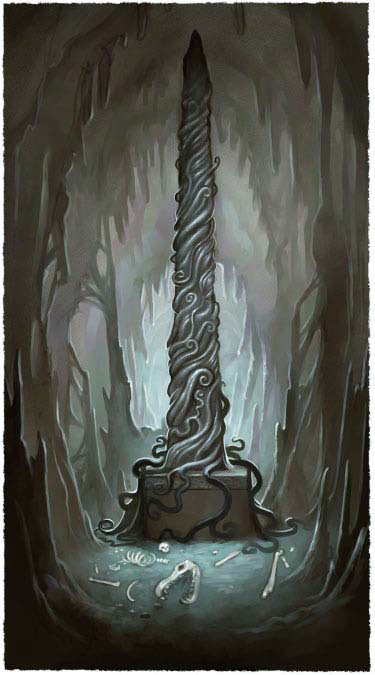
Ptolus - KihomenethothThey climbed back up their rope and returned to the first major chamber they had entered after leaving the laboratories that had been inhabited by the bloodwights: The large room flanked by four massive statues of Ghul.

From here there were four halls: To west lay the bloodwight laboratories and they had explored everything to the north. This left the hall to the east – which they could see ended in a set of large iron doors – and the hall to the south.

They decided to start with the hall to the east: The iron doors opened onto a large room paved in glistening ebony. It rose in three tiers. Two horrific statues stood in the corners of the second tier. To the left a twisting pillar of coiled tendrils and to the right a squat monstrosity.
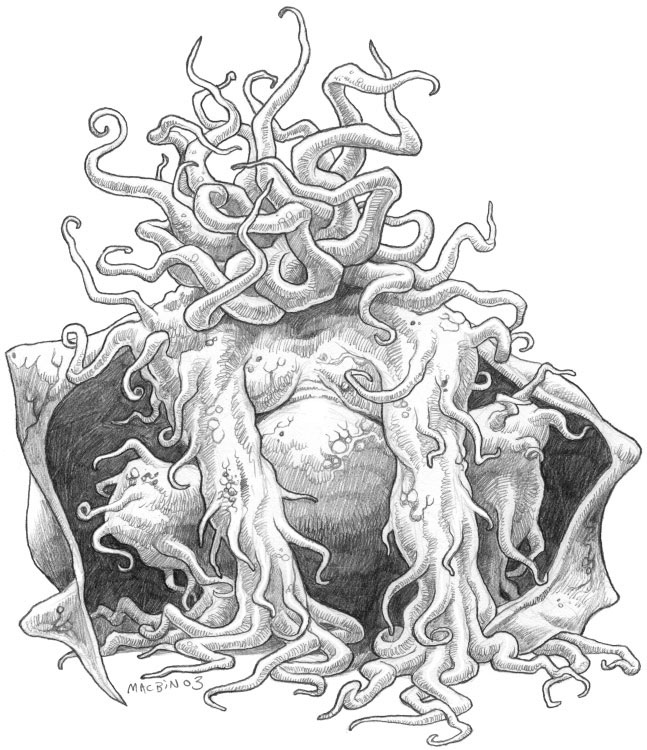
Ptolus - Shallamoth KindredIn the center of the third tier, at the top of the room, there was a slab of black ebony with the appearance of an altar.

The room seemed permeated with a palpable sense of evil, but Tee took a deep breath and slipped through the door. A cursory examination turned up no hidden exits or treasures, but she did discover that inscriptions had been written in a strange and alien tongue upon the base of the two statues on the second tier.

Ranthir, hearing this, entered the room himself and went up to study the statues. He confirmed that the language was completely unknown and, surprisingly, his magical arts gave him no translation, either.

Tee, meanwhile, had been exploring the uppermost tier. The altar or slab in the center of this tier was completely featureless, except – Tee discovered – for a small sigil that had been carved into the rear corner of the altar:

Ranthir finished carefully copying down the inscriptions on the statues into a journal and then joined Tee to inspect the altar sigil. It wasn’t familiar to him, either, but he took the time to copy it as well.

Then they left. As they passed through the doors and shut them behind them, they could feel a palpable sense of dread sluicing off of them like an oil slick.


NEXT CAMPAIGN JOURNAL

IN THE SHADOW OF THE SPIRE

Session 14B: Malkeen Dawning

Before the development of the modern clone spell – a powerful magical rite that would allow a spellcrafter to duplicate his own body – the archaic version of the spell was dangerous to both subject and spellcaster. However, the now largely forgotten blood clone spell was safer, although it was not as useful (the subject would awaken an amnesiac). Most modern practitioners of the craft now considered blood clone to be only one step removed from raising the dead, since one was essentially capturing a soul which would then lose its own identity.

In this journal entry you can see a gimmick that I find appealing: The idea that the magical spells and equipment found in the core rulebook represent the current “state of the art” when it comes to magical understanding in the game world, but that, like any other body of knowledge, it was preceded by long aeons of experimentation and cruder antecedents.

And when you go poking around in the dark and dusty portions of the world (like, say, subterranean vaults) you’re likely to stumble across those antecedents (or their remnants).

Sometimes you can find weird oddities in the way this older stuff works, presenting utility which may have been lost with the more efficient modern versions. (Odd parallel with the Old School Renaissance there.) But this unexpected utility isn’t really the point; the point is to create a sense of antiquity. Or, I suppose more accurately, to give the game world actual antiquity. The sort of real depth that breathes life into a setting and makes the word “ancient” in “ancient ruins” into something that’s meaningful.

Hence the blood clone facility the PCs find here.

If you’re designing antecedent magic for your own campaign, here are a few angles to think about.

LIMITED EFFECT: Like the blood clone spell, look at a magical element and figure out how you could strip out some aspect of its utility. Just stripping out that utility and having a slightly crappier version of the spell is okay, I guess, but it’s better if you can look at that limitation and find a way to evocatively express it.

For example, a mirror image spell which was limited to casting your duplicate images into actual mirrors. Or a teleport artifact based on an older version of the spell that leaves a peephole-sized tear in reality for 1d4 minutes, making it easy for people to see where you’ve gone.

BIGGER: Look at your smartphone. Imagine how many warehouses it would have taken to house that much computing power back in the ‘40s. Now, apply the same logic to magic.

For example:

LEY-LACED MARBLE

Ley-laced marble is a naturally occurring stone. During the metamorphic processes which form the marble, ley-energy permeates the impurities lacing the original sedimentary rocks. The resulting marble (which is usually found on or near ley lines) is possessed of properties similar to a pearl of power. (In fact, it’s hypothesized that pearls of power were created by reverse-engineering ley-laced marble.)

Unlike pearls of power, however, ley-laced marble is not particularly efficient in its retention of magical energy. In addition to being difficult to excavate from the ground, ley-laced marble must be maintained in such large chunks in order to maintain its properties that it is rarely if ever portable in any true sense of the word.

However, rites have been perfected which allow a piece of ley-laced marble to be keyed to a specific object. Anyone carrying the keyed object can access the powers of the ley-laced marble at a distance of 1 mile per caster level.

Later in the campaign, the PCs find the statue of an archer carved from ley-laced marble and the adamantine arrow to which the statue has been keyed in the collection of a lich. Not only does this emphasize that the lich’s legacy stretches back into time immemorial, it also creates treasure with unique interest.

SIDE EFFECTS: You could do the same thing back in Ye Olden Days, but there were consequences we no longer suffer from; kinks that generations of patient work and research have managed to work around.

For example, did you know that the earliest magical potions required you to surgically extract and pulp the brain of a freshly dead arcanist who had memorized the spell? Once established, these could be alchemically maintained sort of like sourdough starters. The problem is that sometimes the drinker of such a potion would be “infected” with the memories of the original arcanist from which the potion stock had been derived. False memories, geas-like obsessions, and other strange affectations could result.

You can also use this to push magical research in the opposite direction: Somebody figures out how to create a magic item that’s more powerful than the common variety, but they haven’t worked out all the kinks yet. For example, I had a potion master in my campaign who had developed potions with unusually powerful effects, but also unusually powerful side effects. For example:

Granite Hide: This grainy, chalk-tasting, orange liquid turns the imbiber’s skin into a pliable yet hard-as-granite substance. (Treat as stoneskin spell.) The potion lasts for 1 hour. After the potion wears off, the victim suffers 1d6 points of Dexterity damage from a calcification of the joints (temporary damage, no save).

Caster Level: 7th; Prerequisites: Brew Potion, stone skin; Market Price 2,350 gp

MISSING LINKS: Once you’ve established one piece of antecedent magic, you can also look at filling in the “missing links” between then and now. For example, later in the campaign the PCs had the opportunity to discover another blood clone facility, but in this case one which showed that the ancient arcanist had figured out how to re-imbue the clone with the original’s memories. It was still an overwrought and complicated process compared to a modern clone spell, but it’s getting closer.

As you can see, this won’t be the last time antecedent magic crops up in this campaign journal. After all, it is, as I said, a gimmick that I like.

Ptolus - In the Shadow of the Spire

IN THE SHADOW OF THE SPIRE

SESSION 14B: MALKEEN DAWNING

January 5th, 2008
The 4th Day of Kadal in the 790th Year of the Seyrunian Dynasty

It was still the dark of night when Tee woke up to find Malkeen Balacazar in her room.

Ptolus - Malkeen BalacazarThe crime lord was sitting on the chair in the corner, the light of the bedside lamp that he must have lit casting shadows that turned the star-tattoo across his eye into a pit of darkness. “Good morning, Tee.”

Tee’s heart was trying to pound its way out of her chest. “What are you doing here?”

“I thought we had an arrangement, Mistress Tee.” Malkeen’s voice was hard and cold. “I would let you and your friends live, and you would never interfere in my business again.”

Tee glared. “And we haven’t.”

“Then explain this.” Malkeen flicked his wrist, throwing a piece of paper onto Tee’s bedcovers. It had been crumpled, burned around the edges, and badly water damaged – but Tee recognized her own handwriting. It was the note that she had written and left for Dullin at the Cloud Theater.

“Dullin was connected to you?”

“My nephew. You didn’t know?”

Tee shook he head.

“Then why were you trying to contact him?”

“We thought his life was in danger.” Tee took a deep breath, and then spilled out the story of finding the note in Helmut’s house. (Although she was deliberately vague on the details of exactly why they were in the house.)

“Do you still have this note?”

“No, but I made a copy.”

“And do you have the copy?”

She did, and was able to produce it from her bag of holding. Malkeen inspected it closely, then folded it and slipped it into a pouch on his belt. “I’ll take this with me and investigate thoroughly. And I’ll be keeping an eye on you. I hope, for your sake, that we will have no more misunderstandings.”

“So do I,” Tee said. And meant it with all her heart.

Malkeen smiled coldly and then disappeared into thin air. (more…)

IN THE SHADOW OF THE SPIRE

Session 14A: Many Unhappy Returns

When Ranthir awoke, he quickly prepared the magical rites he would need to analyze and identify the equipment they had taken from Morbion. Much of this proved to be magical, but perhaps the most valuable were the finely-crafted boots he had worn. These had been enchanted with a levitation charm.

I think managing your gear is an important (possibly essential) part of Dungeons & Dragons. I don’t think it should be a painful or belabored process (and have even gone so far as to create house rules to streamline gear management), but both the balance of the game and its narrative dynamic are driven by PCs managing their equipment.

Some people may think that sounds like a strange idea, but the current session offers a couple good examples of what I’m talking about.

The first, which I already talked about briefly in “Treasure With Context”, is the orrery: A valuable treasure which is difficult to remove from the dungeon due to its bulk. If you were in a campaign that tended to just gloss over matters of encumbrance, it might be simple to simply handwave this away, too. “Once the complex is cleared, you’re able to figure out how to extract the orrery and sell it. Add X amount of gold to your bank account.”

But because there are structures and expectations in place, this campaign defaults to the players needing to figure out exactly how they’re going to solve this problem. The solution they came up with (selling the location of the artifact instead of the artifact itself) was incredibly clever, and thus both entertaining and rewarding in itself. But it also pushed the PCs to enter into an arrangement/alliance with a powerful noble family. That sort of thing has consequences.

Eventually, however, Tee was able to use the boots to reach the high cavern and confirm that there was, indeed, a cindershard outcropping there. Tee threw a rope and grappling hook down to her companions below, allowing Agnarr and Tor to climb up and join her in harvesting the crystals.

The second is the cindershard expedition: Notice that overcoming the challenges preventing them from harvesting the crystals couldn’t be easily overcome until they were properly equipped. Realizing that you aren’t currently carrying the right tools for the job will force a group to disengage and then, importantly, re-engage with the dungeon. Or it will force them to improvise around the lack. Either option will tend to create multi-faceted interest in the form of both challenge and drama as the groups deals with either the immediate jeopardies involved with improvising around missing equipment or dealing with the strategic complexities (and evolving narrative) that comes from leaving and then returning to the dungeon.

Dungeon expeditions are, above all, expeditions: It is a prolonged journey into a dangerous unknown where you are, for the duration of the expedition, cut off and unable to resupply from civilization. The decision to take resource X will unlock certain experiences, but comes at the expense of taking resource Y (which would have unlocked different experiences).

And if you look at Dungeons & Dragons from 1974-2008, the structures of the game are all ultimately focused on (and balanced around) the strategic elements of expeditionary play. While D&D is flexible enough that you can do many different things with it, the further your get from expeditionary play – the further you drift from Arneson’s and Gygax’s expected play – the more mechanical problems you’re going  to find cropping up.

OTHER DYNAMICS

This is often mistaken for one-true-wayism. That’s not the case. Gear management is rewarding for D&D’s dynamic; it often isn’t rewarding for other play dynamics.

Blades in the Dark, Blades in the Dark - John Harperfor example, focuses on criminal crews performing scores. Such scores are generally intended to be (and usually work when they are) one-shotted. You don’t want to disengage and then reengage with them; you want to run them.

To create challenging and drama-filled runs, Blades’ game play is built around two pillars: First, improvisation and retroactive planning. Second, ticking clocks and resource ablation that pushes the PCs to the wall and makes them hurt. The game, therefore, uses an equipment system in which you select a specific Load before each score. The Load determines how many useful items of gear your character is carrying (3 for a Light Load, 5 for a Normal Load, etc.), but you don’t have to decide exactly what those items are until you use them. (Thus you can improvise freely by simply declaring that you planned for and brought exactly the right item for this circumstance, but are also faced with the possibility of running out of Load slots, leaving you unequipped for the next challenge.)

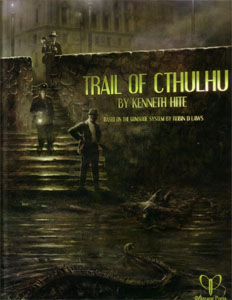
Another example is Trail of Cthulhu, which has a Preparedness skill. As long as an investigator has access to their kit, they can make a Preparedness test to see whether or not they have a particular piece of equipment. This is desirable in Trail because the game’s focus is the investigation; periodically putting the investigation Trail of Cthulhu - Kenneth Hiteon hold in order to prepare an equipment list doesn’t enhance the core game play, it distracts from it. You want to move from getting a clue to seeing the payoff from the clue; you don’t want to pause between those two points for an equipment break.

Why couldn’t you just takes Blades-style Loads or Trail-style Preparedness and graft them onto D&D?

Well, you could. But as I alluded to above, equipment management in D&D is only one of the ways in which the game is designed for an expeditionary dynamic: Wizard spell slots, long-term hit point ablation. The game was built on mounting expeditions into the dungeons below Castle Blackmoor, and virtually all of the core game play that isn’t built around a combat simulator is built around those expeditions. Tearing out one chunk of that game play and replacing it with something else isn’t going to single-handedly change the nature of the game. You’re going to end up with a mechanical chimera. One that may, or may not, work out.

(But, if you don’t give careful thought to the actual effect you’re trying to achieve, is more likely not to.)

Ptolus - In the Shadow of the Spire

IN THE SHADOW OF THE SPIRE

SESSION 14A: MANY UNHAPPY RETURNS

January 5th, 2008
The 3rd Day of Kadal in the 790th Year of the Seyrunian Dynasty

They returned to the surface just as the sun was slipping behind the Spire. They walked home in the Spire’s shadow, arriving as true evening fell and Ptolus’ second dusk began.

They weren’t sure when they had begun to think of the Ghostly Minstrel as home, but as they washed their bloody clothes and bodies in the stables, that’s how they thought of it. And all of them were looking forward to a long and well-deserved sleep in their own beds.

Ptolus - The Ghostly MinstrelBut before they could get there, Tee voiced a thought that was on many of their minds: “We need to talk.”

“Can it wait until morning?” Elestra asked. “Breakfast?”

Tee shook her head. “No. We need to talk now.”

They retired to Elestra’s room – the room that had once been Agnarr’s. Once the door was shut behind them, Tee turned to face Elestra: “What happened down there… That can’t happen again. You nearly got us all killed.”

“It’s not that simple,” Elestra protested. “My snake—“

“It is that simple. That door had to be closed. Agnarr knew it. And you kept opening it.”

Agnarr nodded, and then Tor joined in: “And this isn’t the first time. This is life and death. You have to be focused. If you ever put us in that situation again, I’ll kill you myself.”

“I don’t know about that,” Tee said.

“Better one of us than all of us,” Tor said bluntly. “Dominic can always heal her wounds if we survive.”

Tee didn’t have a response for that. She turned back to Elestra. “Look, you say you care about your snake, but you keep sending it into dangerous situations. And its gets us all in trouble.”

“I understand that,” Elestra said. “But what am I supposed to do?” (more…)

Archives

Recent Posts

Recent Comments

Copyright © The Alexandrian. All rights reserved.