The Alexandrian

Posts tagged ‘d&d’

IN THE SHADOW OF THE SPIRE

Prelude 2B: The Awakening – Dominic

In this installment of the campaign journal, you’ll find some custom-made, Latin-esque spell names and a prayer to Vehthyl, the God of Magic. Both of these were created by Dominic’s player, who simply spun them out of wholecloth during our PBeM sessions.

I really appreciated him doing this.

I know from personal experience that releasing some of your control over the game world can be difficult for a GM to do. But this type of player-initiated world-building should be encouraged for a number of reasons.

First, getting the players to care about the game world is actually quite difficult. Lectures rarely get processed. And even the focused world-briefings I hand out before a campaign rarely make much of an impression. (In the case of Ptolus, I have — on multiple occasions — been able to treat information from the pre-campaign handouts as mysteries that the PCs have to track down information about. The players haven’t noticed. In another instance, events in the same handouts were effecively retconned when I realized it would be more interesting for the PCs to play through those events. At this point, I would actually prefer it if the players didn’t read this and try to track down their copies of those handouts.)

But if the player creates the information themselves? That’s something that they’ll remember. That’s a thread that you can weave into the wider tapestry — and if they follow that thread that they’ve created, then they’ll have a chance to see part of the bigger picture.

Second, you can use this material as a pretty solid indicator of what the player cares about. If he’s designing rituals and heraldry for the order of knighthood his character has joined, you can pretty quickly identify the order as being important. That means that hooks and scenarios involving the order will be effective.

Third, no GM has an infinite amount of time on their hands. If your players are willing to be a resource, you should be willing to take advantage of that. Someone has mapped out the floorplan for their liege lord’s castle? Awesome. When assassins break into the castle, the player has already designed the scenario maps for you.

And won’t he be surprised to discover that there’s a secret passage in that castle that neither he nor his character ever knew about!

Which leads me to my next point: In most roleplaying games, it’s still the GM’s world. And for a large variety of reasons, the GM still needs to be able to exert some control over it. Which means that some ideas may need to be vetoed.

But I’d recommend using a “soft veto” if at all possible. If someone cares enough to put the time and the effort into creating something original and unique, then I think it’s worth your time to try to figure out how you can make it work for them. I have two varieties of soft veto:

THE SOFT VETO: “This looks good, but can we change X and Y?” For example, I remember a campaign from years ago where a player wanted to run a Scottish highlander. Now, my D&D campaign world at the time didn’t feature anything even remotely resembling the Scottish highlands. We took an underdeveloped kingdom on another continent and worked it over until it gave her what she wanted. She didn’t get the kilt that she wanted, but she was able to play the character that she wanted to play.

THE SOFTEST VETO: Sometimes I allow a “questionable” element into one campaign only to drop it from the game world after the campaign has been completed. This is for stuff that doesn’t quite mesh with my vision of what the game world looks like, but isn’t so problematic that there’s any good reason to reject it for a player who wants it.

But the truth is that player-created content is often pretty awesome. At some point I’m going to be able to properly utilize the element-worshipping Talbarites — a religious sect given its genesis entirely by a PC named Talbar (who, in a different campaign, was played by the creator of Agnarr the Barbarian).

Gadacro - Monster Manual VI’ve written about dissociated mechanics before. But it’s notable that WotC’s designers began unleashing these immersion-shattering monstrosities before the release of 4th Edition. The latter days of 3rd Edition are riddled with them, as well.

For example, I was trolling my way through Monster Manual V this afternoon when I came across the gadacro demon. These creepy little customers “relish their victims’ eyes, preferably plucked from the skull of a victim that sill lives”.

A little demonic creature that plucks the eyes from your head sounds pretty horrifying. Just the type of thing that can really instill a true sense of demonic terror in the hearts of your players. So I took a peek at the mechanics they’d given us for modeling this…

Eyethief (Ex): A gadacro can forgo its sneak attack damage or extra damage on a confirmed critical hit to instead blind its opponent for 5 rounds. A creature that has been blinded in this way cannot be affected again until it has recovered from the current effect. Creatures that lack eyes are immune.

Yup. They’ll steal the eyes right out of your head and then, 30 seconds later, your eyes will miraculously regenerate and you’ll be just fine.

Wait… what?

A mechanic that allows for the true theft of an eye needs to be carefully balanced because it can be so devastating, but this ain’t the way to do it.

Here’s a better way, one that’s actually associated with the game world:

Eyethief (Su): When scoring a critical hit, a gadacro can be choose to forego all damage from the attack and instead attempt to pluck out the eye of its opponent. The victim may make an immediate Fortitude save (DC 10, based on Strength). If the save is successful, the gadacro’s attempt has failed.

If the save is failed, the gadacro has seized the eye. The eye is immediately damaged, imposing a -2 penalty on Spot checks and ranged attacks. If all of a victim’s eyes are damaged in this way, the victim is blinded. (This damage is permanent, but can be repaired with a remove blindness spell.)

If the gadacro suffers any damage or if the victim succeeds on an opposed grapple check before the gadacro’s next turn, the gadacro’s attempt comes to an end.

However, if the gadacro is undisturbed, on its next turn it can attempt to complete the theft of the eye as a full action. The victim must make another Fortitude save (DC 10). If the save is successful, the gadacro’s attempt has failed.

If the save is failed, the gadacro has plucked out the character’s eye. (The damage to the eye can no longer be repaired with a remove blindness spell. It requires regeneration or a similar ability to correct.)

It should be noted that there’s nothing mechanically wrong with the ability as presented in the rulebook. The only problem is that the mechanics are, in no way, a faithful represenation of what they’re supposed to be representing. A demon that can mystically steal the power of sight from your eyes is otherworldy, strange, and evocative.

(Although I’d probably be tempted to go one step further and allow the demon to actually see through the sightless eyes of its victim. Such a demon would feast on its experiential theft.)

Thinking About Morale

January 27th, 2009

D&D Basic Set (1981)

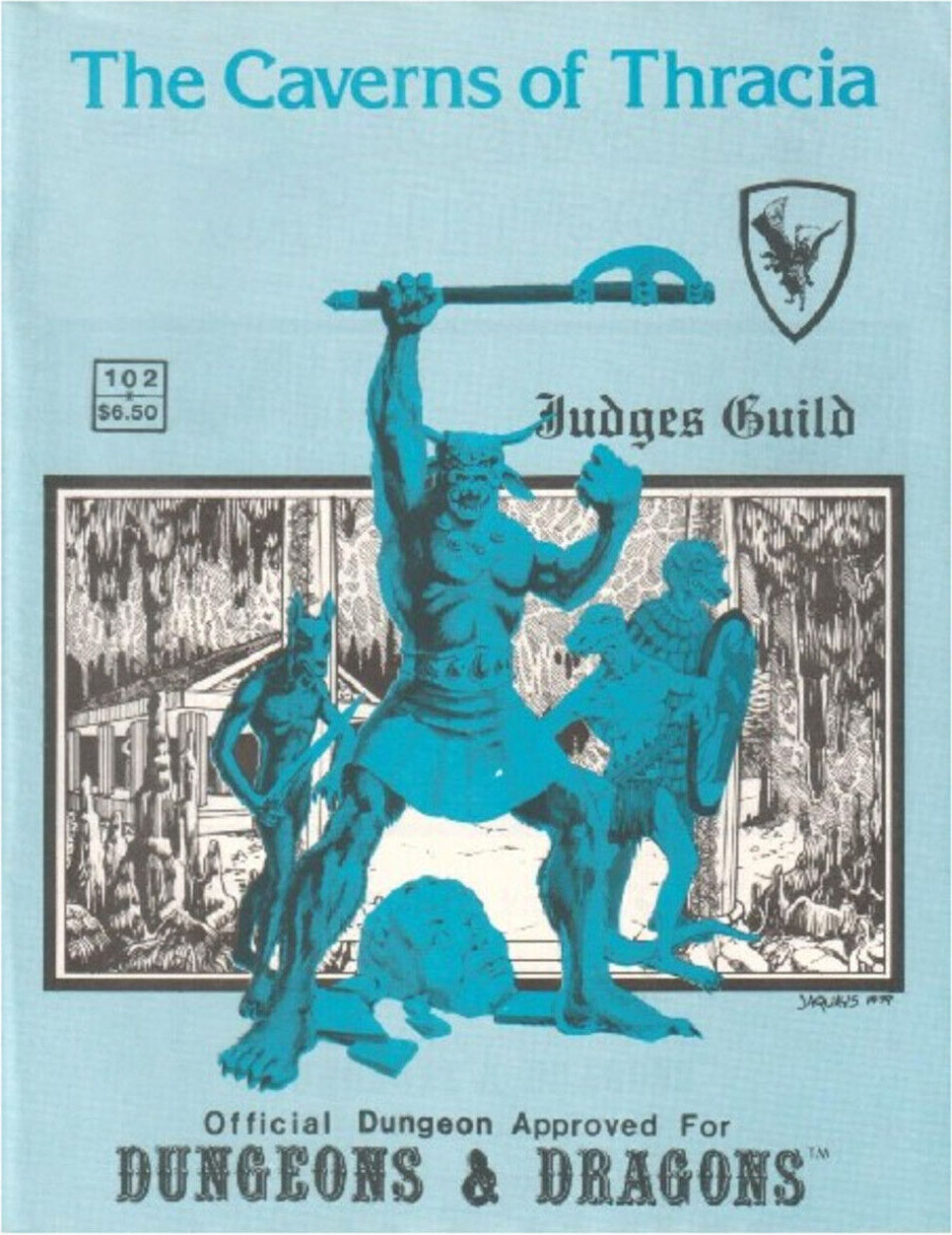
James Maliszewski at Grognardia has spoken at various times about the Moldvay morale rules. (Tom Moldvay being the TSR designer responsible for the 1981 edition of the D&D Basic Set.) James even went so far as to say that “D&D combat only makes sense if you assume the use of morale”.

This is an interesting thought. It was one that I initially rebelled against when I first read it, but it’s been kind of churning around in my head for a few weeks now. It’s been one of those memes that just refuses to let go.

I think the reason I mentally rebel against it is that it impinges into my “zone of GM control”. When I GM, I make a point of roleplaying the monsters. Hurt a wild animal badly enough and it’ll give up… unless it’s rabid. Get a one-shot kill on the goblin chieftain and at least some of the goblins are likely to rout.

A morale mechanic has always seemed like a fairly crude way of modeling this behavior.

On the other hand, I understand James’ point: If you don’t take morale into consideration, D&D combat — particularly the classic D&D combat he’s talking about (when 0 hit points meant dead) — always ends in a slaughter. No quarter is ever given; no prisoners are ever taken. Once you start fighting, everyone keeps fighting until they’re dead.

For those who don’t have access to the 1981 Basic Set, these were Moldvay’s morale rules:

Any creature in battle may try to run away or surrender. Characters are never forced to do this; a character always reacts in the way the player wishes. NPCs and monsters, however, may decide to run away or surrender. To handle this situation, each monster is given a morale score. Good morale (a high morale score) indicates a willingness to fight on, regardless of the odds. Bad morale (a low morale score) means the monster will tend to panic and desire to withdraw from combat.

MORALE SCORES: A monster’s morale score is given in each monster description. The score is a number from 2-12. The higher the morale score, the better the morale. A score of 6-8 is average. A score of 2 means the monster will not fight. A score of 12 means the monster will fight to the death without checking morale. Creatures with a morale score between 2 and 12 will need to “check morale” at some time during a battle, as explained below.

HOW TO CHECK MORALE: During combat it is often necessary to check monsters’ morale to see if they will continue to fight. To check morale, roll 2d6. If the result is greater than the monsters’ morale score, the monsters will try to retreat or use a fighting withdrawal. If the result is less than or equal to the morale score, the monsters will continue to fight.

WHEN TO CHECK MORALE: In general, morale is checked in critical combat situations. Two recommended times for morale checks are:

1. After a side’s first death in combat (either monsters or characters).

2. When 1/2 the monsters have been incapacitated (killed, asleep due to magic, so forth).

Monsters that successfully check morale twice will fight to the death.

ADJUSTMENTS TO MORALE: Morale can be changed by situations (unless the morale score is 2 or 12). Adjustments to morale may be permanent or temporary. The exact adjustments are left to the DM. A maxmium of +2 or -2 is recommended; for example, if monsters are losing a battle, their morale score may be temporarily adjusted by -1. If they are winning, the monsters’ morale score may be temporarily adjusted by +1.

RETAINER MORALE: The morale score of a retainer is based on the Charisma score of the player hiring him (or her). Retainers must check morale after each adventure. If the morale check is failed, they will not adventure with their employer again. Retainers do not need to check morale in combat unless the danger is greater than might be reasonably expected. If a retainer is given a full share of treasure for several adventures, his or her morale score might permanently become 1 higher than the original morale score.

SURRENDER: A character or creature may offer to surrender at any time; however, the opponent need not accept the offer, nor even stop fighting long enough to listen! The DM will handle any talks about surrendering that occur between monsters and characters. Even non-intelligent creatures will usually act reasonably and try to run from hopeless battles. Surrender will usually occur when a morale check is failed, if the defender cannot safely escape. If an intelligent creature surrenders, it will usually offer treasure (from its lair or friends) as payment for its life.

(There’s one obvious error in these rules: A score of 2 actually means that a monster might continue to fight. Morale scores should be one a 1-12 scale if you actually want to design monsters that will automatically run at the first critical juncture in combat.)

There are a few things these rules make me think about:

(1) How simple they are. Part of my objection to morale systems is, as I mentioned before, the crudity of them. But in some ways, if I were to use a morale system, I would prefer this kind of streamlined approach: As a DM it gives me a dollop of information (are they staying or are they going?), but lets me figure out what the information means. (Are they fleeing madly? Making a fighting retreat? Dropping their swords? Staying on guard while trying to negotiate?)

Adding more complexity to this system probably won’t make it any more faithful to reality. In many ways, it might actually make it less faithful and believable.

(2) Retainer morale. I have always been fascinated at the use of retainers in classic D&D gameplay. Despite that, I’ve only played in a single (very short-lived) campaign in which hirelings were ever a significant part of gameplay. If I ever did end up with retainers in play, I think a morale system for them makes a lot of sense: They’re sort of the players’ purview and they’re sort of the DMs’ purview, so it makes sense to use the completely impartial arbiter of the dice determine their outlook.

(3) While I’m still loathe to turn over sentient NPCs to a morale system (because roleplaying them is one of the things I enjoy about DMing), I think it would be interesting to use a morale system for certain types of opponents: Animals for example. And even petty thugs and mooks.

I’ve mentioned in the past that one of things I really love about GMing is being surprised by the actions of my players. (I probably despise railroading more as a GM than I do as a player, actually.) I enjoy seeing events unfold in unexpected ways at the game table. It seems like morale rules would help make that happen.

(4) Is there any easy way to implement a morale system in 3rd Edition? Many efforts I’ve seen in the past start by looking at some sort of mechanic based around Will saves. This has the advantage of using an existing statistic (so that you don’t have to add a morale score to every stat block that you use), but has the disadvantage that the bonus to Will saves increases with level.

Because the Will save bonus increases, you’re left with two options: Either you can complicate the rules in order to vary the DC (which, as I’ve noted, make the rules seem far less appealing to me). Or you’ve effectively introduced another save-or-die effect into the game — one which is pervasive and constant (insofar as it happens every combat).

For example, Heroes of Battle introduced a morale check which was simply a DC 20 Will save. (It was specifically designed for mass combat, but also included an optional variant for “Morale in the Dungeon”.) It kind of split the difference: It had a handful of modifiers that could effectively vary the DC of the check from 15 to 32 (thus adding complexity to the check), but for the most part it was just a flat DC 20 check.

Moldvay sidesteps this issue by using a flat scale. To mix-and-match edition terminology, a CR 1 creature can have morales from 2 to 12 and so can CR 20 creatures.

But the interesting thing about Moldvay’s rules is that, although they look like a flat scale at first glance, they aren’t in practice. Why? Because the triggering conditions are based on the toughness of the monsters. A CR 1 creature with a morale score of 8 and a CR 20 creature with a morale score of 8 might appear to have the same morale… but it’s actually much more difficult to score a “first kill” against CR 20 opponents than against CR 1 opponents.

Moldvay’s system breaks down a bit when it comes to monsters keeping mixed company — does it really make sense for the ancient red dragon to panic because the heroes have killed one of the hundreds of goblin goons he keeps around? — but that type of issue can probably be glossed over through the use of DM discretion.

And maybe that’s the solution for morale mechanics: Use a Moldvay-style flat rating system, but don’t bother specifying the “critical combat conditions” that trigger a check. The DM simply makes a check whenever it seems appropriate. Ultimately, you’re giving the DM the final discretion in how and when… but then, at the crucial moment of decision, he gives up his control and lets the dice decide.

So that, in the end, even the DM can be surprised by the result.

(I’ve also noticed that Moldvay’s doesn’t seem to play well with solo monsters. This probably has a lot to do with the fact that encounters with solo monsters were comparatively rare in previous editions, but nonetheless it would definitely be something to look at if you were planning on using Moldvay’s rules.)

Whether you use a morale system or not, I think it’s important to remember that many (if not most) opponents won’t fight to the death unless they’re forced to.

But also remember that routed opponents can also regroup, go for help, or otherwise return to the field of battle… either during the same confrontation, or later after they’ve had a chance to recover.

Back to Reactions to OD&D

Ptolus - In the Shadow of the Spire

IN THE SHADOW OF THE SPIRE

PRELUDE 2A: THE AWAKENING – RANTHIR

PBeM – March 5th thru 9th, 2007
The 15th Day of Amseyl  in the 790th Year of the Seyrunian Dynasty

(more…)

IN THE SHADOW OF THE SPIRE

Prelude 2: The Awakening – Ranthir

I started gaming in the summer of 1989. It was right around this time that I also discovered the local BBS scene in Rochester, MN — most notably the North Castle BBS. At the raging speeds made possible by a 1200 baud modem I was able to plug into the ADND FidoNet echo.

For those of you unfamiliar with FidoNet, it was similar to Usenet: A set of completely text-based messageboards. However, unlike Usenet, the individual BBSes that made up the FidoNet were not in perpetual contact with each other. Instead, during each day, the FidoNet systems would call each other during the ZoneMailHour (ZMH) and exchange messages. Local systems would push messages up to regional hubs and those hubs would circulate the message around the world and then push them back down to local systems.

Which meant that sometimes it would take you several days to see a message posted by someone else and sometimes you would see it immediately (if the person posting it was on the same BBS you were).

One of the features of the ADND FidoNet echo were the campaigns that were played through it. This was my earliest exposure to the concept of Play-By-Mail (PBM) games.

My first experience with roleplaying games was when I created my own. My second major experience was the true old school play of campaign-hopping characters, whipping out dungeons on graph paper, and playing during every possible stolen moment of the school day. But my third major experience was watching and playing in the PBEM (Play-By-Echo-Mail) games of the ADND echo.

Because of the asyncrhonous nature of communication, the ADND games all followed a similar structure: The DM would post a lengthy summary of events and then the players would respond. If they were facing a physical challenge or combat, player responses were usually tactical in nature — summarizing a strategy for the next several rounds of play instead of specifying particular actions. If it was a conversational situation, players would just start responding to each other’s messages.

But the asynchronous communication, of course, meant that not all of these responses necessarily meshed. (For example, you might have two characters both respond to a straight line with the same joke.) So, at some point, the DM would draw a line in the sand and end that particular phase of play. They would then gather up all the responses and summarize the official version of events. These summaries were referred to as “Moves”.

From my understanding, this system is similar to the original Play-By-Mail games which were played by physically posting letters — but with the added advantage that the players could actually talk to each other without the DM acting as an intermediary.

All of which is a long-winded way of saying: PBeM games had a major impact on my formative years as a gamer.

But, on the other hand, I profess that I have never seen a PBeM campaign end successfully. Even keeping a tabletop campaign together is difficult, and while it would seem as if the non-intensive nature of a PBeM would help keep it running… in practice the lack of any physical demand for attention means that players tend to just wander away and interest tends to atrophy.

Which is unfortunate, because — in my experience — PBeM play has some unique strengths. It lends itself particularly well, for example, to a more contemplative style of play. In ongoing tabletop campaigns, I’ve found PBeM to be a good way of dealing with certain types of side-action. It can also be used to fill in the occasional lengthy gap between playing sessions.

All of these features made PBeM play ideal for launching the Ptolus campaign: The characters were separated, the contemplative style gave the players time to ease themselves into their roles, and we had a gap of time before the campaign could start because of incompatible schedules.

(And if anyone reading this happens to have an archive of old FidoNet ADND games — particularly those run by Bruce Norman — I would dearly love to get a copy. I used to have a substantial archive myself, but it was wiped out by a bad floppy disk. Now I only have a handful of random moves that were tucked here and there.)

Archives

Recent Posts

Recent Comments

Copyright © The Alexandrian. All rights reserved.