MAPS
CARTOGRAPHY BY ABIGAIL LALONDE
Scale = 5’ x 5’
LEVEL 1
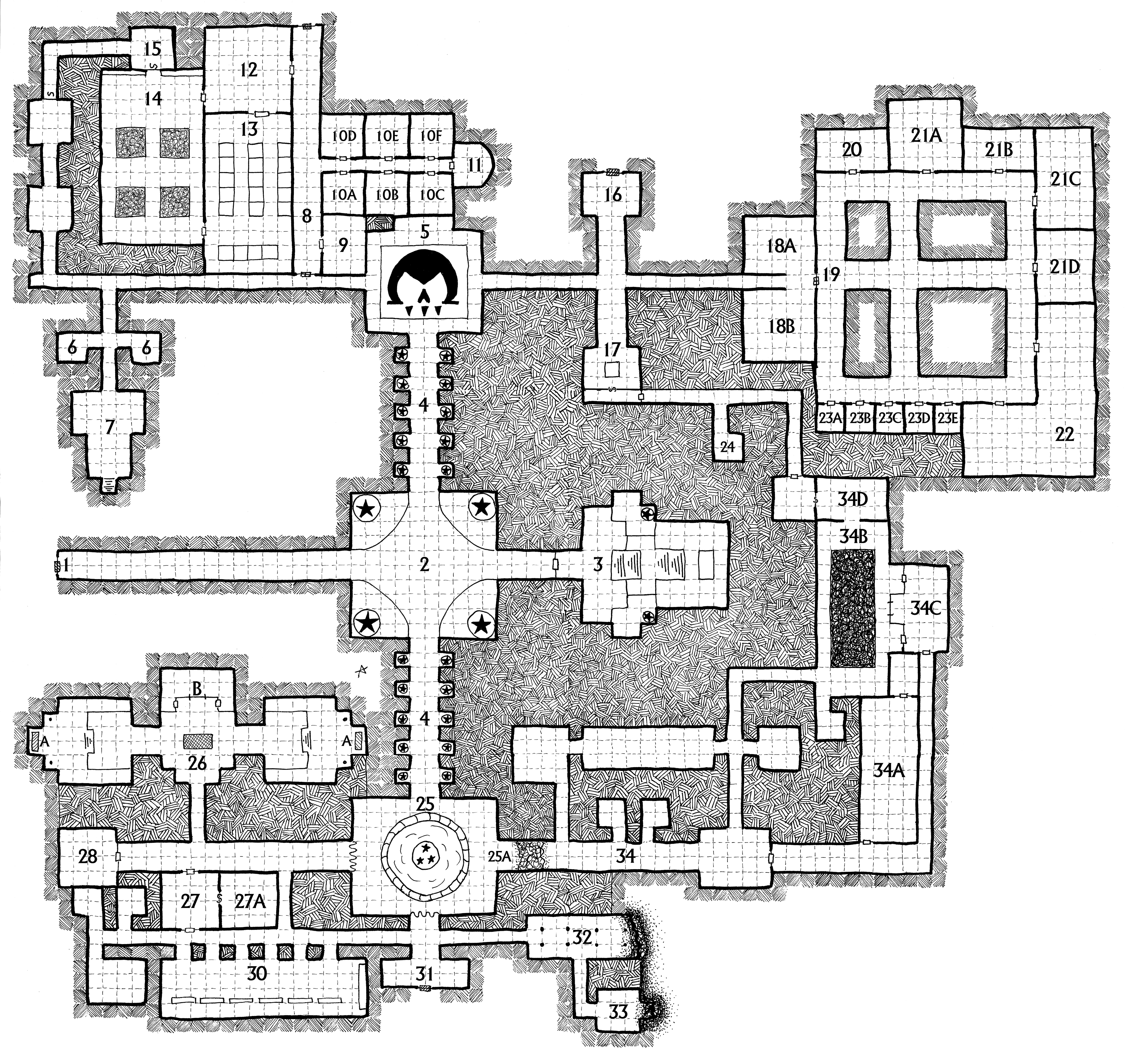
LEVEL 2

(click maps for larger images)
With the 5th Edition and Cypher System versions of Monte Cook’s Ptolus being announced this past week, I thought it might be fun to visit The Laboratory of the Beast. This scenario was originally designed as part of my ongoing Ptolus campaign, and I’ve discussed it quite a bit in the “Running the Campaign” columns that accompany the campaign’s journal entries. For those who haven’t read those journal entries, here’s the short version of the scenario’s origins:
Beneath the city-state of Ptolus there are a number of overlapping dungeon complexes. One of these is Ghul’s Labyrinth, the remnants of a vast and ancient underground citadel created by the dark lord Ghul. In the main Ptolus sourcebook there’s a scenario called “Trouble with Goblins” in which a number of goblins emerge from Ghul’s Labyrinth into the basement of an abandoned house and do various terrible things.
When I ran this scenario early in my campaign, the PCs backtracked the goblins and followed their trail down into the Labyrinth. In the published scenario, the trail goes cold and the PCs don’t find anything of interest in the dungeon. I decided it made more sense for the trail to lead somewhere, and so I designed a little mini-scenario.
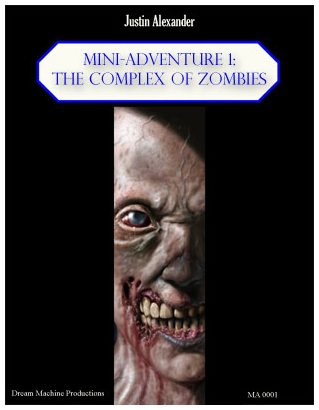
I later published that scenario as The Complex of Zombies. As I described here, the published version of the scenario had been adapted to make it a generic scenario, notably changing the research complex so that it now belonged to the enigmatic Sons of Jade.
 A key feature of this mini-scenario is that, ultimately, the goblins’ trail leads back through a bluesteel door: These doors, which are a common feature in Ghul’s Labyrinth, are essentially impassable for low-level characters unless they know the password. (As I discuss in “The Blue Doors of Ptolus”, this is a great way to control and define transitions in a megadungeon complex.)
The basic design goal here was to give the PCs a reward for successfully pursue the trail, but then definitively end the scenario so that they could move on to other things.
But it didn’t work out that way.
As described in “Tales from the Table: Unexpected Successes” (which is probably worth a read, if I do say so myself), the PCs managed to pull a rabbit out of their hat and successfully guessed the password, causing the bluesteel door to open.
The Laboratory of the Beast is what lies on the other side of the door. (The goblin trail ultimately leads through the laboratory to another scenario called The Goblin Caverns of the Ooze Lord. If response is positive to The Laboratory of the Beast, perhaps I’ll be able to share that latter adventure in the near future.)
With all this in mind, there are a few ways that you could use The Laboratory of the Beast in your own campaign:
I’m presenting the scenario here basically in its original form (with a minimal amount of clean-up to hopefully make my intentions clear to people who don’t live inside my skull), so if you use it in combination with The Complex of Zombies you’ll probably want to make a decision about whether you’re using the Skull-King Ghul or the Sons of Jade.
If you’re planning to use this scenario in your own Ptolus campaign, you should also note that it was written for the version of Ptolus as it exists in my personal campaign world and may, therefore, have any number of metaphysical inconsistencies with Ptolus Prime.
GENERAL FEATURES
During the time of Ghul the Skull-King, this complex was being used to breed the hounds of Ghul — powerful war hounds who, through the machinations of this laboratory, became ever more dire and horrific.
Walls: Cream-colored stone (hardness 8, 15 hp/inch).
Unkeyed Rooms: These are empty, dusty rooms. Some might contain vague discolorations on the floors and walls, suggesting that they might have once contained equipment which has been removed. Or strange alchemical stains.
Bluesteel Doors: Indicated by a shaded door on the map. Made from steel with a distinct bluish tint. One cannot open them by normal magical means and they have no lock to pick. Instead, each door will open in response to a specific word. (3 inches thick, hardness 12, 120 hp, Break DC 31)
Glass & Bronze Doors: Indicated in room keys. Made of glass bound in bronze. These doors are very fragile, but have been laced with dark magic which curses whose who break them. (The effect will be described in the key entry when appropriate.) Resisting the curse requires a Will save (DC 24) and can be removed only by a cleric of at least 13th level casting remove curse on sanctified ground.
Taint: Various items and locations are tainted. See Advanced D20 Rules: Taint for rules on this dark perversion of reality.
Kaostech: Kaostech items can be found throughout the laboratories. See Kaostech for more information on this technomantic art.
Yesterday I rolled out some experimental rules for revising hydras and creating new hydroid creatures. Today we’re going to put them into practice with a few sample creatures.
Bear in mind that this is still an installment of an Untested column: The general rules for hydroids haven’t been tested and these specific monsters even less so. If you do find occasion to use them in your own games, please circle back and let us know how it went!
HYDRALING
Baby hydras — also known as hydralings – are two-headed serpents, only developing the legs of an adult hydra during adolescence. The mothers of hydralings have been seen to deliberately bite off one of the heads from their offspring, prompting the growth of an additional head. Some have hypothesized that this is because hydralings never truly sleep (since one of their heads is always awake), but it’s more likely an instinctual action which prompts (or is prompted by) the hydraling’s development.
HYDRALING
Medium monstrosity, unaligned
Armor Class 13 (Natural Armor)
Hit Points Special
Speed 40 ft., swim 20 ft.
STR 12 (+1)
DEX 15 (+2)
CON 12 (+1)
INT 2 (-4)
WIS 10 (+0)
CHA 6 (-2)
Skills Perception +3, Stealth +4
Senses passive Perception 13
Challenge 1/2 (100 XP)
Amphibious. A hydraling can breathe air and water.
Hydroid. The hydraling has two heads. For every 10 points of damage the hydra suffers, one of its heads dies. If all of its heads die, the hydraling dies.
At the end of its turn, the hydraling grows two heads for each of its severed heads, unless it has taken fire damage since the head was severed. A hydraling can have a maximum of five heads.
Multiple Heads. While the hydraling has more than one head, it has advantage on saving throws against being blinded, charmed, deafened, frightened, stunned, and knocked unconscious.
For each additional head beyond one, it gets an extra reaction that can be used only for opportunity attacks.
While the hydraling sleeps, at least one of its heads is awake.
ACTIONS
Multiattack. The hydraling makes as many bite attacks as it has heads.
Bite. Melee Weapon Attack: +4 to hit, reach 5 ft., one target. Hit: (1d4 +2) piercing damage.
TENTACULAR ABOMINATION
A dog-size creature with eel-like skin. It has no head, but its back is a writhing mass of tentacles.
TENTACULAR ABOMINATION
Medium monstrosity, unaligned
Armor Class 15 (Natural Armor)
Hit Points: Special
Speed 30 ft.
STR 17 (+3)
DEX 12 (+1)
CON 14 (+2)
INT 6 (-2)
WIS 13 (+1)
CHA 6 (-2)
Skills Perception +5
Senses Blindsight 60 ft., passive Perception 15
Challenge 3 (700 XP)
Pack Tactics. The tentacular abomination has advantage on an attack roll against a creature if at least one of the tentacular abomination’s allies is within 5 ft. of the creature and the ally isn’t incapacitated.
Hydroid. The tentacular abomination has five tentacles. For every 10 points of damage the abomination suffers, one of its tentacles dies. If all of its tentacles die, the abomination dies.
At the end of its turn, the abomination grows two tentacles for each of its severed tentacles, unless it has taken acid damage since the head was severed.
Multiple Heads. While the tentacular abomination has more than one head, it has advantage on saving throws against being blinded, charmed, deafened, frightened, stunned, and knocked unconscious.
For each additional head beyond one, it gets an extra reaction that can be used only for opportunity attacks.
While the abomination sleeps, at least one of its heads is awake.
ACTIONS
Multiattack. The abomination makes as many tentacle attacks as it has tentacles.
Tentacle. Melee Weapon Attack: +5 to hit, reach 10 ft., one target. Hit: (1d6+3) bludgeoning damage. The target is grappled (escape DC 13) by one of the abomination’s tentacles. Until this grapple ends, the tentacular horror can’t use that tentacle on another target.
LENGLIAN SERAPHIM
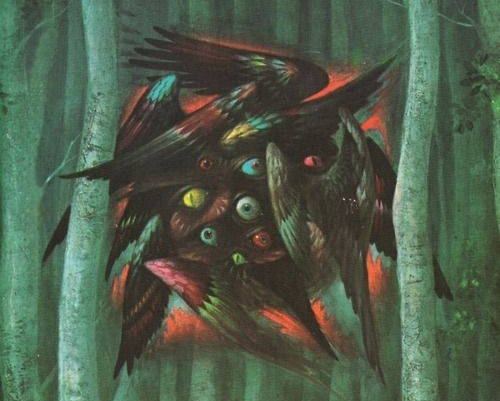
Wings. Dozens of wings clustered together as if shielding a central mass (although no such mass exists within the impossible dimensional toroid of the Lenglian seraph), with eyes opening and shutting between the wings. Some Lenglian seraphs are also known to emit smoke or aurora-like, multi-colored halos as their wings continue to fold and unfold, stretching, reaching, searching, beating the air around them.
(It is also not unusual for Lenglian seraphs to be confused for a swarm of winged creatures, particularly from a distance.)
LENGLIAN SERAPHIM
Large celestial, lawful good
Armor Class 17 (Natural Armor)
Hit Points Special
Speed fly 80 ft.
STR 22 (+6)
DEX 21 (+5)
CON 14 (+2)
INT 21 (+5)
WIS 16 (+3)
CHA 19 (+4)
Saving Throws Wis +7
Skills Perception +7
Damage Resistance Radiant; Bludgeoning, Piercing, and Slashing from Nonmagical Attacks
Condition Immunities Charmed, Exhaustion, Frightened
Senses Truesight 120 ft., passive Perception 17
Languages All, Telepathy 120 ft.
Challenge 12 (8,400 XP)
Innate Spellcasting. The seraph’s spellcasting ability is Charsima (spell save DC 17). The seraph can innately cast the following spells, requiring only verbal components:
Hydroid. A Lengling seraph has thirty-five wings. For every 5 points of damage the seraph suffers, one of its wings is severed. If all of its wings are severed, the seraph dies.
At the end of its turn, the seraph grows two wings for each of its severed wings, unless it has been splashed with unholy water since the wing was severed or is under the effects of a bane spell.
Many Eyed. A seraph has eyes proportionate to its wings. While the seraph has more than one wing, it has advantage on saving throws against being blinded, charmed, deafened, frightened, stunned, and knocked unconscious.
For every five wings the seraph has, it gets an extra reaction that can only be used for opportunity attacks.
ACTIONS
Multiattack. The seraphim can make one wing attack for every five wings it has.
Wing. Melee Weapon Attack: +8 to hit, reach 5 ft., one target. Hit: (1d8+6) bludgeoning damage.
Radiant Gaze (Recharge 5-6). One creature that the seraph can see within 60 feet of it must make a DC 17 Constitution saving throw, taking 70 (20d6) radiant damage on a failed save, or half as much damage on a successful one.
LEGENDARY ACTION
Can take one legendary action. Only one legendary action can be used at a time, and only at the end of another creature’s turn. Spent legendary actions are regained at the start of each turn.
Buffeting Wings. The seraph beats its wings. Each creature within 10 ft. of the seraph must succeed on a DC 17 Dexterity saving throw or take 1d6+6 bludgeoning damage and be knocked prone. The seraph can then fly up to half its flying speed.
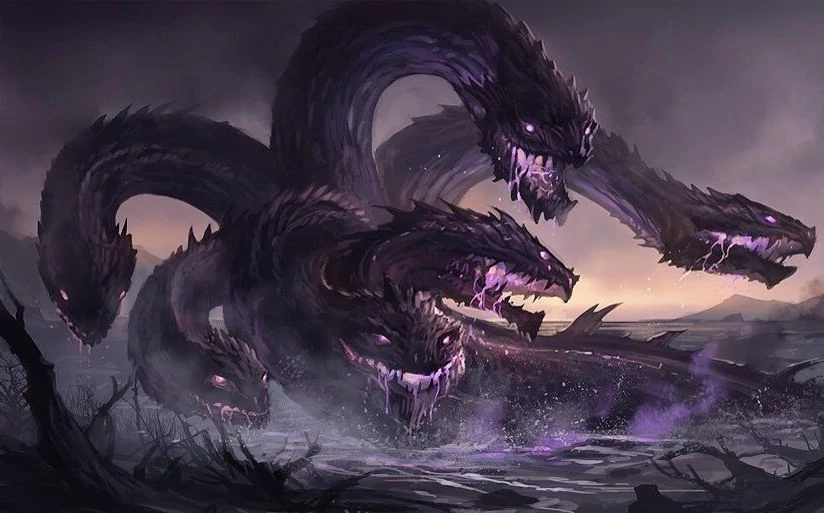
I woke up this morning with a cool idea for how to handle hydras in D&D. A quick check of the 5th Edition Monster Manual, however, alerted me to the fact that 5th Edition basically already did it that way.
Well played, 5th Edition.
Upon further investigation, it became clear that my subconscious had dredged up a goulash of 3rd Edition, 2nd Edition, and OD&D mechanics and then regurgitated them.
Which, upon further consideration is a pretty good summary of the design methodology of 5th Edition. (This is not a critique.)
Hydras, in D&D 5th Edition, work like this:
Multiple Heads. The hydra has five heads. While it has more than one head, the hydra has advantage on saving throws against being blinded, charmed, deafened, frightened, stunned, and knocked unconscious.
Whenever the hydra takes 25 or more damage in a single turn, one of its heads dies. If all of its heads die, the hydra dies.
At the end of its turn, it grows two heads for each of its heads that died since its last turn, unless it has taken fire damage since its last turn. The hydra regains 10 hit points for each head regrown in this way.
The heads give a couple other advantages (extra opportunity attacks, it can sleep while still having one head awake to keep watch), but that’s the fundamental mechanic that models the classic hydra.
There are a couple of changes to this approach that I’d like to experiment with:
So if a fighter gets in there and deals 50 points of damage, his flurrying blades will have hacked off a couple of heads at once. Then maybe the rogue leaps onto its back, deals another 25 points of damage, and hacks off a third head. On the hydra’s turn, it will grow back six heads (two for each severed head).
REVISING THE HYDRA
Thus we can say that a hydra should be mechanically defined as:
The “Hit Points” entry of their stat block would be listed as “Special”: They only die if they run out of heads.
Here’s what our revised hydra special abilities would look like:
Hydroid. The hydra has five heads. For every 25 points of damage the hydra suffers, one of its heads dies. If all of its heads die, the hydra dies.
At the end of its turn, the hydra grows two heads for each of its severed heads, unless it has taken fire damage since the head was severed.
Multiple Heads. While the hydra has more than one head, it has advantage on saving throws against being blinded, charmed, deafened, frightened, stunned, and knocked unconscious.
For each additional head beyond one, it gets an extra reaction that can be used only for opportunity attacks.
While the hydra sleeps, at least one of its heads is awake.
CREATING HYDROID CREATURES
These mechanics can be used as the basis for other hydroid creatures. Here are some proposed guidelines for doing so.
Damage Threshold. This is the number of hit points required to chop off one of the hydroid appendages. These numbers are loosely based around the idea that a character of the appropriate level should be roughly capable of taking out one head per turn.
CR 0-2 10 hp
CR 3-6 20 hp
CR 7-12 25 hp
CR 13-18 30 hp
CR 19-20 40 hp
I’d recommend halving this value if the sealing damage type or other condition is an unusual one. (This would mean that the killing the monster would typically require killing the heads faster than they can grow back.)
# of Heads. Using the Creating Quick Monster Stats table on p. 274 of the Dungeon Master’s Guide, multiply the minimum hit points for your selected CR by 0.75 and then divide by the damage threshold listed above for its CR.
For example, a CR 10 creature would have 206 hp using the table above, so multiply by 0.75 (154) and then divide by 25 (per the damage threshold table above) to determine that your monster should have six heads.
(This is based strictly on reverse-engineering the existing hydra stat block and it’s unclear if it holds up in practice. It seems to pretty reliably give you 4-8 heads, so you could also probably just get away with slotting in 5-6 heads and not worrying about it.)
You can also use this method to very quickly adapt existing stat blocks. For example, if you wanted to have a hydroid warg (CR ½) you’d take the warg’s current hit point total of 26, multiple by 0.75 (19.5), and then divide by 10. The hydroid warg would start with two heads.
Variant: Maximum Number of Heads. In 2nd Edition, Lernaen hydras could grow maximum of 12 heads. In 3rd Edition, they were limited to no more than twice its original number of heads. You might consider doing the same for some hydroid creatures.
DESIGN NOTES
Hydras have a well-known gimmick: They regrow their heads unless you cauterize the stumps with fire. It’s a fun gimmick the can create an encounter which mechanically feels different from other encounters. The only problem is that, because the hydra still has a hit points that’s easier to wipe out than its heads, the mechanical gimmick is irrelevant: There’s often little or no advantage to pursuing it, so parties will just bypass it.
This is boring.
So we fix it by eliminating the bypass. Just like you can’t bypass a troll’s regeneration by just dealing lots of hit point damage to it, you can’t bypass a hydra’s heads.
And, just as regeneration mechanics were created for trolls and now underlie a whole bunch of creatures, these hydroid mechanics can also be used for all kinds of things. We’ll take a look at several examples of this tomorrow.
As described in The Art of the Key, the first published module for D&D was Palace of the Vampire Queen. It used a very simplistic, tabular key:
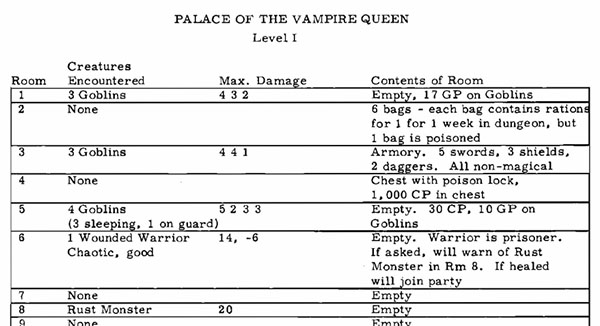
A year later, Judges Guild would release Wilderlands of High Fantasy, the first published hexcawl. This book keyed only a fraction of the hexes on its map, also using mostly tabular methods:
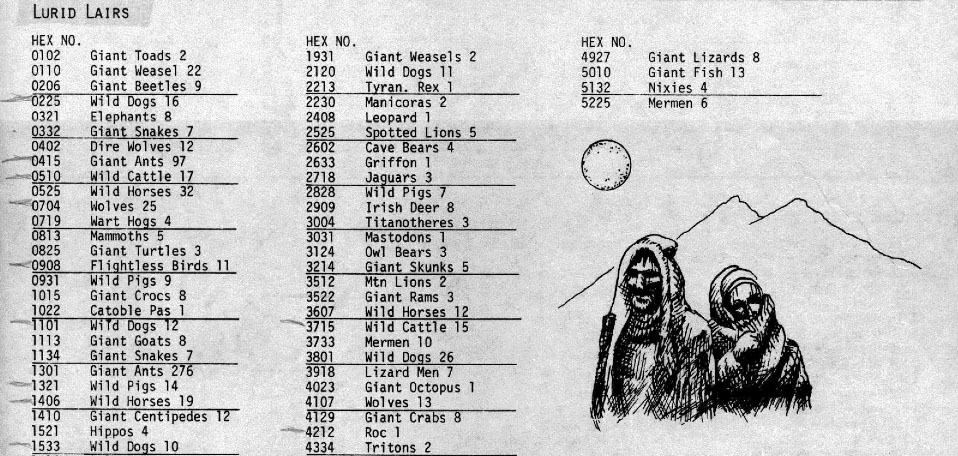
Different table formats were presented for Lurid Lairs (above), Villages, and Citadels & Castles.
These tablular entries are supplemented with short, one or two sentence entries like these:
1002-Above Ground Ruined Temple-3 Windwalkers
2822-Overgrown Antique Paintings-Copper Dragon
1418 Isle of Grath – Abode of four huge Ogres which relish human flesh. Every Ogre has three eyes, and flaming red hair. A pet giant crocodile follows them to feast on the leavings.
(“Overgrown Antique Paintings” is just a typo. Based on the format of other entries, it should be specifying an overgrown something in which antique paintings are the treasure to be looted from a copper dragon. The image it conjures of a copper dragon living inside magical antique paintings that one can presumably enter is just too fantastic for me not to call it out here. But I digress.)
But whereas the published presentation of dungeons has significantly developed and improved over the last 40+ years, the presentation of hexcrawls largely has not. If you pick up virtually any of the OSR hexcrawls released over the past few years, you’ll still find:
Incomplete keys, in which lots of hexes aren’t keyed at all. This is generally an indication that your hexcrawl is at the wrong scale. This creates two problems in actual play. First, it tends to create very poor pacing (with long spans of time in which navigational decisions are not resulting in interesting feedback in the form of content). Second, the lack of content equates to a lack of structure. One obvious example of this is that hexcrawls with vast spans of empty space lack sufficient landmarks in order to guide navigation.
Underdeveloped keys that aren’t ready for actual play. Telling me that there is, for example, a dungeon in a particular hex with “Hobgoblins 42” in it doesn’t actually give me any meaningful information for bringing that dungeon into play.
Perhaps the most egregious example of this sort of thing are products like Carcosa, which feature keys almost entirely generated by rolling on the random stocking tables found in the back of the book and jotting down the result. There’s zero value in such a key. Why? Because you could just as easily roll on the random stocking tables yourself.
Transitory keys, in which the content keyed to a hex is something you only encounter once and then the hex is functionally empty the next time you go there. (For example, from Isle of the Unknown, “A 9th-level cleric… in a red surcoat with a white cross rides southeast to take ship upon a holy pilgrimage.”) Because this content effectively deletes itself from the key, over time this transitory content turns even a complete key into an incomplete one. It should instead be encoded as a random encounter (or similar structure).
SO WHAT?
Why is this a problem?
Well, imagine if we designed dungeons this way.
THE TOMB OF SAGRATHEA
Level 1: 12 skeletons.
Level 2: The original laboratories of the lich Sagrathea, now divided into a tribe of 17 ghost eaters and a kingdom of 46 skeletons locked in war with each other.
Level 3: The walls of the Bloodpool Labyrinth are of pinkish flesh which bleeds a grease-like substance if injured. There are many traps here. Patrolled by 2 flaming skulls.
Level 4: [intentionally left blank]
Level 5: [intentionally left blank]
Level 6: 121 skeletons + 4 ogre skeletons.
Level 7 – Sagrathea’s Gardens: A collection of 27 caverns each rendered as a miniature biome. Sagrathea has recorded his spellbook in these gardens, with each garden cavern recording a single spell of the 4th to 9th level of potency.
Level 8 – Sagrathea’s Manse: The lich Sagrathea sits upon a throne of black stone with his wight bride.
You can add in a side-view illustration of the dungeon showing each level’s vertical elevation, but if you can imagine looking at this dungeon “key” and being asked to run the Tomb of Sagrathea, then you know how I generally feel when I open up a typical hexcrawl and see the “key” inside.
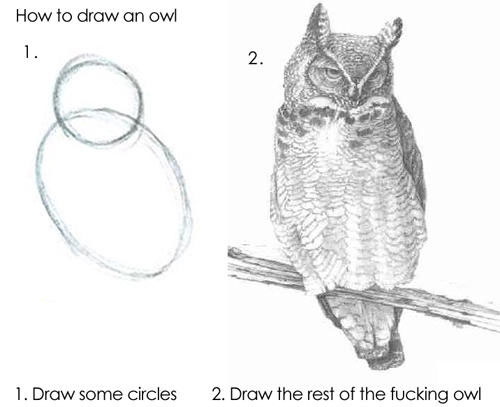
There’s a real “draw the rest of the fucking owl” vibe to it.
WHAT SHOULD A HEXCRAWL LOOK LIKE?
Published hexcrawls are, in my opinion, providing a poor example of the value a hexcrawl structure is actually capable of providing.
At a basic level, I want to be able to pick up a hexmap and its key and have a fundamentally playable experience.
 At a more advanced level, once you have a fully functional hexcrawl, there’s all kinds of cool utility that you can leverage out of that hexcrawl. For example, in Thinking About Wilderness Travel I looked at how the basic scaffolding for rich route-based travel basically just falls out of a properly designed hexcrawl key. Hexcrawls can also provide the context and tools for rapidly restocking empty dungeon complexes, as described in (Re-)Running the Megadunegon.
You can see the sample hex key I included as part of my longer series on hexcrawls.
If you’re looking for something like this on the market right now, check out The Dark of Hot Springs Island by Jacob Hurst, Gabriel Hernandez, Even Peterson, and Donnie Garcia. Every hex is keyed with content. Every lair and dungeon is mapped. And it’s paired to the incredible Field Guide to Hot Springs Island, an incredibly rich handout that’s designed to be given to your players as a kind of rumor table on steroids. It’s not just everything I want in a hexcrawl product; it’s more than that. And it’s the absolute gold standard to which any hexcrawl supplement should aspire.