
G. asks:
I’ve run a couple Powered by the Apocalypse games and I don’t get the hype. What are the strengths of PBTA games supposed to be compared to games like Call of Cthulhu, Vampire the Masquerade, or Savage Worlds?
Let’s start with a quick orientation for people not familiar with Powered by the Apocalypse:
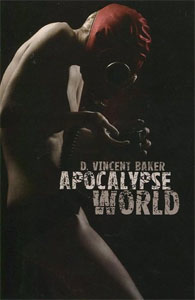
- Vincent and Meguey Baker released Apocalypse World in 2010.
- The Bakers put the game under a free license.
- As a result, the novel system has been adapted and used in hundreds of RPGs. These games are referred to as Powered by the Apocalypse (PBTA).
- The system also notably influenced John Harper’s Blades in the Dark, which has also inspired countless RPGs published as Forged in the Dark.
In actual practice, Powered by the Apocalypse is barely a dice mechanic loosely paired to the concept of Moves. And on of Baker’s own PBTA games doesn’t include the dice or the moves. So there’s a huge range in what “PBTA games” do and how they do it.
But let’s break down each feature that seems to be closely identified with Powered by the Apocalypse.
CORE MECHANIC
PBTA uses a generally three-tier outcome for all action resolution: Success, Partial Success/Success with Consequences, Failure.
It’s pretty typical for RPG mechanics, particularly pre-PBTA, to default to binary outcomes. Even conventional RPGs featuring something like margins of success or critical hits will still usually define success as “the PC achieves exactly what they want” and then maybe they get something extra if they roll or a critical or their margin of success is high enough. PBTA, on the other hand, tends to define typical success as “the PC gets SOME of what they or they pay a price for it” with “achieve exactly what you want without cost” being treated as the exceptional result.
Similarly, conventional RPGs tend to have the Failure state default to “you didn’t do it.” PBTA instead defaults to having consequences for your failure: You didn’t just “miss” the ogre; you rushed the ogre and the ogre punched you in the face. This approach also means that PBTA games tend to embrace failing forward, while leaning towards not just player-facing mechanics, but a specific flavor of player-facing mechanics featuring fortune-in-the-middle decisions.
PC MOVES
Beyond three-tier resolution, PBTA almost always package their resolution mechanics into Moves. The distinction here can get pretty fuzzy (due to the breadth of both conventional RPG and PBTA design), but the result in what I consider better PBTA games is a throwback mechanic that evokes true old school design: In the ‘80s, RPG design shifted almost entirely to the “generic universal mechanic” as their core design. (Usually, but not necessarily, some variation of ability score + skill + dice vs. difficulty.)
The distinction here can be confusing to some, because quite a few OSR retro-clones have retrofitted the games they’re emulating to be built around a generic universal mechanic. But the older of old school games were built around, “You want to do something? Let’s build a custom mechanic for it!”
PBTA isn’t strictly old school, though, because it’s less, “Here’s a collection of stuff we made ad hoc at the table to address situations that came up” and instead “here’s a carefully curated selection of tools which will deliberately shape the focus and direction of play.”
Let’s think of this as neo-old school design.
(And, again, this applies to the, in my opinion, better PBTA games. There are quite a few PBTA games that turn their Moves into generic, unfocused mush because their designers are defaulted back to “generic universal mechanic” as their design model.)
PLAYBOOKS
A character creation and advancement system featuring distinct Playbooks for different types of characters is also a common feature of PBTA games.
In practice, though, this is just class-based or archetype-based character creation, which is quite common in conventional RPGs. (I’ve seen any number of efforts to explain how, “No, no! It’s totally different!” But it really isn’t, although the class abilities can have a unique feel to them because of how they tie into the Moves methodology.)
GM MOVES
This is another neo-old school design element.
To explain what I mean by that, consider the original 1974 edition of D&D: It included a hyper-specific procedure for running a dungeon. If you strictly follow that procedure, you get a very specific style of play and type of adventure.
GM Moves in Apocalypse World are designed to do that the same thing, providing a very specific structure of prep coupled to a very specific procedure of play that creates a very specific outcome at the table.
This is, it should be noted, another place where a lot of PBTA games turn into generic mush by designing their GM Moves as “the generic stuff that GMs do.” (Often accompanied by weakening or removing the provision that GM Moves are the ONLY thing a GM is allowed to do.) In some cases, these chapters degrade entirely into generic GM advice.
An interesting lens that can help understand this distinction is Blades in the Dark, which, as noted above, is heavily influenced by PBTA, but distinct from it. John Harper, the designer, notably replaced GM Moves with a chapter called GM Actions, which is the “generic GM advice” approach to GM Moves. But, notably, this is because Harper has moved all the hyper-specific procedure stuff into The Score and Downtime chapters. (And, in fact, made it even more hyper-specific, in a style very similar to the 1974 D&D dungeon procedures.)
FRONTS/THREATS
The last thing that I, personally, consider a core identity for Apocalypse World was the concept of Fronts: A collection of threats and agendas, motivated by a Fundamental Scarcity, defined with specialty Moves, and tracked with Countdown Clocks. Fronts were a specific structure for prepping situations, and the GM was instructed to create their campaign by simply setting up Fronts and then playing to find out what happened as those situations evolved dynamically in concert with the PCs’ actions and agendas.
But then Apocalypse World 2nd Edition eliminated the entire concept of Fronts and replaced it with a heavily revised system for managing Threats. I haven’t run a game using the revised system, so I can’t comment too much on the details, but although the methodology was significantly altered, the core intention and approach remained the same: Stock the world with dynamic situations. Use them to pressure the PCs and, when the PCs respond, play to find out by following your procedures (Moves, Clocks, etc.).
The basic concepts of Fronts and Threats have been adapted in myriad ways by other PBTA games.
WHITHER THE APOCALYPSE?
Circling back to the original question, if PBTA games really are “special” or different from other RPGs, why might someone playing them not understand what the big deal is?
Well, depending on what non-PBTA games you’ve been playing and also how you’ve been playing them, PBTA games may not, in fact, be a radically different experience for you. Situation- and procedure-based play have, as I noted above, go all the way back to Arneson and Gygax. It’s really, fundamentally, what the RPG medium was designed to do. I’ve personally been preaching about how you can do situation-based play in any RPG for a couple of decades now, and a wide variety of old-school and OSR games are designed around these principles, too. (And even more now than when Apocalypse World first came out.)
On the other hand, as I mentioned, there are a number of PBTA games that turn these core features of Apocalypse World into mush: Moves just become generic “you do stuff.” Fronts become disconnected from procedure. Sometimes whole chapters of How to Prep Plots are attached. Even the core mechanic often gets defaulted back towards something much closer to traditional binary outcomes. So it’s quite possible to play a PBTA game that pretty thoroughly disguises or eliminates the most distinctive features of PBTA games.
Similarly, there are a lot of GMs running PBTA games — including Apocalypse World — that aren’t actually running those games. This is actually a surprisingly frequent phenomenon with RPGs: No matter what the rulebooks actually say, for these GMs every game just defaults to a core resolution mechanic that they arbitrarily invoke. (In many cases, you’ll see this degrade even further, with resolution mechanics that amount to little more than “high roll on the dice = good, low roll = bad” regardless of skill modifiers, difficulty classes, or anything else.)
Some GMs have also been so thoroughly conditioned in prepping and running adventures in one specific way (often, but not always, a linear railroad), that they similarly default to habit no matter what structures a game may be designed for. Sadly, some of these GMs, when running Apocalypse World, will even go so far as to prep a bunch of Fronts and/or Threats as the rulebook instructs… only to do nothing with them. At best, the Fronts serve as a kind of idea board for them. Often they’re just laid aside entirely, and the GM will be left scratching their head and wondering why they wasted all that “pointless” effort.
Combine both of these — railroad adventure prep and “all systems are a die roll and a vibe” — in a single GM (which is far from uncommon), and you pretty much eradicate everything that makes Apocalypse World and PBTA games special and unique.
With all that being said, even if you’ve been running or playing the full-fledged PBTA experience, it’s quite possible that it’s just not your jam. Not every game is made for every person.
But if you’ve played a PBTA game and it didn’t feel different from, say, a D&D dungeoncrawler… well, that probably means something got mushy somewhere. Might’ve been the game design. Might’ve been the GM. Either way, it’s probably worth giving PBTA another chance and finding out what happens when you really embrace the structure of the game.