The Alexandrian

Archive for the ‘Roleplaying Games’ category

UA-Style Rumors for D&D

June 21st, 2010

Unknown Armies is a great little RPG. As I once wrote in a review, “UA is, I’ll be the first to admit, possessed of some flaws — but it bubbles with such creativity, originality, potential, and brilliance that it overwhelms those flaws.” Unfortunately, it never caught on in the way it probably deserved to. (And it probably never will: Too many other games have stepped in and stolen its stuff over the past decade.)

One of the (many) great things about Unknown Armies, however, was the “What You Hear” section. In the world of Unknown Armies all the half-crazed conspiracies and crack-pot theories and urban legends you’ve ever heard are true at one level or another, but in a way completely alien to anything you might have expected. “What You Hear” was basically a rapid-fire conglomeration of one- or two-sentence rumors that peeled back the mundanities of the world and revealed them to be something horribly different. They were a distorted lens through which the world could be viewed and used.

The great thing about them was that they could be used in any number of ways: Disinformation. Intriguing background detail. Full-fledged adventure seed. Idle chit-chat from a nervous underworld contact. All kinds of stuff. And all of it mysterious and enigmatic and awesome.

Circa 2004, a guy named RemyBuron started a thread on RPGNet for people to post UA-style rumors. Here a couple examples:

There is no state of Wyoming. I mean, have you ever met anyone from there?

If you had been crucified would you ever want to see a cross ever again? The common symbol of a crucifix actually wards off the power of Christ rather than invoking it. That most people believe differently is one of Satan’s greatest successes, just above killing a carpenter by nailing him to a wooden structure.

A few months later I started a thread for UA-Style Rumors: Dungeons & Dragons. Recent free-associating resulted in memories of the thread surfacing out of the deep murk of my brain, and I thought it would be fun to track the thread down and loot the stuff I had posted in it. When I did, I was pleasantly pleased to discover that the thread has been periodically revived over the past several years — with the most recent spurt of activity coming just a few weeks ago (and including someone describing it as the “best thread ever“).

Without further ado, here are my UA-style rumors for D&D (including a couple of new ones that never appeared in the thread). Check out the original thread for lots of good stuff from other people.

Mages were all born centuries ago. In fact, they’re not even human. No, seriously, think about it: Have you ever known a kid who grew up to be a mage? Nope. All the mages you’ve ever known are already adults, and most of them are old. Apprentices? Most of them are duped slaves. The few who can actually cast spells are actually archmages. They’re just putting on an act to keep up appearances.

Dragons aren’t really that impressive. In fact, even the biggest of ’em don’t grow any bigger than a large dog. The rest are just bullshit spun by would-be heroes trying to look important.
Why are there are only nine towns in Ten Towns?

You ever notice how the king is never seen without the queen? That’s because he’s really a living mannequin. The real king died years ago. If you watch closely, you can see the queen’s fingers twitching the invisible strings.

Underdark? There’s no such thing. The dark elves just live on the other side of the planet. (Although it’s true that you can get there through the dungeons — some of them go deep enough, although you have to watch out for the gravity shift.) And they’re not evil. That’s just racist elven propaganda. They don’t like anybody without pointy ears and alabaster skin. They think we’re all orcs.

All those monsters who prowl the wilderness? They were put there by the king. The court wizard makes ’em, and most of them are mutated from prisoners. You can see the lights in the wizard’s tower every night from the rituals. Why does he do it? To keep us commonfolk stuck in the cities and the villages. If we were able to travel safely and talk to each other we’d be free of him soon enough.
The gods are a sham. A couple hundred years ago some powerful elven spellcasters set themselves up as “gods”. Now the elves effectively rule the world, and their duped priests don’t even know they’re doing it. The dragons know the truth. That’s why they’re hunted.

Somewhere in the Duchy of Colbane there’s a village. Everybody there is a mind-slave controlled completely by a lich. Everybody.

Bags of Devouring don’t actually destroy anything. They just transport it to another bag. The most powerful person in the whole multiverse is the guy who owns the bag all the Bags of Devouring empty into. I only know this because a friend of mine told me. I’ve never seen him again.

Look, you’ve gotta stop casting fireballs. They’re dangerous. No, seriously, stop laughing. I mean they’re dangerous. There’s this dungeon you can’t go to any more. It’s full of fire. All the time. Some wizard cast three fireballs in quick succession and they all kind of… collapsed into each other. Ripped open a vortice to the Plane of Fire. I used to go delving with a wizard who was scrying on them at the time. He told me that if it had happened on the surface it would have wiped out the whole world. Seriously.
Liches? Not really undead. In fact, most of them aren’t even that powerful. They’re posers. I heard that a bunch of apprentices who couldn’t master more than basic weavings cooked up the whole “lich” thing as a secret society. They used a couple of simple illusion spells to wow a couple of hick villages and build a rep. Some adventurers managed to take out a couple and, hyped up on their own egos, built up the rep of the Liches even more. But now things are changing: The group is attracting more powerful members. And my friend Jacob heard some nasty rumors about that coup in Covartain last year. Something about “lich-ghouls”…

Have you ever noticed how there are always exactly 6 members in every adventuring party? That’s the number of the Beast. Think about it.

Tell me about it. My friend got hooked on those things. This would have been back before I lost my eye. It got to the point where he couldn’t get through a day without drinking one. Then it got worse. He had to use more and more powerful cure wounds potions to get the same kick. He was downing two or three potions every hour. And then they stopped working altogether. That’s when he switched to inflict wounds. Gods, that’s an ugly way to die…

I find designing these rumors for D&D particularly interesting: With UA you can just look a the world around you and add a spice of oddness or magic. But D&D is innately strange and magical. You can’t just say, “There’s a dungeon with weird stuff in it.” Dungeons are supposed to be filled with weird stuff. Shapeshifters and covens and illusions are all part of the package. In order to get that full UA-style punch, therefore, you need to look a the typical expectations of a D&D campaign and then deliberately invert those expectations. Force ’em to look twice and re-evaluate their preconceptions.

Got an idea for your own UA-style rumor? Hit the comment button.
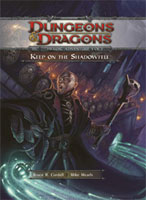
KotS Revision Correction

June 19th, 2010

I was running an OD&D version of Keep on the Shadowfell on Thursday night and discovered that I made a mistake while compiling the PDF cheat sheet for the adventure. Specifically, two relatively important paragraphs got dropped:

The kobold tribe is known as the Clan of the Withered Arm. Once in every generation a child of the clan is born with a withered arm, marking them as the future leader of the clan. The clan’s history in the area around Winterhaven actually dates back more than 25 years to a time period when they were driven from their ancestral lands by Necross the Black Mage. The villagers in Winterhaven, however, were largely unaware of their presence: They survived by hunting wild game and generally shunned contact with the civilized races (who they had learned to fear).

Kalarel’s arrival in the area changed all that. He sent one of his goblin lackeys — a brutish oaf named Irontooth — with a band of thugs to take control of the kobolds. They took the kobolds by surprise, overpowered their leader (a kobold named Issitik), and chopped off his arm. Irontooth now wears the withered arm on a chain about his neck.

This was included in the original posts on the website. It just got dropped from the compilation.

You can download the corrected PDF here.

Go to Part 1

Up to this point I’ve been fairly vague about exactly what I mean by a “node”. This is largely because there isn’t really a hard-and-fast definition of the term.

In generic terms, you can think of each node as a “point of interest”. It’s the place (either literally or metaphorically) where something interesting can happen and (in most cases) information about other interesting things can be found.

In my experience, nodes are most useful when they’re modular and self-contained. I think of each node as a tool that I can pick up and use to solve a problem. Sometimes the appropriate node is self-evident. (“The PCs are canvassing for information on recent gang activity. And I have a Gather Information table about recent gang activity. Done.”) Sometimes a choice of tool needs to be made. (“The PCs have pissed off Mr. Tyrell. Does he send a goon squad or an assassin?”) But when I look at an adventure, I tend to break it down into discrete, useful chunks.

Chunks that become too large or complex are generally more useful if broken into several smaller nodes. Chunks that are too small or fiddly are generally more useful if grouped together into larger nodes. The “sweet spot” is about identifying the most utilitarian middle-ground.

(To take an extreme example: “All the forestland in the Kingdom of Numbia” is probably too large for a single node. On the other hand, 86,213 separate nodes each labeled “a tree in the Forest of Arden” are almost certainly too fiddly. Is the appropriate node the “Forest of Arden”? Or is it twelve different nodes each depicting a different location in the Forest of Arden? I don’t know. It depends on how you’re using the Forest of Arden.)

Let’s get more specific. Here are the sorts of things I think of as “nodes”:

LOCATIONS: A place that the PCs can physically go. If you think of a clue as being anything that “tells you where to go next”, telling the PCs about a specific place that they’re supposed to go is the most literal interpretation of the concept. Once PCs arrive at the location, they’ll generally find more clues by searching the place.

PEOPLE: A specific individual that the PCs should pay attention to. It may be someone they’ve already met or it may be someone they’ll have to track down. PCs will generally get clues from people by either observing them or interrogating them.

ORGANIZATIONS: Organizations can often be thought of as a collection of locations and people (see Nodes Within Nodes, below), but it’s not unusual for a particular organization to come collectively within the PCs’ sights. Organizations can be both formal and informal; acknowledged and unacknowledged.

EVENTS: Something that happens at a specific time and (generally) a specific place. Although PCs will often be tasked with preventing a particular event from happening, when events are used as nodes (i.e., something from which clues can be gathered), it’s actually more typical for the PCs to actually attend the event. (On the other hand, learning about the plans for an event may lead the PCs to the location it’s supposed to be held; the organization responsible for holding it; or the people attending it.)

ACTIVITY: Something that the PCs are supposed to do. If the PCs are supposed to learn about a cult’s plan to perform a binding ritual, that’s an event. But if the PCs are supposed to perform a magical binding ritual, then that’s an activity. The clues pointing to an activity may tell the PCs exactly what they’re supposed to be doing; or they may tell the PCs that they need to do something; or both.

NODES WITHIN NODES

In other words, at its most basic level a node is a person, a place, or a thing.

As suggested above, however, nodes can actually be fairly complex in their own right. For example, the entire Temple of Elemental Evil (with hundreds of keyed locations) could be thought of as a single node: Clues from the village of Hommlet and the surrounding countryside lead the PCs there, and then they’re free to explore that node/dungeon in any way that they wish.

Similarly, once the PCs start looking at the Tyrell Corporation they might become aware of CEO James Tyrell, the corporate headquarters, their shipping facility, the server farm they rent, and the annual Christmas party being thrown at Tyrell’s house — all of which can be thought of as “sub-nodes”. Whether all of these “sub-nodes” are immediately apparent to anyone looking at the Tyrell Corporation or if they have to be discovered through their own sub-network of clues is largely a question of design.

In short, you can have nodes within nodes. You can plan your campaign at a macro-level (Tyrell Corporation, Project MK-ALTER, the Chicago Sub-City, and the Kronos Detective Agency), look at how those macro-nodes relate to each other, and then develop each node as a separate node-based structure in its own right. Spread a few clues leading to other macro-nodes within each network of sub-nodes and you can achieve highly complex intrigues from simple, easy-to-use building blocks.

Advanced Node-Based Design

Go to Part 1

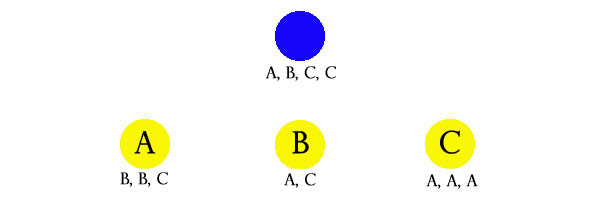
Everything we’ve been discussing here are basic, systematic designs. But there’s no reason you need to be symmetrical. Maybe node A has two clues pointing to node B while node C is clue-happy for node A.

Node-Based Scenario Design - Asymmetrical Nodes

On a larger scale, you’ll probably find yourself mashing together lop-sided conglomerations of disparate structures.

For example, a good-sized chunk of my current campaign is based around a general layer cake approach: An interconnected web of criminal organizations allow the PCs to generally make their way up the “chain of command”. But this layer cake naturally funnels towards various sub-conclusions, and I’ve also included loops designed to carry the PCs back to points prior to the various funnels.

That approach may seem jargon-filled, but it’s really just a matter of embracing the fundamentally flexible principles of node-based design, strewing clues liberally, and spot-checking to avoid problem areas.

Looking over my notes for this campaign, I’ve come to think of this as the “cloud”: Dozens of nodes all containing clues and linked to by clues. Even if we discount all the different ways in which the PCs can approach each of these nodes, the complex relationships which emerge from the node structure make literally hundreds of potential outcomes possible.

But I didn’t have to think about that emergent complexity as I was designing the campaign-scale scenario: All I needed to do was design the criminal organization, break it into node-sized chunks, and then lay down the clues necessary to navigate to and from each node.

As I write this, my players are about mid-way through this section of the campaign. It’s been filled with countless surprises for all of us, and these surprises lead me to a final point regarding the strengths of node-based design: It’s flexible in play.

Because each node is, effectively, a modular chunk of material, it becomes very easy to rearrange the nodes on-the-fly. For example, when the PCs raided an enemy compound and wiped out half of their personnel before being forced to pull back, it was very easy for me to look around, grab a different node full of bad guys, and plug them in as reinforcements.

In other words, it was as easy for me to call in the reinforcements as it was for the NPCs to pick up the phone. Node-based design gives you, by default, the scenario-based toolkit I talked about in “Don’t Prep Plots”. And the underlying structural function of that node hadn’t changed: The NPCs still had the same clues to provide that they’d been designed to provide at their previous location.

Go to Part 9: Types of Nodes

Go to Part 1

LARGE LAYERS

In case it hasn’t been clear, I’ve been using three-node layers in these examples because it’s a convenient number for showing structure. But there’s nothing magical about the number. Each “layer” in the previous examples constitutes an interlinked environment (either literal or metaphorical) for exploration or investigation, and you can make these environments as large as you’d like.

As long as each node has a minimum of three clues in it and a minimum of three clues pointing to it, the Three Clue Rule and its inversion will be naturally satisfied and guarantee you a sufficiently robust flow through the layer. But as you increase the number of nodes, you also open the possibility for varying clue density: Particularly dense clue locations could have six or ten clues all pointing in different directions.

Obviously, however, the larger each layer is, the more prep work it requires.

DEAD ENDS

Dead ends in a plotted mystery structure are generally disasters. They mean that the PCs have taken a wrong-turn or failed to draw the right conclusions and now the train is going to crash into a wall: There should be a clue here for them to follow, but they’re not seeing it, so there’s nowhere to go, and the whole adventure is going to fall apart.

But handled properly in a node-based structure, dead ends aren’t a problem: This lead may not have panned out, but the PCs will still have other clues to follow.

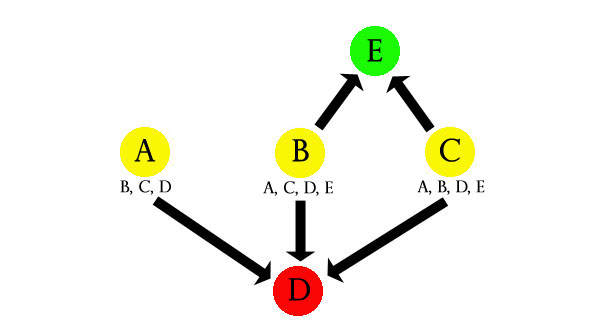
Node-Based Scenario Design - Dead Ends

In this example, node E is a dead end. Clues at nodes B and C suggest that it should be checked out, but there’s nothing to be found there. Maybe the clues were just wrong; or the bad guys have already cleared out; or it looked like a good idea but it didn’t pan out into usable information; or it’s a trap deliberately laid to catch the PCs off-guard. The possibilities are pretty much limitless.

The trick to implementing a dead end is to think of clues pointing to the dead end as “bonus clues”. They don’t count towards the maxim that each node needs to include three different clues. (Otherwise you risk creating paths through the scenario that could result in the PCs being left with less than three clues. Which may not be disastrous, but, according to the Inverse Three Clue Rule, might be.)

On the other hand, as you can see, you also don’t need to include three clues leading to a dead end: It’s a dead end, so if the PCs don’t see it there’s nothing to worry about.

Of course, if you include less than three clues pointing to the dead end then you’re increasing the chances that you’re prepping content that will never be seen. But this also means that the discovery of the dead end might constitute a special reward: Extra treasure or lost lore or a special weapon attuned to their enemy.

Which leads to a broader point: Dead ends may be logistical blind alleys, but that doesn’t mean they should be boring or meaningless. Quite the opposite, in fact.

In the same vein as dead ends, you can also use “clue light” locations. (In other words, locations with less than three clues in them.) Structurally such locations generally work like dead ends, by which I mean that clues pointing to clue light locations need to be “bonus clues” to make sure that the structure remains robust.

The exception to this guideline is that you can generally have a number of two-clue locations equal to the number of clues accessible in a starting node. (For example, in the layer cake structure diagram you have three nodes in the bottom layer with only two clues each because the starting node contains three clues. If there wasn’t a starting node with three clues in it, the same structure would have potential problems.)

LOOPS

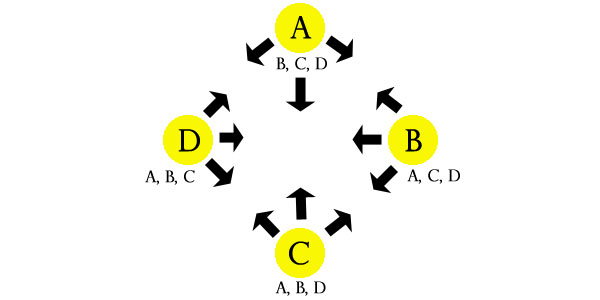
Node-Based Scenario Design - Loops

In this simple loop structure all four nodes contain three clues pointing to the other three nodes. The advantage of this simple structure is that the PCs can enter the scenario at any point and navigate it completely.

Obviously, this is only useful if the PCs have multiple ways to engage the material. In a published product this might be a matter of giving the GM several adventure hooks which can be used (each giving a unique approach to the adventure). In a personal campaign, clues for nodes A, B, C, and D might be scattered around a hexcrawl: Whatever clues the PCs find or pursue first will still lead them into this chunk of content and allow them to explore it completely.

Go to Part 8: Freeform Design in the Cloud

Archives

Recent Posts

Recent Comments

Copyright © The Alexandrian. All rights reserved.