The Alexandrian

Archive for the ‘Roleplaying Games’ category

Go to Part 1

#6. MAKE IT PHYSICAL

Handouts are a great way of conveying information for two reasons:

(1) Players love them. Give them a handout and they will sit up and take notice.

(2) Handouts are tangible and persistent.

If you tell the players something, it can go in one ear and out the other. Or be forgotten by the next session.

But if it’s a handout, then they have a constant reminder that the information exists. And if they forget a detail, they can just look at the handout again.

Although elaborate and detailed handouts will be more interesting and attract greater focus and attention, don’t get so wrapped up in the production values that you become reluctant to include the handouts. For example, I’ll rarely take the time to write out a letter by hand on a authentic-looking parchment…. but I’ll almost always type up the letter and hand it to them on a separate sheet of paper.


#7. MAKE IT REPETITIVE

We learn through repetition of information: Mention something once, we might remember it. Mention it again, the odds go up. Mention it several times, and our brains will generally identify it as notable information and file it away.

The problem with repetition is that it can also be very boring. Getting the same chunk of information dumped in their laps over and over again is not very interesting for the playerrs, and will eventually prompt a frustrated response: “Yes. All right. We get it already. Give it a rest.”

Now they know, but they still don’t care.

The trick is to figure out how to make each repetition of the information interesting in its own right. This is actually relatively easy to achieve by varying the type and content of the information.

For example, imagine that Bairwin Wildarson — a famous half-elven hero — has been placed in a stasis chamber somewhere deep beneath the surface of the earth. When the PCs find this stasis chamber you want it to be a major WOW! moment — as if they had just discovered Robin Hood. Obviously, for that to happen, the players need to appreciate just how famous and important Bairwin Wildarson is.

First, you might have the PCs start their adventures in the town of Bairwin — which was, of course, named after the legendary hero (Make It Personal). Perhaps, just to reinforce the point, some annual festival might be held by the village in the hero’s honor. The festival could even be disrupted by an attack by the Dark Fey (Make It Plot).

Second, after defeating the Ogre Crones in the Western Hills, the PCs might recover from their treasure hoard the sword that Bairwin famously lost early in his adventuring career (Make It Treasure).

Third, after raiding the Tower of Magentine Hues, the PCs might find an antique copy of The Adventures of Bairwin Wildarson — summarized by way of a handout (Make It Physical).

In many ways, this is just another variation of the Three Clue Rule, and it naturally works quite well with the Make It Mystery technique. In many cases you won’t even need to make the mystery explicit: As the players pick up various bits of information regarding Bairwin Wildarson, they’ll start trying to piece it together for themselves.


#8. BREAK THE RULES FOR EFFECT

If you heed this advice, then your campaign will start operating under a new paradigm. At this point, something interesting happens: Because you’ve eliminated the common occurence of McLecture the Scottish Elf, the players will suddenly be very interested when McLecture does show up. (If you handle it correctly, of course.)

For example, not that long ago I had an NPC in my Ptolus campaign deliver a page-long lecture regarding the history and lore of the Banewarrens. Rather than serving as a chance for my players to tune out, the event actually served as the dramatic culmination of an entire session. It was a taut and exciting cliffhanger.

What made it work?

(1) The Banewarrens were not an unknown quantity at this point. I had been dropping various hints regarding their existence and their importance over the course of the entire campaign. Because of this, the players had been looking for more information.

(2) Because I had been following the “rules” outlined above, the players weren’t used to getting more than little snippets of information. So when they suddenly got inundated with information they (a) drank it up like thirsty men at a desert oasis and (b) they knew it was a portentous and important event.

(3) I also laid the groundwork for that portentous atmosphere. The NPC delivering the lecture had been known to the PCs for a long time, but when she came on the scene to deliver the lesson in lore, she seemed like a very different person. They weren’t just hanging out in a bar and having a good time any more. This was important to her. And because she had become important to them, the fact that she considered it important carried weight.

So, like most rules, you need to know when to use them and you need to know when to break them. But it’s also important to realize that what makes breaking the rules so effective is the fact that you were using them before.
Go to Part 1

#3. MAKE IT TREASURE

Let me clue you into the Golden Rule of Gaming, by way of Ben Robbins:

Players pay attention when you describe treasure.

(See, it’s the Golden Rule because gold is treasure. Get it? Get it? … Okay, never mind.)

The one time you’re guaranteed to have everyone’s undivided attention at the gaming table is the moment when you’re opening the goody bag and getting ready to distribute the goodies.

Want them to know about the ancient dwarven empire that ruled the surface world aeons ago before the Dragon War forced them to retreat into their mountain citadels? Then let them find a cache of ancient dwarven coins with the Imperial motto “All that the sun shines upon shall be shaped by our forge” written upon them. Place the forgemark of the Greatfall Armories on the next magic sword they find. Give them a treasure map leading to the ancient ruins of a dwarven palace.

Sometime knowledge itself can be the treasure: Lorebooks, diaries, and the like can all be looted.

And sometimes you can use knowledge to boost the value of the treasure. For example, they might find a very nice tapestry worth a few hundred gold pieces. With a successful History check, however, they might recognize the tapestry as being a famous depiction of the Battle of the Firebane. Find the right collector, and the value of the tapestry has quintupled. Now the Battle of the Firebane isn’t just a bit of fluff text — it’s the reason they’re earning the big bucks.


#4. MAKE IT MYSTERY

Take your lore, break it down into a series of specific revelations. Then use the Three Clue Rule to liberally sprinkle your campaign with the requisite clues necessary for figuring out each revelation.

If the players have to struggle to figure something out, then they’ll focus on it. And feel a sense of accomplishment when they finally piece together the truth. Of course, this usually means that you’ll need to find some way of motivating them to figure it out. (Unless you’re lucky and have players who motivate themselves at the sign of any enigma.)

In many ways, making it a mystery is really just a specific way of making it short (by parceling the information into separate revelations) and making it plot (by providing the players with a motivation to figure it out).


#5. MAKE IT PERSONAL

Let’s return for a moment to Lord Dartmouth’s destruction of the village of Cairwoth. The event can be made instantly memorable if Cairwoth was the home town for one of the PCs… and their parents were slaughtered by Dartmouth.

Of course, making it personal for the PCs doesn’t mean it needs to be traumatic. Let the PCs find documents suggesting that they might be a direct descendant of the Silver Duke of Amartain, for example, and you’ve got a fairly good chance that they’ll lap up whatever information you choose to dish out about the Silver Duke.

These personal ties can arise during actual gameplay, but they can also be established during character creation.

In my campaigns, character creation tends to be a collaborative process:

(1) I’ll provide the player with my standard handout describing the campaign setting.

(2) The player will pitch me their character concept. This concept can range from the barebones (“I want to play a human wizard”) to the brief (“I’d like to play a barbarian from somewhere up north. I think it might be cool if my village was attacked by slavers.”) to the elaborate (a detailed, three page biography).

(3) I’ll take the concept and, using my greater knowledge of the setting, begin to flesh out the details. (If they tell me they want to play a barbarian, I’ll give them a specific tribe and provide them appropriate cultural and historical detail, for example.) My goal here is generally not to change the concept. I’m just working to help them realize the concept.

Most of this work is done via e-mail, and it’s not unusual for the character concept to get passed back and forth several times as we polish it up. Sometimes my suggestions will be completely off-base, at which point we go back to the drawing board and try a different approach.

But I digress. My point here is that this collaborative process of character creation can be used to establish information regarding the world. Maybe it’s something that will become important during the course of the campaign. Or maybe it’s just something that you find cool and feel like sharing. But, in either case, you’ve put yourself in the position where (a) the player will care about those details and (b) they’ll do the heavy-lifting in terms of sharing those details with the other players.

(Another tangent: Things don’t always go like you plan, of course. In one campaign, I thought I had gotten things setup so that one of the PCs (whose central character trait was the desire to learn secrets) was in a position to receive various pieces of secret lore. I thought I could use the character’s passion for learning secrets to funnel information into the campaign. The only problem? It turned out that the character liked to learn secrets… so that she could keep them. The information funnelled into the PC… and stopped there, creating a very different dynamic than I had anticipated.)

To be continued…

I think every GM probably has a story about the time that they spent hours carefully detailing some piece of lore or a particularly intricate conspiracy… only to discover that their players didn’t really care. Or you complete a dramatic and powerful series of adventures featuring the unraveling of a conspiracy wrought by the Dark Gods of Keht… but three months later you mention the name “Keht” and are met by blank stares from the players.

But often — even as you’re meeting with this kind of frustration — the players are still having a great time. They’ll tell all sorts of tales about the time that their characters did X… and do you remember that time that Y did Z?

In discussing this problem with other GMs, I’ve seen many of them come to the conclusion that players just don’t care that much about the game world. And that they never will. So don’t waste your time with all that world-building stuff — focus on statting up the next combat encounter.

Well, there’s a grain of truth in that. But I think it’s an over-reaction. While there may be players out there who really don’t care about that sort of thing, I don’t think that’s the general rule. I think if there’s a failure in processing, understanding, appreciating, and remembering these types of details, then the failure lies as much on the GM as it does the players (if not moreso).


#0. STOP PLAYING POKER

Are you sure you actually want the players to know what’s going on? Or are you subconsciously playing poker with them — keeping your cards hidden behind an implacable poker face reinforced with a GM’s screen?

This should almost go without saying, but based on what I’ve seen it needs to be said: If you want your players to know something, you have to make sure that you actually tell it to them.

I think we often slip into the trap, while plotting out conspiracies and mysteries, of forgetting that the PCs are actually supposed to figure it out eventually. GMs often wonder why their players don’t remember all the wonderful details they had worked out… when, in point of fact, the only way they could have learned those details was by secretly mastering the art of telepathy.

Hand-in-hand with this is a basic principle: Details which the PCs can never learn of or interact with aren’t worth wasting time on.

There may occasionally be times when you need to work up some sort of background detail to make the foreground details hang together. But whenever you find yourself designing a detail like that, I’d like you to ask yourself a few questions: Is there any reason why the PCs shouldn’t be able to learn this detail? And if they shouldn’t learn it, why are you designing it? It can’t be information necessary for the scenario to make sense (because if it was actually necessary, then the PCs should be learning it). And if it isn’t necessary and no one will ever know about it, why are you spending time on it?

For example, I was recently re-reading the Darkness Revealed adventure trilogy for White Wolf’s Trinity roleplaying game. I like the potential of these adventures a great deal, but large swaths of them are given over to describing the detailed activities and personal dramas of the NPCs. The PCs rarely have any way of learning about these dramas, which means that their experience while playing through this campaign is a little like the captain of the Titanic observing an iceberg — he’s only seeing the top 10% and the rest of it’s a wreck.

The other example I always think of when talking about this wrong-headed design approach is the Ravenloft adventure Touch of Death. I found this module in the public library when I was twelve or thirteen years old. I remember reading through it and thinking that it had a pretty amazing story… and then I realized that there was absolutely no way that the PCs playing through the adventure would ever see it. The entire thing dealt with an immense and ancient power struggle between legendary NPCs. The PCs had no way of learning the history of the conflict or even, in many respects, knowing that there was a struggle going on. If you played the adventure as written, it would consist of the PCs stumbling from one incomprehensible sequence of events to another.

These are extreme examples, but they impart an important lesson: If the players never see it, then it might as well have never happened.

And look at it from the opposite point of view: If you’ve got this really interesting bit of history or lore or back story that you’re developing… well, don’t you want the players to see it? Wouldn’t it be nice to share what you’ve created?


#1. MAKE IT SHORT

Okay, so you’ve developed the character background for Lord Dartmouth. This conniving fellow has a long history of Machiavellian murder and mayhem to his credit and you want the PCs to learn of his villainy (either because you want to motivate them to oppose him or it’s necessary information for stopping him or just because it’s interesting).

The first thing you have to remember is that the players have a short attention span. If you try to give them the entire history of Lord Dartmouth in a single sitting, they will tune out.

They’ll partly tune out because they don’t want to listen to a three minute monologue about some esoteric piece of lore that doesn’t mean anything to them. But they’ll also tune out because it’s actually not that easy to process and remember all of that information. Maybe if they were taking notes… but taking notes isn’t particularly fun for most people.

We’ll be delving into more specific methods for actually delivering the information. But regardless of the method you end up using, you need to focus on giving out small bursts of detailed information. This doesn’t mean that everything in the game needs to be simplistic — it just means that the players are more likely to process, remember, and care about complex ideas if they’re delivered in smaller and more comprehensible pieces.

In many ways this is also a more effective technique from a dramatic standpoint. Slowly revealing the big picture piece by piece is usually far more interesting than having McLecture the Scottish Elf explaining it all in a big lump.


#2. MAKE IT PLOT

Option 1: McLecture the Scottish Elf spends three minutes explaining that Lord Dartmouth was responsible for destroying the village of Cairwoth, explaining in detail exactly how the horrific destruction was carried out.

Option 2: The PCs go to Cairwoth and discover the tale of destruction for themselves — the scorch marks from the fireballs; the decapitated heads jutting from spikes; the mass grave; the diabolical laboratory of blood.

Players are more likely to remember things that they have done than things that they are told. Quests or missions can be particularly straight-forward ways to incorporate setting detail.

But please note that I said “plot” not “background”. The distinction between the two is subtle, but important. If the PCs get sent on a quest to deliver the Starfury Blade to the Elven Tribune of the Silverwood that doesn’t mean that McLecture the Scottish Elf’s five minute oration on the background and history of the Starfury Blade has suddenly become part of the plot.

In fact, about the only thing you can really hope for in that scenario is that the players will remember that there is something called a “Starfury Blade”. And even that might be hoping for too much because what they probably heard was, “Deliver the McGuffin to McGuffin Land.” Everyone loves a good McGuffin, but, much like McLecture, nobody really processes the content of one.

On the other hand, if during their escort mission the PCs are put in a position where the secret powers of the Starfury Blade were to manifest themselves and, thus, force them to engage in a conspiracy of bribes and cover-up to keep the details of that event secret from the Elven Tribune (who would be furious that outsiders have learned the secret of the blade)… well, now you’ve made the details part of the plot. The PCs will remember the powers of the blade and they’ll remember that the Elven Tribune wants to keep those powers secret.

Making something a part of the plot, however, doesn’t always mean making it a huge and convuluted affair. Here’s another example, this one drawn from my current campaign:

The PCs are seeking information that can be found in Alchestrin’s Tomb. As part of this scenario I want to establish some lore and history around the character of Alchestrin. One piece of information is that Alchestrin was the Third Lord of Castle Shard.

“Third Lord of Castle Shard.” That’s a title. Nothing is more likely to go in one ear and out the other than a title. (This isn’t just about RPG players, it’s pretty true in real life, too. For example, take a look at the full list of titles and honours belonging to Queen Elizabeth II. Did your eyes glaze over half way through? I thought so.)

But I can make that info part of the plot pretty easily.

Player 1: We need to find the location of Alchestrin’s Tomb.
Player 2: What do we know about him? I make a Knowledge (history) check.
DM: He was the Third Lord of Castle Shard.
Player 1: Let’s go to Castle Shard and see if they know.

Honestly, they probably still won’t remember that Alchestrin was the “Third Lord of Castle Shard”. But it’s very likely that they will, at the very least, remember that there was a connection between Alchestrin and Castle Shard.

(In reality, the PCs actually blew up my clever little scheme by independently involving Castle Shard in this sequence of events before they’d even heard the name Alchestrin. Ah well.)

To be continued…

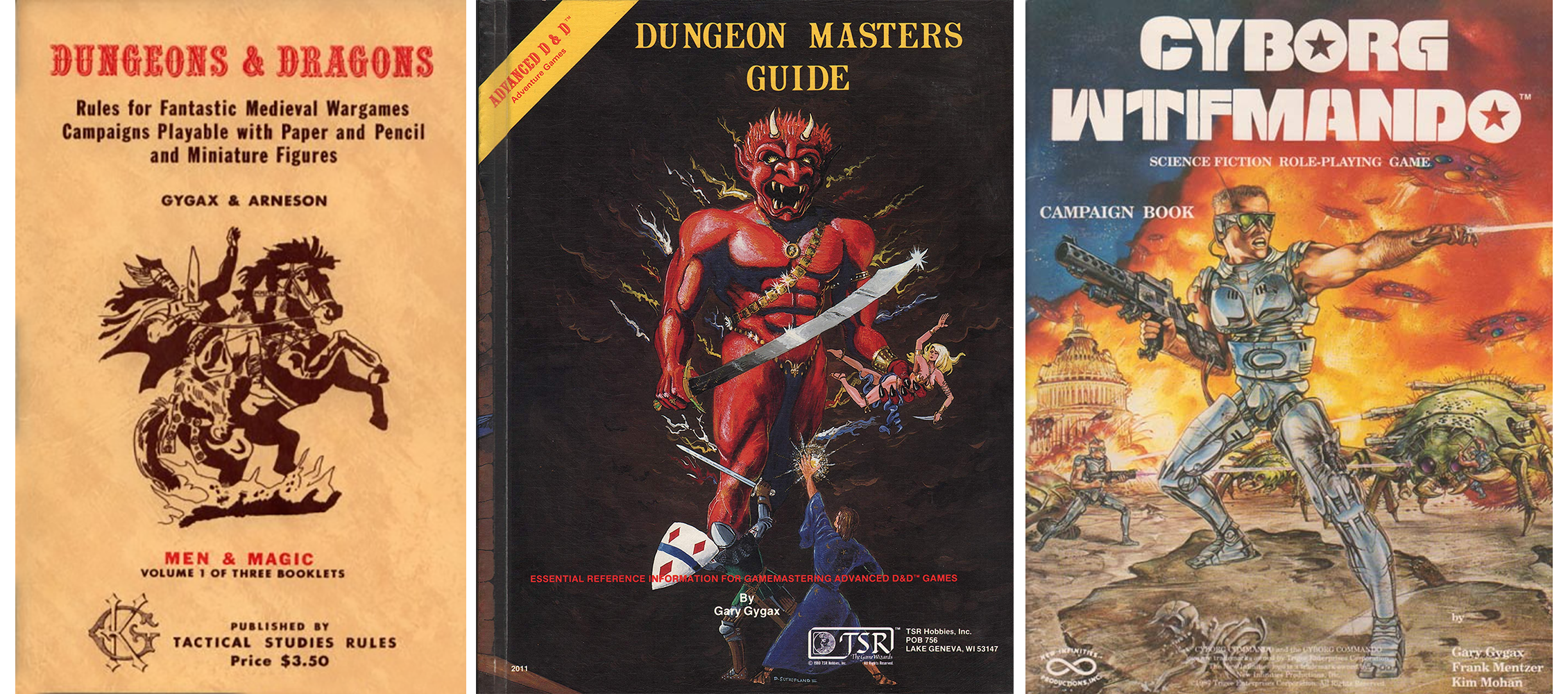
1974 D&D / AD&D 1st Edition Dungeon Master's Guide / Cyborg Commando

I mentioned earlier in this series of reactions that, while I respect and admire Gary Gygax for many reasons, that doesn’t change one simple truth:

He should never have been allowed to organize a rulebook.

Write? Sure. Like James Maliszewski (although perhaps not to quite the same fervent degree) I’m actually a fan of his prose and I find his style to be very evocative. But once he’s done writing, it’s time to call in the professional editors to clean up the mess.

Let me give you just two examples. First, from page 19 of Volume 1: Men & Magic, is the section “Level Above Those Listed”, which comes immediately on the heels of the various class progression tables:

Levels Above those Listed: Progressions of Dice for Accumulative Hits, Fighting Capability, and Spells & Levels may not be evident. An 11th level Lord would get 10 +3 dice and fight as he did at the 10th level; but at 12th level, he could get 11 + 1 dice and fight at Superhero + 2. At 13th level dice would be 11 + 3 with Fighting Capability at Superhero + 2. A 17th level Wizard would get 9 + 3 dice and fight as a 16th level, just as an 18th level Wizard would get dice of 10 + 1 with no change in Fighting Capabilities — the change coming at the 19th level, fighting then being done at Wizard + 3. An 11th level Patriarch would get dice of 7 + 3 with Fighting Capability unchanged; at 12th level dice would be 8 + 1 with no change in fighting; and at 13th level the Patriarch would get 8 + 2 and fight as a Superhero – the next change in Fighting Capability coming at the 17th level.

Spell progression for Magic-Users is: 17th level Wizard — 6, 6, 6, 5, 5, 5; 18th level Wizard — sizes across the board; and so on. Spell progression for Clerics is: 11th level Patriarch – 4, 4, 4, 3, 3; 12th level Patriarch — fours across the board; 13th level Patriarch — 5, 5, 5, 4, 4; and so on.

Umm… couldn’t you have just put that info on the actual class tables? I mean, you still didn’t bother to actually explain the methodology behind the progressions, so all you’ve accomplished is to take a big chunk of information and arbitrarily convey it through a different (and much more confusing) method.

The second example is the “chapter” dedicated to spell descriptions. And like every edition of the game except for 3rd Edition, the spells are grouped together according to their level.

Was there ever a less useful method of organizing that material? The only way to find the spell you’re looking for is if you’ve memorized the level of the spell. So you’re basically demanding people to achieve system mastery just to find information in the rulebook.

And then it stuck around for the next 25+ years as some sort of horrible “legacy”.

Admittedly, part of my objection here is philosophical. In organizing a rulebook you have to look at how that rulebook will be used. When it comes to roleplaying manuals, there are three uses:

(1) Learning the game
(2) Character creation
(3) Playing the game

Problems arise because these uses are not always compatible with each other. For example, organizing spells by spell level is useful for character creation because you want to quickly know which spells you can use to fill your available spell slots. On the other hand, it’s completely frakkin’ useless when you’re actually playing the game and trying to figure out how a particular spell works.

I believe that there are usually ways to structure the manual so that all three uses can be satisfied simultaneously. It can be difficult and sometimes it might mean repeating information, but it can almost always be done. And if push really does come to shove, then I think it’s better to favor utility in playing the game.

(Why? Because you spend more time playing the game than you do creating a character.)

As an example of how to do it right, you can look at 3rd Edition’s method for handling spells. There are spell lists which groups the spells together according to level (which provides the necessary utility for character creation), but then the spell descriptions themselves are completely alphabetical (which makes it easy to find the specific spell that you’re looking for). So you get the best of both worlds and full utility out of your rulebook.

(4th Edition, of course, promptly went back to doing it the stupid way. It doesn’t have spells, but they arranged all the powers by level.)

Back to Reactions to OD&D

The Levitz Paradigm was created by Paul Levitz, who has worked as a writer and editor at DC Comics since the 1970’s. The Paradigm itself is a rather straight-forward method for handling multiple ongoing plots in serialized storytelling (although the link I’m providing here would lead you to believe that it’s as complicated as neurosurgery).

I bring it up here because most roleplaying campaigns are, in fact, serialized stories with ongoing plot threads being carried from one session to the next. And I think the basic structure of the Levitz Paradigm can be usefully incorporated into the GM’s toolkit.

The Levitz Paradigm basically works like this:

(1) Plot A is your main plot. It will be the primary focus of attention during the current session.

(2) Plot B is your secondary plot. It functions as a subplot, getting some attention but not as much as Plot A.

(3) Other plots (C, D, and so forth) are given little or no attention.

(4) Once Plot A has been resolved, the other plots get promoted. Plot B becomes your new Plot A, Plot C becomes the new Plot B, and so forth.

(5) In order to avoid predictability, mix things up: Story X might remain Plot B for several sessions, while various other stories 1, 2, and 3 are all promoted to Plot A and resolved in the spotlight. Sometimes you might have two stories in the Plot B position. Or you can demote a plot from A to C, leaving it to simmer for a bit before moving it back into the spotlight. Or maybe in one session you have plots 1, 2, and 3 in the A, B, and C positions; but then in the next session you have plots 3, 4, and 6 in your A, B, and C positions.

USING THE PARADIGM

Basically, the use of the Levitz Paradigm gives you a simple organizational principle that you can use to keep track of multiple complex plots simultaneously. To do that, you just need to focus on doing two things:

(1) Keep a master list of all your active plot threads.

(2) For each session, know which plots are going to be your Plots A, B, and C (and so forth).

It’s dead simple in practice

Denny O’Neil (another DC editor) explains the appeal of the Levitz Paradigm: “Having three-plus stories running simultaneously is a small insurance policy against boring reads.” In a comic, this means that you’re basically upping your chances of any given reader being interested in at least one of the plots you’re currently developing.

The other appeal of the Levitz Paradigm is that it allows the writer to offer meaningful closure (by resolving their Plot A) without offering a convenient “jumping off” point from the title (because there’s always some sort of unresolved plot thread dangling out there).

The appeal of a similar paradigm in gaming is clear: The players are the audience and by simultaneously offering them several different ongoing plot threads, you make it possible to cater to each of them in different ways. And avoiding a “jumping off” point isn’t just about keeping people engaged (although that’s just as important in gaming as it is in serialized fiction), it’s also about maintaining a sense of pace and momentum.

THE PARADIGM WITHOUT PLOT

O’Neil goes onto say: “Another reason to employ the Levitz Paradigm requires us to step, gingerly from the practical to the philosophical. It seems to me that this storytelling method is the best imitation of life possible in a work of fiction. Life, you may have noticed, does not happen in parcels, but as a continuum.”

I’ve been using the word “plot” because that’s the terminology that comes baggaged with the Paradigm. But I think it’s important to note, given the important interactive nature of roleplaying games, that this method works just as well for managing scenarios in non-plotted campaigns: The choice of focus does not need to rest solely with the GM. While the players choose where to focus their attention, the GM can use the method to make sure that other important events, threads, and backdrops are kept in play.

Archives

Recent Posts

Recent Comments

Copyright © The Alexandrian. All rights reserved.