The Alexandrian

Archive for the ‘Roleplaying Games’ category

While some ivory scraps can be scavenged from the tusks of beasts, most ivory is mined. In an age long lost, behemoths trampled the land beneath feet which could crush the metropoli of this modern era. Their cylcopean corpses, buried now in vast elephantine graveyards beneath the surface of the earth, have left behind vast deposits of ivory.

The mines themselves are fantastical, but so are the crafts which this mined ivory allows. In the real world, one cannot find slabs of ivory as tall as a man (or taller). One cannot pave royal throne rooms with it. One cannot carve life-size statues from it. Nor can one marvel at the Ivory Palaces of the Seven Island Caliphates.

Stat Blocking with the Barghest

February 21st, 2011

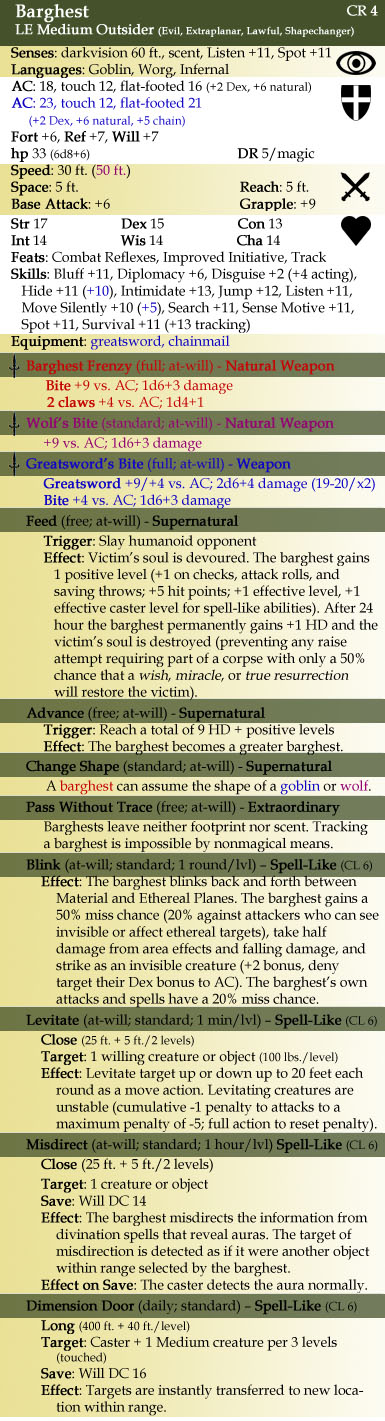
Jeffrey challenged me to a barghest stat block using the “3rd Edition rules; 4th Edition format” style I talked about yesterday.

As I mentioned to Jeffrey in the comments, the first thing I needed to do was fix the barghest: Designing a monster so that you need to apply new HD to it in the middle of combat is just bad design. Oddly, the designers of 3rd Edition knew this, which is why they included a negative level template (-1 on all checks, -5 hit points, -1 effective level, lose your highest level spell and your highest level spell slot). It seems pretty obvious to me that the way to fix the barghest is to reverse this template (as shown in the stat block below).

Jeffrey also made the point that 3rd Edition’s “laundry-list” of spell-like abilities can be difficult to make work with a 4th Edition-style stat block. I believe the trick of that is to simplify the spell descriptions down to “essential information”. (On the rare occasions when you need more detailed information on the spell, that’s when you crack open the reference manual.)

What really made me interested in rising to the challenge, though, were some thoughts I had on how the 4th Edition-style stat block could be used for shapechangers. Traditionally, I’ve simply gotten in the habit of prepping multiple stat blocks for shapechangers (so that when they change shape, I can just swap stat blocks). But I had some thoughts on color-coding that might make it possible to run them from a single stat block: The colors on the stat block below are coded to conditions described in the monster’s ability. (In this case, coded to different shapes.) The monster can only use colored abilities when the code is in effect (e.g., that shape has been assumed). Black text can always be used.

There are some formatting errors below, but the process I used to build these stat blocks is time-consuming to correct. (So I apologize for being too lazy to fix them.) I have concluded, in retrospect, that supernatural and spell-like abilities should be coded to icons to further clean-up the lay-out, but that hasn’t been executed.

Barghest - 4th Edition Style Stat Block

UPDATE: And since I’ve got too much time on my hands, here’s a balor:

(more…)

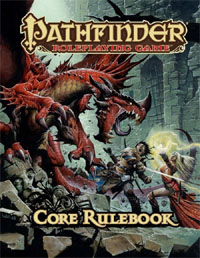
Pathfinder RPGYesterday I talked about Robert J. Schwalb’s theory that 4th Edition’s formatting was a barrier for players of 3rd Edition.

It is interesting to note, however, that Schwalb is not the only designer from Wizards publicly trying to figure out what went wrong in converting 3rd Edition players into 4th Edition players. Earlier in the week, Mike Mearls actually argued for genericizing the D&D trademark in the name of recognizing that D&D isn’t a game, but rather an experience that we all share regardless of which rules we use. (Or possibly he’s arguing that it doesn’t matter what we’re playing, as long as it has the “Dungeons & Dragons” trademark on it. The essay is a little vague in its kumbaya.)

Ultimately, of course, the problem is that they had a specific game that had been revised multiple times but maintained its core gameplay from 1974 to 2008. And then, in 2008, they stopped selling that game. Until they accept that, they aren’t going to find the solution they’re groping for. (To be fair, even if they do realize that this is the problem, there’s not much they can do about it: Publishing a new edition any time before at least 2015 would completely poison their market. And writing off the development costs of the DDI as a loss by obsoleting the current platform would basically amount to corporate malfeasance.)

NEW vs. CLASSIC

The comparison to “New Coke” is often made here, but it’s not entirely apt: This is more akin to the Coca-Cola Corporation giving its original formula to somebody else before stopping their own production of it and then using the “Coke” trademark for New Coke. The result was completely predictable: WotC kept the people who were loyal to the trademark and they kept the people who prefer New D&D to Classic D&D. They lost everybody else.

How bad is it? Well, there are multiple reports that Paizo’s Pathfinder is either tying or beating Wizard’s 4th Edition sales. If Pathfinder represented the totality of 3rd Edition players who didn’t migrate to 4th Edition, that would still be bad news for Wizards. But, of course, Pathfinder doesn’t. How many 3rd Edition players are just continuing to play with their existing 3rd Edition manuals?

(It would be nice to imagine that Pathfinder‘s success can be attributed to the RPG market simply growing, of course. But there doesn’t seem to be any evidence for such a massive increase in the market.)

WHAT WENT WRONG
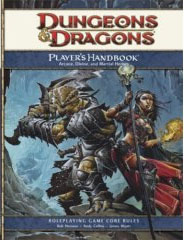
Player's Handbook - 4th EditionWhen consumers are faced with an upgrade, there’s always going to be some portion of the customer base that says, “Nah. I’m good with what I’ve got.” (This applies beyond RPGs: Look at the varying success of Windows Vista and Windows 7 at winning over existing Windows customers.) In the case of D&D, the two most effective transitions in the history of the game were the transition from OD&D to AD&D and the transition from AD&D2 to D&D3.

In my opinion, both of those transitions were effective because (a) they addressed perceived shortcomings in the existing rules; (b) they worked to form a bridge of continuity between the old edition and the new edition; and (c) they were effective at reaching out to new customers.

Now, the actual methods by which these goals were accomplished were radically different. AD&D (a) aimed to codify a more “official” version of the game while also expanding the detail of the rules in an era when “more realism” and “more detail” were highly prized. It was launched with a Monster Manual that was (b) designed to be used with the existing OD&D rules (by the time the first PHB came out, a sizable chunk of the customer base was already using AD&D products in their OD&D games). And it was released hand-in-hand with a Basic Set that (b) remained highly compatible with the 1974 ruleset and (c) offered a mainstream, accessible product for attracting new customers.

D&D3, on the other hand, (a) radically revised a game that was perceived as clunky and out-of-date, which allowed them to (c) reach out to a large body of disillusioned ex-customers. They simultaneously (b) released conversion guides and used a massive, public beta testing period to get large numbers of existing players onboard with the changes before the game was even released.

The conversion to D&D4 failed for several reasons.

First, no effort was made form a bridge between the old edition and the new edition. (A crazy French guy screaming “Ze game remains the same!” like some sort of cultic mantra notwithstanding.) In fact, WotC went out of their way to insist that there was no bridge between the editions.

Second, WotC was attempting to reach out to new customers. But I maintain that they made the fundamental mistake of trying to pull customers away from video games by competing with video games on their own turf. That’s just not going to cut it. If RPGs are going to be successful in the future, it will be because they emphasize their unique strengths. Tactical combat and prepackaged My Perfect Encounters(TM) aren’t going to cut it.

Finally, 2008 was misidentified as being another 2000.

In 2000 WotC was dealing with an overwhelmingly dissatisfied fanbase and responded with a new edition that largely addressed that dissatisfaction without overstepping the boundaries of its “mandate”. It wasn’t perfect. Plenty of people remained dissatisfied (or hadn’t been dissatisfied in the first place). But there were also a lot of people saying “3rd Edition looks just like my house rules for AD&D” or “it’s exactly what I’ve always wanted D&D to look like”, and success followed.

In 2008, I think it’s clear that WotC thought they had a similar level of overwhelming dissatisfaction. But either they didn’t or their sweeping and fundamental changes to the game exceeded the “mandate” of that dissatisfaction. Or both. (Personally, I suspect they were misled by the echo chamber of the ‘net and a corporate decision to prevent OGL support for 4th Edition. They tried to solve “problems” that most players weren’t actually experiencing and simultaneously “fixed” them in an unnecessarily excessive fashion.)

In some ways this takes us back to the “New Coke” metaphor: The taste tests for New Coke indicated it would be a huge success. But the taste tests were fundamentally flawed: They were “sip tests”. And in sip tests the smoother, sweeter taste of New Coke won. But nobody buys their soda by the teaspoon; they buy it by the can.

4th Edition radically overhauled D&D’s gameplay in order to respond to complaints driven by CharOp specialists, armchair theorists, and other lovers of spherical cows. For a lot of people on the ground, the game didn’t have those problems and 4th Edition was a solution in search of a problem.

THE OGL AND SRD

WotC’s corporate culture had clearly turned against the OGL by 2008. They no longer saw a massive network maintaining interest in their game and generating new customers who were all funneled back into their core products. Instead, they saw an entire industry profiteering on their IP.

The argument of whether or not WotC was right or not can be saved for another time. (Although I will note that every scrap of evidence I’ve seen indicates that the strategy works both in the RPG industry and outside of the RPG industry. D&D3, Pathfinder, and the OSR community all seem to have flourished under it as well.)

But given the existence of the OGL, the decision to stop making Classic D&D and start making New D&D was a disastrous one. The goal appears to have been to create an edition with enough fundamental incompatibility that the OGL couldn’t be used to support it, but the practical effect was to leave the largest network of material supporting an RPG in history all pointing towards a giant void.

A void into which it was absolutely trivial for someone to step.

THE MISSED OPPORTUNITY

My biggest regret is that I feel WotC missed an opportunity. There are, in fact, some significant problems with 3rd Edition.There are key abilities in 1st to 10th level play (polymorph, for example) that need to be fixed. And from 12th to 20th the game begins to crack and then break down. These problems require an overhaul of the basic foundations on which the game is built.

It is, however, possible to fix these problems without nuking the core gameplay which has been successful since 1974.

WotC chose the nuke option.

Meanwhile, Paizo couldn’t make those changes with Pathfinder while simultaneously stepping into the void vacated by WotC.

That’s the missed opportunity here: WotC had the chance to polish and improve Classic D&D; to take the next step with the game. Instead, they side-stepped and gave us New D&D instead.

Looking ahead, I think the time period right around 2014-2015 will be potentially very interesting: WotC would be able to theoretically roll out a new edition, and the question will be whether they’ll stick with improving New D&D or if they’ll try to revert to Classic D&D. (Or do something else entirely.) Meanwhile, if Paizo continues to solidify (or even build) their market share, then right around that same time they’ll potentially be in a position to attempt a 2nd Edition of Pathfinder that can be more radical in its efforts.

On the other hand, maybe not. The emerging long-tail economics combined with open licensing may mean that no revision of the 3rd Edition ruleset will ever be able to break 3rd Edition’s network of players and support material. The D&D trademark might have been able to do it in 2008, but in decoupling the D&D trademark from Classic D&D WotC seems to have created a massive player base that no longer has any loyalty to that trademark. The horse may have left the barn for good.

Does Format Matter? (A Response)

February 20th, 2011

Robert J. Schwalb has a post hypothesizing that 4th Edition would have been more widely accepted if it had been formatted differently.

Fourth edition’s presentation abandoned nearly everything familiar about the game’s look. Eight years of 3rd edition, I think, created strong expectations about how the game should read and since the game didn’t match the visual expectations, it certainly must not match the play experience.

He goes on to argue that 4th Edition wasn’t as big of a shift from D&D if you compare it to the proto-4th Edition supplements being published by Wizards in the last couple years of 3rd Edition (Tome of Battle, for example). This is true. But I think Schwalb is ignoring the fact that their proto-4th Edition supplements were bringing with them proto-4th Edition critiques even before 4th Edition was released.

Schwalb also includes a PDF of what 4th Edition powers might have looked like if they’d been formatted more like 3rd Edition spells and asks, “I wonder if those changes might have been more palpable had we shifted back toward the old presentation, even if doing so meant that the game would be harder to learn.”

I doubt it. Oh, I’ve seen some people comparing the new powers format to Magic: The Gathering cards and the like. But when you dig down into the real complaints people have about 4th Edition they tend to be either dissociated mechanics, abandoning the traditional D&D gameplay that existed from 1974-2008, dissatisfaction with the “miniatures are mandatory” combat, or some combination thereof.

Personally, I think 4th Edition has some great formatting. I’ve been completely sold on the idea that monster stat blocks should contain all the rules for running the monster since at least 2000 (when my earliest adventure prep notes for 3rd Edition prominently featured monster stat blocks modded to do just that).

So count me down pretty firmly in the camp of “I like the format, I don’t like the rules”.

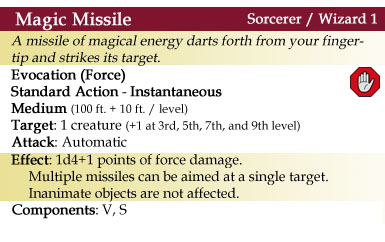
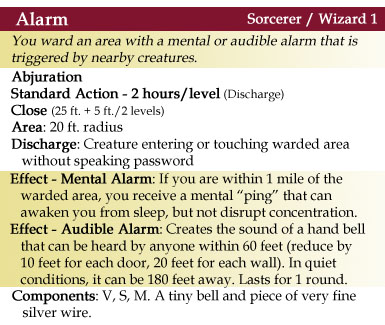
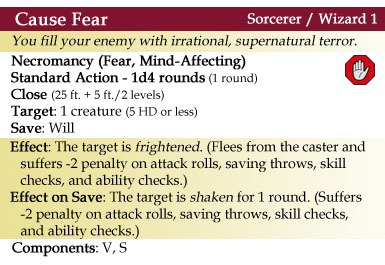
And to that end, consider this small sampling of 3rd Edition wizard spells formatted with 4th Edition stylings:

Magic Missile Spell - 4th Edition Style

Alarm Spell - 4th Edition Style

Cause Fear Spell - 4th Edition Style

(The red hand indicates that spell resistance applies.)

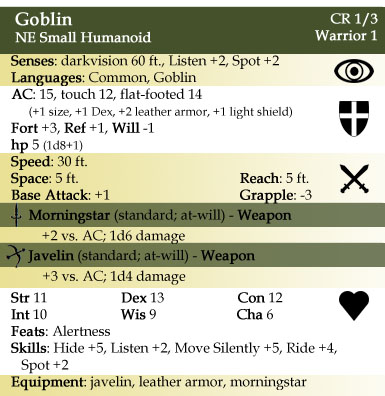
And here’s a 3rd Edition Goblin using a 4th Edition styled stat block structured similarly to my own revised stat blocks:

Goblin - 4th Edition Style

I doubt that such formatting would really have been a turn-off for anybody. (In fact, Paizo’s reformatting of spells for Pathfinder spells is not terribly dissimilar, albeit slightly more conservative.)

In fact, let me go one step further: Schwalb hypothesizes that 4th Edition might have been hurt by its radical formatting shift. I think the opposite is true. I think 4th Edition’s superior formatting has attracted people who would otherwise have stuck with 3rd Edition. Significant chunks of the utility 4th Edition gets praised for (like including all of the rules necessary for running a monster in the monster’s stat block) is stuff that can just as easily be done in 3rd Edition.

On the Slaying of Spherical Cows

February 17th, 2011

A couple years ago I talked about the way in which “modern” encounter design had crippled itself by fetishizing balance, resulting in encounters which were less flexible, less dynamic, and less interesting. This trend in encounter design has, unfortunately, only accelerated. More recently, I’ve started referring to it as My Precious Encounter(TM) design — a design in which every encounter is lovingly crafted, carefully balanced, painstakingly pre-constructed, and utterly indispensable (since you’ve spent so much time “perfecting” it).

Around that same time, I was also talking about the Death of the Wandering Monster: The disconnect between what I was seeing at the game table and the growing perception on the internet that wizards were the “win button” of D&D. Even a casual analysis indicates that the “win button” wizard only worked if you played the game in a very specific and very limited fashion. Given all the other possible ways you could play the game, why were people obsessing over a method of substandard play that was trivially avoided? And, in fact, obsessing over it to such a degree that they were willing (even desperate) to throw the baby out with the bathwater in order to fix it?

The root problem which links both of these discussions together are the Armchair Theorists and CharOp Fanatics.

Now, let me be clear: Good game design is rooted in effective theory and strong mathematical analysis. Any decent game designer will tell you that. But what any good game designer will also tell you is that at some point your theory and analysis have to be tested at the actual gaming table. That’s why solid, effective playtesting is an important part of the game design process.

The problem with Armchair Theorists is that their theories aren’t being meaningfully informed or tested by actual play experiences. And the problem with CharOp Fanatics is that, in general, they’re pursuing an artificial goal that is only one small part of the actual experience of playing an RPG.

Among the favorite games of the Armchair Theorists is the Extremely Implausible Hypothetical Scenario. The most common form is, “If we analyze one encounter in isolation from the context of the game and hypothesize that the wizard always has the perfect set of spells prepared for that encounter, then we can demonstrate that the wizard is totally busted.”

Let’s call it the Spherical Cow Fallacy: “First, we assume a spherical cow. Next, we conclude that cows will always roll down hills and can never reach the top of them. Finally, we conclude that adventures should never include hills.”

Ever seen the guys claiming that wizards render rogues obsolete because knock replaces the Open Locks skill? That’s a spherical cow. (In a real game it would be completely foolish to waste limited resources in order to accomplish something that the rogue can do without expending any resources at all. It’s as if you decided to open your wallet and start burning $10 bills as kindling when there’s a box of twigs sitting right next to the fireplace.)

Another common error is to implicitly treat RPGs as if they were skirmish combat games. Ever notice how much time is spent on CharOp forums pursuing builds which feature the highest DPS (sic)? Nothing wrong with that, of course. But when you slide from “this is a fun little exercise” to believing that a class is “br0ken” if it doesn’t deliver enough DPS, then you’re assuming that D&D is nothing more than a combat skirmish game.

Another variant is Irrational Spotlight Jealousy. A common form of this is, “The rogue disables the trap while everyone sits around and watches him do it.” (In a real game, traps are either (a) more complicated than that and everyone gets involved or (b) take 15 seconds to resolve with a simple skill check. The idea that a game grinds to a halt because we took 15 seconds to resolve an action without everybody contributing is absurd.)

Then there’s the Guideline as God, which becomes particularly absurd when it becomes the TL;DR Guideline as God. This is the bizarre intellectual perversion of the CR/EL system I described in Revisiting Encounter Design in which the memetic echo chamber of the internet transformed some fairly rational guidelines for encounter design into an absolute mandate that “EL = EPL”. (For a non-D&D example, consider a recent thread on Dumpshock which featured a poster who considered the statement “when a corporation or other needs someone to do dirty work, they look to the shadowrunners” to be some sort of absolute statement and was outraged when a scenario included a corporation performing a black op without using shadowrunners.)

And when these fallacies begin feeding on each other, things get cancerous. Particularly if they become self-confirming when designers use their faulty conclusions as the basis for their playtests. Playtests, of course, would ideally be the place where faulty conclusions would be caught and re-analyzed. But playtests are like scientific experiments: They only work if they’ve been set-up properly.

For example, 4th Edition suffers as a roleplaying game because so much of the game was built to support the flawed My Precious Encounters(TM) method of adventure design. Proper playtesting might have warned the designers that they were treating 4th Edition too much like a skirmish combat game. But unlike the playtesting for 3rd Edition (in which playtesters were given full copies of the rules and told to “go play it”), the reports I’ve read about 4th Edition playtesting suggest that the majority of playtesters were given only sections of the rules accompanied by specific combat encounters to playtest. Such a playtest was designed to not only confirm the bias of the design, but to worsen it.

(Not a problem, of course, if you believe that D&D should be primarily a skirmish combat game.)

Personally, I think it’s time for a slaughtering of these spherical cows. Neither our games nor our gaming tables are well-served by them.

Archives

Recent Posts

Recent Comments

Copyright © The Alexandrian. All rights reserved.