The Alexandrian

Archive for the ‘Roleplaying Games’ category

Dice of Destiny

March 3rd, 2011

This article was written in 1999 and originally published in Pyramid Magazine.

Dice of DestinyAll roleplaying systems have a method of resolving action. Most use dice to check against a numerical value in one fashion or another to determine the success or failure of those actions. Few systems, however, provide any framework for interpreting those successes and failures.

This lack is surprising. The roleplaying experience relies entirely on the ability of the Game Master and players to communicate the reality of a fictional world and the characters therein as believably as possible. The real world, and the vast majority of worlds of fiction, do not exist in a binary fashion – when Conan swings his sword he does not “hit” or “miss”, he “swings his mighty blade and with thews of steel crushes the skull of his hapless captor” or “brings his sword about in a massive sweep, narrowly missing his hastily retreating opponent”.

Yet, beyond some mumbling of how a “higher margin of success means the character has had a greater success than if he had succeeded by a slimmer margin” roleplaying systems on the whole do not provide any intuitive clues for the GM to describe the outcome of a resolved action to his players.

This article attempts to rectify this lack by providing a meta-system – a system which can be applied to many different systems. In this case, any system which uses more than a single die for action resolution. It is not an attempt to “lock” GMs or players into an unalterable scheme of description, however. The system is designed to provide more than the crudest outlines of exactly how success was achieved, but it attempts to supplement, not usurp, the creativity of the play group.

OVERVIEW

Before looking into what this new system consists of, let us first look at what is provided by the action resolution systems typically found in most current games.

Any action resolution mechanic must provide, at a minimum, two degrees: A success and a failure for any action attempted under its auspices. Many of these systems, whether they acknowledge it or not, also contain a simple evaluation of how “well” or “badly” the success or failure of the action was. This takes the form of a “margin of success” or a “margin of failure”. In short, the greater the difference between the number you wanted to roll and the number you did roll the better the success or the worse the failure. If, for example, you needed to roll at least a 10 on 3d6 to succeed and you roll a 16, the GM would conclude that your character easily succeeded at what he was attempting to do. On the other hand, if you rolled exactly a 10, he might make your success much more slim – instead of clearing the canyon with room to spare, the character’s foot hits right on the edge and he teeters for a moment on the edge of balance before, finally, stumbling forward.

And this is where the vast majority of resolution systems stop – which is good in itself, but incredibly limiting. The GM is left with a vast void to fill in describing the outcome of actions. When confronted with a system which doesn’t even possess a margin of success, the GM is left with the arduous task of attempting to reconstruct a Picasso painting from a black and white sketch – and even with a margin of success you’ve barely established a grayscale.

What’s missing? In short, the GM knows that you succeeded or failed – and the margin by which you did so – but why did you succeed or fail? What form did that success or failure take? If you succeeded exceptionally, why? If you failed marginally, why? Should a marginal failure ever be catastrophic? Marginal success be akin to slight failure?

The system proposed in this article fixes these problems by giving the GM a wider grasp of what effects led to the success or failure of the PC. Beyond the simple margin of success involved, implementing this system will tell the GM a great deal of information on any number of topics on which he wishes to seek more guidance: How much time was required to accomplish the action? Was it bad luck or a lack of skill that caused a failure? Even a simple hit location system is provided for games without them – without adding a single die roll!

The only proviso to this system is that the resolution mechanic of the system in question must use more than one die. A GM using a percentile system should use 2d10 for percentile dice (instead of a single d100). A GM using a single die system will not be able to use the system found in this article without modification to his resolution mechanic. GMs whose resolution mechanic uses different types of dice (a d20 and a d6 together, for example) may also need to make a few modifications to the system in this article before it functions smoothly.

In short, each die roll is assigned a different quality. To keep track of the different dice, each die should be a different color or have some other form of easy identification mark. Making the decisions after rolling about which die represents which quality doesn’t help the GM at all.

After assigning desired qualities to the dice of his resolution mechanic, the GM then analyzes each roll. The die which is “best” (for success) or “worst” (for failure) had the most influence on the outcome.

For example, if the die which has been assigned the quality of “Time Required” is rolled with the best result, then the action took very little time. If, on the other hand, it was a comparatively poor result, then the action took more time. Quickly might be “an hour” for fixing a car, of course, and a long amount of time might only amount to a couple of minutes instead of a few seconds when picking a lock.

The GM should never feel bound to the results of the dice in describing what happened, nor should the players attempt to point to this system and “force” desired outcomes. The system is designed to be a guideline to feed the creative impulses, not a straitjacket to strangle them with.
Continued…

When encountering a hostile force, a group of PCs can:

  1. Fight
  2. Avoid
  3. Flee
  4. Negotiate
  5. Trick
  6. Suborn
  7. Call Reinforcements

First Thought: When you’re designing a scenario, just give a couple seconds of thought to how a group of NPCs might react to each stratagem. If something particularly clever occurs to you, jot it down and perhaps restructure the scenario to better support it.

Second Thought: When NPCs encounter a hostile force (i.e., the PCs) they can have the same reactions. Think about it.

Untested: Inspiration Points

February 28th, 2011

One potential mode of “old school” play is the idea that “everybody starts at 1st level”. Combined with each class having a separate experience chart table, individual experience awards, and open gaming tables it was pretty typical for adventuring parties to have a pretty wide variance in their levels. This, of course, isn’t “balanced“, so it’s come in for a good deal of scorn in the past couple of decades. Most groups today allow new characters to be rolled up using the party’s current level and keep everybody in lock-step through unified XP awards.

(My Ptolus group, however, has experienced a 1-3 level variance due to a variety of reasons. I have not found this be inherently traumatizing.)

Having played a megadungeon OD&D campaign for awhile now, however, I’ve found that there are a few mitigating factors in practice:

First, the open gaming table combined with super simple character creation results in everybody running a “stable” of characters. They can self-select whichever character is the best match for the current group or roll up an entirely new character depending on whatever is most appropriate.

Second, due to the lethality faced by 1st-level characters, players rolling up new characters want a couple higher level characters to accompany them. It greatly increases the odds of survival and the pace of advancement.

Third, it doesn’t actually take that long to “catch up”. For example, in the time it takes a 5th level fighter to reach 6th level, a 1st level fighter will reach 5th level. (And will catch up and become 6th level before the more experienced fighter reaches 7th.)

With all that being said, I’ve been giving some thought on how you can make the level gap more palatable.

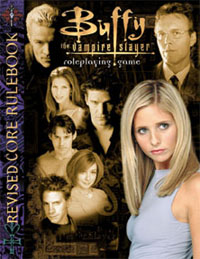
Buffy the Vampire Slayer - Roleplaying GameIn Eden Studio’s Buffy the Vampire Slayer roleplaying game, they compensate for the power difference between the Slayer and the Scooby Gang by giving the weaker characters additional drama points. Could this be adapted? Let’s say lower level characters get +1 inspiration points per difference in level? (So a 3rd level character adventuring with 6th level characters would get 3 inspiration points to spend per session.)

Inspiration points are a dissociated mechanic, obviously, but they could represent all sorts of things: It’s the guy who’s inspired to greater heights by Superman’s example. Or picks up a few tricks from sparring with D’Artagnan. Or gets an assist from Bruce Lee during the melee. But, basically, you’re rubbing shoulders with some elite dudes and some of it is wearing off.

Mechanically, we could simply use the existing action point mechanics for 3rd Edition. Alternatively we could continue taking our page from Buffy and allow for an inspiration point to be spent much more significantly:

  • I Think I’m Okay: Restores half your lost hit points.
  • Righteous Fury / Time to Shine: +5 to all actions for the current combat.
  • Dramatic Editing: Actually alter the game world. (“Hey! There’s a secret door over here that leads us to the back of the goblin encampment!” “Good thing somebody dropped some holy water over here!”)
  • Back From the Dead: Return from the grave through resurrection, a clone duplicate, a long-lost twin, or whatever else strikes their fancy.

Some of these look like they would exceed my “tolerance threshold” for D&D. Others wouldn’t. Your mileage will almost certainly vary.

A few years ago Monte Cook posted an essay on his website called “Ivory Tower Game Design“. It raises some very important points, but over the years I’m afraid I’ve come to find it deeply annoying because whenever somebody links to it or quotes from it, I can almost guarantee you that they’re about to completely misrepresent the essay’s entire point.

What Cook basically says in the essay is, “Instead of just giving people a big toolbox full of useful tools, we probably should have included more instructions on when those tools are useful and how they can be used to best effect.”

But the vast majority of people quoting the essay instead snip some variant of “we wanted to reward mastery of the game” out of context and then go ape-shit because D&D3 deliberately included “traps” for new players.

The methods of selective quoting vary, but they all basically look something like this:

“Toughness [is] not the best choice of feat.”

OMG! WHY WOULD THEY INCLUDE A SUCKY FEAT LIKE THAT?

There are two problems with this.

First, the full quote is actually, “Toughness, for example, has its uses, but in most cases it’s not the best choice of feat.” And then the essay goes on to further clarify its meaning: “To continue to use the simplistic example above, the Toughness feat could have been written to make it clear that it was for 1st-level elf wizards (where it is likely to give them a 100 percent increase in hit points). It’s also handy when you know you’re playing a one-shot session with 1st-level characters, like at a convention (you sure don’t want to take item creation feats in such an instance, for example).”

In other words, Toughness is a special purpose tool. When used properly, it’s a useful tool. When used improperly, it’s a wasted feat slot. The designers felt like people should be smart enough to figure that out for themselves, but the point of Cook’s essay is that it probably would have been better to include more usage guidelines.

Which ties into the second problem. The larger fallacy here is the belief that you can allow for meaningful choice in any kind of complex system without having some choices be inferior to other choices. This is something I discuss with more detail in “The Many Types of Balance“, but the short version is that in order to achieve this faux-ideal of “every single choice is just as good as every other choice, no matter what combination of choices you make” you need to severely limit either (a) the flexibility of character creation, (b) the scope of gameplay, or (c) both. As a goal, it’s not only without value, but it will significantly cripple your game design. It’s like demanding that a2-a3 and the King’s Gambit both be equally valid openings in Chess.

So the next time you see someone misquoting Cooks “Ivory Tower of Game Design”, do us all a favor and link them here. Maybe it’s not too late to nip this bit of false truth in the bud.

In “Revisiting Encounter Design“, I make the argument that 3rd Edition plays better if you use old school encounter design. To briefly sum up:

  1. Design most encounters around an EL 2 to 4 lower than the party’s level.
  2. Feel free to use large mobs (10+ creatures) with an EL equal to the party’s level.
  3. Sparingly use encounters with an EL equal to the party’s level.
  4. Occasionally throw in an EL+2 or EL+4 encounter.

Using this encounter design results in faster combats (which means you accomplish more in a typical game session) and drastically reduces the likelihood of the 15 minute adventuring day.

This advice is not radically different from that provided in the 3.5 DMG, which suggests that encounters should be 30% with ELs lower than the party’s level, 50% with ELs equal to the party’s level, 15% with ELs 1-4 higher than the party’s level, and 5% with ELs 5+ above the party’s level. (Let’s call this the 30/50/15/5 ratio for easy reference.)

THE ANALYSIS

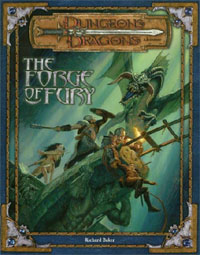
The Forge of FuryThis 30/50/15/5 ratio was not atypical in early 3rd Edition modules. For example, here’s the EL breakdown of combat encounters in the first section of The Forge of Fury (designed for a group of 3rd to 5th level characters):

EL 1
EL 2 (x7)
EL 3 (x3)
EL 4 (x4)
EL 5 (x4)
EL 10

If we use an average party level of 4th, this ratio breaks down to: 55/20/20/5. Not an exact match, obviously, but definitely within the ballpark of having 80% of your encounters equal to your lower than the party’s level.

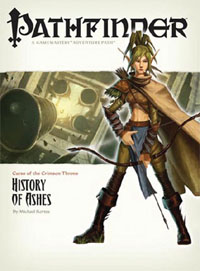
Curse of the Crimson ThroneBut as you look at modules published in the last 5-6 years, the misguided “common wisdom” of how to design encounters for 3rd Edition had taken hold. For example, here’s the encounter breakdown from part four of Paizo’s Curse of the Crimson Throne (designed for 10th level characters):

EL 8
EL 10
EL 11 (x2)
EL 12 (x2)
EL 13
EL 14 (x3)

That’s a ratio of 10/10/80/0. 80% of the encounters are now above the party’s average level instead of below it.

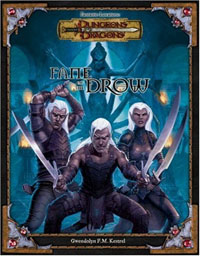
Fane of the DrowYou can see the same design principles in Wizard’s modules. For example, here’s Fane of the Drow (designed for 4th level characters):

EL 3
EL 4 (x4)
EL 5 (x5)
EL 6 (x5)
EL 7 (x2)

Which is roughly 5/25/70/0.

Similarly, here’s the breakdown from “The Demon Council”, the last section of Expedition to the Demonweb Pits (for 11th level characters):

EL 10 (x2)
EL 11 (x3)
EL 12 (x10)
EL 13 (x4)
EL 14 (x2)

Which gives us a ratio of 10/15/75/0. (This one looks a little better if you assume that the PCs are supposed to level up to 12th halfway through this sequence.)

THE TIP

A couple weeks ago, as I looked over my recent usage of published 3rd Edition scenarios, I realized that I’ve been instinctively using modules published in the last 5-6 years when the PCs are 2-3 levels higher than the recommended level.

For example, when you apply this guideline to the modules used above you end up with:

  • Curse of the Crimson Throne 4: 50/10/30/0
  • Fane of the Drow: 60/30/10/0
  • “The Demon Council”: 70/20/10

Which definitely slants them back into the ballpark of what we’re looking for.

Reflecting on this also taught me something new: The tips in “Revisiting Encounter Design” are designed to widen the dynamic range of your encounters. Shifting the recommended level for these published modules made me realize that we’re also widening the dynamic range of our adventure design.

Fane of the Drow, for example, isn’t unachievable for 4th level characters. But it is a tough slog. And if you use “tough slog” as your baseline for normalcy, then you have nowhere to go: If your 4th level characters face anything tougher than this, their odds of dying horribly begin to skyrocket. Which means that if your 4th level characters “skip ahead” or take an unexpected shortcut, they could easily run headlong into a deathtrap.

But if Fane of the Drow is, instead, your expected baseline for 5th or 6th level characters, suddenly you’ve got room to breathe.

And where would having room to breathe become particularly important? Node-Based Scenario Design.

Revising your approach to encounter design allows you to be more fluid and dynamic in how you run and combine your encounters; it also allows you be more fluid and dynamic in how you run and combine your scenarios.

Archives

Recent Posts

Recent Comments

Copyright © The Alexandrian. All rights reserved.