The Alexandrian

Archive for the ‘Roleplaying Games’ category

Are We Really This Stupid?

January 10th, 2011

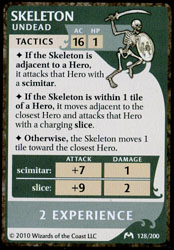
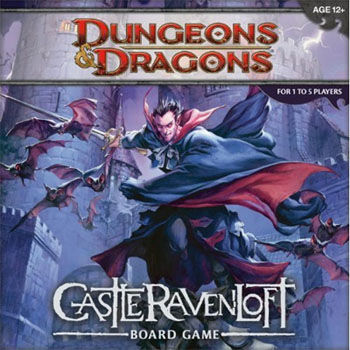
Castle Ravenloft - SkeletonAs I mentioned a couple days ago, the fun I’ve been having with the Castle Ravenloft board game has recently inspired me to read (or re-read) I6 Ravenloft and Expedition to Castle Ravenloft. This has put me in the rather interesting position of comparing all three. And this has, in turn, forced me to ask a simple question:

Are we really this stupid?

Let me expand on that a little bit.

The Castle Ravenloft boardgame is a dungeon-crawler without a Dungeon Master. Out of necessity, therefore, it is forced to provide a “program” for each monster in the game. When the monster is activated, it simply follows the program and takes the actions described. It’s a relatively simple mechanic which provides some interesting strategic wrinkles. (Since you know what the monster will do when presented with a given set of stimuli, you can exert some degree of “control” over them in a semi-prescient fashion.)

That’s all fine. But let me give you a sampling of the text from the boardgame:

Place the Start tile on the table. Place each Hero on a square adjacent to the stairway on the Start Tile. When a Hero reveals the Laboratory […] place Klak on the bone pile.

(…)

If the Skeleton is adjacent to a Hero, it attacks that Hero with a scimitar. If the Skeleton is within 1 tile of a Hero, it moves adjacent to the closest Hero and attacks that Hero with a charging slice. Otherwise, the Skeleton moves 1 tile toward the closest hero.

And here’s some text from Expedition to Castle Ravenloft (pg. 32):

Have the players place their figures at the end of the tile, with the single circle closest to them and the other two farther away. Place a figure for Balam in the close circle.

(…)

On its turn, each zombie moves from its starting position toward the closest enemy it can attack. A zombie behind a door opens it as part of its first move action.

Both carcass eaters attack the closest PCs. If an adjacent character drops to -1 hit points or fewer for any reason, a carcass eater uses its rend fallen ability.

Is there a reason why we’re treating modern Dungeon Masters as if they were only barely more competent than an inanimate piece of cardboard?

Are we really this stupid?

ISOLATED ENCOUNTERS

Expedition to Castle Ravenloft was one of the earliest adventures to use the “delve format”. But this isn’t just a matter of growing pains: This kind of “so prepackaged you can just turn off your brain” method of designing encounters has remained a staple of WotC’s adventure design right up through today.

Conceptually, there’s one thing I really love about the delve format: Putting everything you need to run an encounter area in the description of the encounter area. That just makes good sense. But in practice, the delve format suffers from two problems:

First, it artificially isolates the “encounter”. This tends to fatally sabotage the entire point of the delve format to begin with.

For example, take encounter E6 in Expedition to Castle Ravenloft:

This encounter takes place the first time the PCs enter this crossroads from any direction.

Tactical Encounter: E6: Ghoul Foray on page 38.

Development: These ghouls are not part of the necromantic infection, but an independent pack of undead taking advantage of the chaos. After venturing out of the cemetery (area E8), the ghouls are moving from house to house in search of valuables and still-living creatures. They are upset by the quick conversion of zombie victims to yet more zombies, but they are so hungry that they consume even the rotting undead. They lust for fresh corpses.

That information is, in my opinion, rather crucial for running the encounter. Attempting to isolate a tactical encounter from the context in which that tactical encounter occurs, in my opinion, results in a very choppy, ineffective style of play.

But even if you moved that information into the tactical encounter itself, the problem still wouldn’t be solved because encounters shouldn’t be taking place in a physical vacuum. For example, encounter E6 here takes place just one block away from Barovia’s church, which is encounter E7. What happens if the battle with the ghouls goes poorly and the PCs decide to retreat towards the church? Now I’m forced to go back to the adventure key, reorient the encounter within the context of the other geographical features around it, and then flip to the delve format presentation of E7 in yet another section of the book.

Rather than making it easier for me to find all the information I need, you’ve got me flipping back and forth through the module just trying to orient myself.

(Most of these problems were solved by Keep on the Shadowfell, which simply keyed the adventure to the tactical encounters. But after Keep on the Shadowfell, Wizards went right back to doing it the broken way they’d been doing it before.)

THE PERFECT ENCOUNTER

The other problem with the delve format, in my opinion, is that it tends to encourage the unproductive false idol of the “perfect encounter”. (Partly because it isolates the encounter and partly because the format inherently forces all encounters to be designed to the same specs.) Each of these encounters is designed to be “perfectly balanced” with monsters who have been pre-selected, pre-positioned, and pre-programmed.

This tends to limit flexibility. You’ve invested a lot of preparation into carefully arranging the “perfect encounter” involving goblin bombadiers and guard drakes scurrying about a half-excavated room:
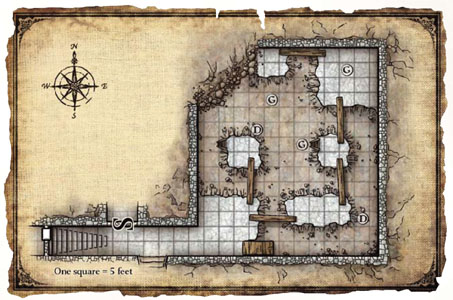
Keep on the Shadowfell - Goblin Excavations

But if you have those goblin bombadiers respond to a cry for reinforcements from the goblins just down the hall, you’re throwing all of that preparation away.

Plus, when you’ve put this much effort into prepping an encounter, you can’t just let the PCs avoid it.

And, to make a long story short, that’s how you end up with adventure modules which are just long, linear strings of isolated, prepackaged encounters.

ENCOUNTERS ON THE FLY

The counter-argument, of course, is that encounters shouldn’t be boring.

I couldn’t agree more.

But I don’t think we need to try so hard. I think when the original Ravenloft module reads:

The maid, Helga, is a vampire who will attack the PCs only when an opportunity to do so without having to fight the entire party presents itself. She also attacks if commanded to do so by Strahd. Helga will join the party, if asked to. She claims to be the daughter of a villager, cruelly forced into service of the Strahd.

We don’t need a pregenerated tactical map showing where Helga is standing in room K32 with accompanying text telling the DM to have the players position their miniatures within 10 feet of the door when it opens in order to have an interesting encounter.

I think publishers can put a little more trust in DMs (and, as DMs, we can put a little more trust in ourselves). So that when we ask the question–

Are we really this stupid?

–the answer can be, “No. We’re not.”

And maybe that means the goblin bombadiers don’t lay an ambush in their excavated chamber. Maybe it means that the PCs end up barricading themselves in that chamber. Or the goblins all retreat into that chamber. Or the PCs return to find animated goblin zombies have been stationed in that chamber as guards.

Once you remove the shackles of believing that the “perfect encounter” can be predesigned, you’ll be tapping into the strength of the RPG medium in creating encounters which are perfect for your gaming group because they were created by your gaming group.
Castle Ravenloft

January 7th, 2011

Castle RavenloftAs a roleplaying game, 4th Edition sure makes a great boardgame.

… Zing!

But in all seriousness, I’ve been looking forward to getting my grubby paws on a copy of the new Castle Ravenloft game for awhile now. For the better part of two decades now, I’ve been looking for a boardgame that could be played when you were in the mood for a little dungeon-crawling but didn’t have anyone to DM.

(Over the years I’ve dabbled with dungeon-crawling boardgames that require DMs, but I’ve pretty much sworn off them at this point. Descent is a decent game, for example, but I can’t imagine a scenario when I would ever play it: Since it requires a DM, I might as well just grab my copy of Dungeons & Dragons off the shelf. The full-fledged RPG is a richer and more rewarding experience in almost every way, and with the speed of OD&D character creation you can actually get the game set-up and start playing much quicker, too.)

Most recently, Munchkin Quest looked like it might fill that slot for me. It had some pacing issues, but after fixing those problems the game saw a couple months of intense use. But after that, the game started collecitng dust: The competitive aspect meant it still wasn’t quite scratching that dungeon-crawling itch. And it was too long (3-5 hours) given the relative shallowness of its gameplay. Way too many sessions ended with all of us wishing that the game would just end already.

Castle Ravenloft is pretty much at the opposite end of that spectrum: The prepackaged adventure scenarios all feel lightning fast and can easily be completed in 60 minutes or less. I’ve played it more than a dozen times already (having gotten it only a week ago). The real test, of course, will be whether or not the game endures after the first flush of excitement. But for the moment I wanted to talk about some of my first impressions.

RANDOM DUNGEON, BUT SHALLOW EXPLORATION

The game features a random dungeon construction: Individual puzzle piece tiles are laid out as your heroes explore the dungeon. The result can be quite tense at times as you cross your fingers against drawing a black tile (which results in a debilitating encounter being drawn), but very few of the tiles have any kind of special effect or meaningful identity in a given scenario.

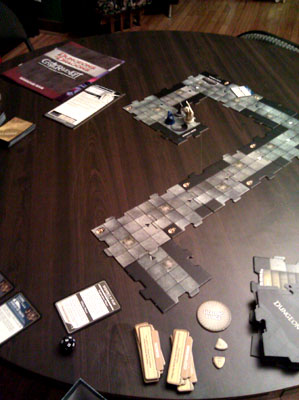
Ravenloft Play 1So while the game is more variable and interesting than dungeon-crawlers featuring pre-determined dungeon layouts, there’s also no sense of actually exploring the dungeon in most of the scenarios.
Similarly, because the dungeon layout is random it doesn’t really matter where you go: You virtually never hit a dead end, and at some point you will draw the location tile containing your goal for the given scenario.

Here’s a simple hack I may be trying in the near future: For scenarios involving the use of the special 1×2 Start Tile (which is most of them), start by forming a random 3×4 grid of face-down dungeon tiles with the Start Tile in the middle of them. Now take any scenario-specific tiles and shuffle them into a stack of random dungeon tiles to form a stack of 13 additional dungeon tiles. Deal these out randomly to form a face-down, 5×5 grid (including the original 3×4 grid). (For a longer game, form a 6×6 grid instead.)

TACTICS, BUT NOT AS WE KNOW THEM

Although Castle Ravenloft offers a setup superficially similar to 4th Edition, this can actually be quite deceptive. As a result, I’ve seen quite a few reviews complain that Castle Ravenloft doesn’t have any tactical depth.

Ravenloft Play 2This is not, strictly speaking, true: Castle Ravenloft does have tactical depth; it’s just a tactical depth that looks absolutely nothing like 4th Edition’s tactics.
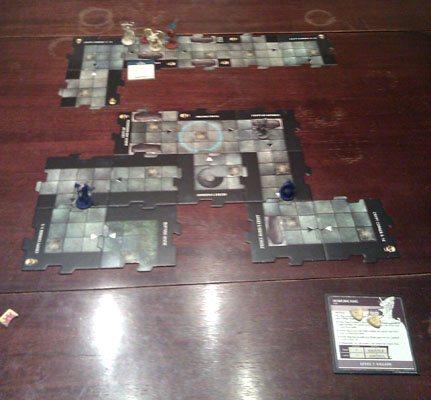
The primary tactical crux of Castle Ravenloft lies in the fact that heroes move by spaces but monsters by tile. (For example, a typical hero might move 5 spaces on their turn. A typical monster, on the other hand, will move 1 or 2 tiles.) Thus, the core tactics of the game revolve around managing the placement of monsters and heroes around the tile borders.

These basic tactics are complicated by the necessity to manage the monster’s control sequences; the panoply of variable hero abilities; and the random crises generated by a fair-sized chunk of the game’s encounter cards.

(The game may also suffer in the opinion of some because it’s very easy to brute-force your way through the early, introductory scenarios. It’s thus possible to completely ignore the tactics and strategy of the game and still pull out early victories, leading one to the false conclusion that the game has no strategy. In that respect it’s kind of the inverse of Settlers of Catan — a game which you think has a strategy when you first start playing it and then eventually realize is dominated completely by dumb luck.)

HORRIFIC RULEBOOK

The Castle Ravenloft rulebook is quite possibly the worst I’ve ever read. It’s poorly organized, fails to explain basic terminology, establishes other terminology which it then proceeds to use inconsistently, and then compounds all of these problems with an atrocious (lack of) organization. And given the relative simplicity of the rules, the experience of the designers, and the fact that the game is built on the back of a fairly well-established ruleset… well, it’s completely inexcusable.

It’s also disappointing that WotC failed to leverage their existing stock of high quality fantasy art to spice up the cards. The lack is particularly felt, in my opinion, when it comes to the treasure cards.

MONSTERS & SCENARIOS

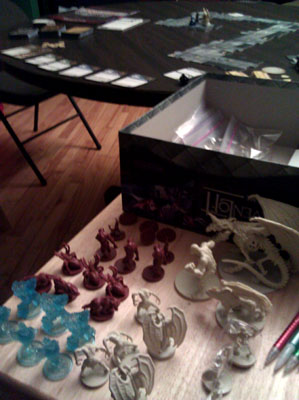
Ravenloft MonstersThe argument could certainly be made that it’s worth buying the game just for the 42 miniatures that come with it. I don’t think I’d disagree: Amazon is selling the game for $50 right now, so the price per mini comes out to about $1.20. Since that includes a Huge Dracolich, I’m pretty happy with it. (And that’s ignoring the general utility of the interlocking dungeon tiles.)

Laying that aside, I do wish the game had a bit more variety when it came to monsters. There are basically ten varieties of “grunt” in the game (zombie, skeleton, blazing skeleton, wraith, ghoul, wolf, kobold, spider, rat swarm, gargoyle) and you’ll see a lot of them all. While the varied scenarios are keeping much of the game fresh for me right now, the monsters have all become rather hum-drum.

Fortunately, this is an aspect of the game which is surprisingly easy to customize. Although game balance probably requires that you keep 10 different types of creature for each adventure, swapping them out for equally challenging monsters isn’t a problem. There’s a ton of fan-created monsters already available, and there are cheap D&D mini singles available all over the place.

Speaking of scenarios, the game comes with 12 (including two solo scenarios) and 2 more have been released through Wizard’s website. The scenarios are varied (often completely changing your strategic approach to the game) and have been easily supporting multiple play-thrus for me. For example, in this scenario:

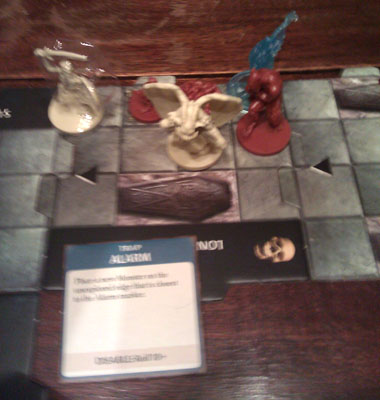
Ravenloft - Howling Hag Scenario

The heroes start play having been randomly teleported to different corners of the dungeon. You have to reunite with each other and shut down a demonic summoning while the villain of the piece continues to assault the heroes with teleportetic assaults.

(In the image above you can see where we’ve set off an Alarm trap — which summons additional monsters each round — in a section of the dungeon we were subsequently teleported out of. One of the (blue) heroes has been abandoned in a dead end corridor. And both of the heroes are dreading the possibility that the villain is going to teleport them back up to where all those monsters are waiting to devour them.)

But I do wish there were more of them. When I compare the relatively anemic number of scenarios offered by Castle Ravenloft to the dozens of scenarios offered by Betrayal at House on the Hill (another game I received this Christmas which features variable scenarios of roughly equivalent complexity), I do feel this was an opportunity missed by the designers.

FINAL WORD (FOR NOW)

Castle Ravenloft is fun.

I’m enjoying it a lot, and I keep roping in more and more people who all seem to agree.

It’s not perfect, but its only egregious flaw (the atrocious rulebook) is relatively easy to overcome.

Having just reviewed my early thoughts on Munchkin Quest, I realize that initial success may not translate into a permanent or even long-term success. But as I write this I’ve already gotten more than a dozen plays out of the game, and I’ve only touched half the scenarios it shipped with. A couple scenarios have already seen 4+ plays. Even if that’s where the game tops out, I’ll still get 40+ plays out of it. That’s pretty good compared to most of the games I own.

Go to Castle Ravenloft: Rulebook Woes

Biologies of the Fantastic

January 3rd, 2011

NASA Imagery

NASA has recently announced the discovery of a bacteria in Mono Lake by Dr. Felise Wolfe-Simon which uses arsenic instead of phosphorous for its phosphorylation.

This may not sound all that impressive at first glance, but what Wolfe-Simon has discovered is a little critter which uses a substance inherently poisonous to every other form of life on the planet as one of its most elementary building blocks. It’s literally an entirely alternate path by which life could potentially evolve (and even thrive) in environments which would be completely hostile to (most) terrestial life. (I’m radically summarizing here. For a better summary, follow the link.)

As a scientific discovery, this is interesting in its own right. And its potential application in science fiction (from alien lifeforms to the utterly transhumanic) is pretty obvious.

But reading about this discovery also tickled my brain into thinking about the deeper substrates of fantasy. Here’s a quick quote from the link:

Phosphorus plays an important biological role in the form of ATP (Adenosine triphosphate), which is a cell’s “energy currency.” ATP is key to metabolic functions, and works by activating structural proteins & enzymes through donating its phosphorus groups.
On the Periodic Table, arsenic sits directly below phosphorus (meaning, among other things, they have the same number of valence electrons). In humans & other forms of life, arsenic can be deadly, since it disrupts cellular respiration by competing with phosphorus & diminishing ATP formation.

An organism that uses arsenic in its biochemistry is “alien” to what is known, since it must have ATP-like molecules with arsenic swapped in phosphorus’ place and because they must have evolved mechanisms such that arsenic doesn’t kill them. All signs point to this announcement being tied to the work of biochemist Felisa Wolfe-Simon, who theorized in the past that the unusual ecosystem in California’s Mono Lake could have led some life to follow a different “evolutionary pathway.”

What other alien biochemistries could we imagine swapping into that process? Something alchemical? Something magical? Something celestial? Something other-planar? What pulses life through a migo’s cells or Cthulhu’s rubbery skin-substitute? What allows a dragon to process its food so efficiently?

This wouldn’t mean, of course, that dispel magic is going to automatically cause a dragon to cease to exist (any more than putting a plant in the shade will cause it to instantly wither). Such creatures might suffer from prolonged exposure to antimagic fields, but otherwise they’re probably fine. (Although we’d have to call into question fantasy’s prolixity for half-breeds.)

How could such life evolve? Well, it might arise naturally in a world permeated with magical energies. Or it might spawn from an artificial creation (perhaps even accidentally so). “Life will find a way” is hokey as science; but we’re not exactly dealing with science here: So when the animated rugs in the flying castle suddenly start mating with each other, we might not be quite as justified in our shock.

To a certain extent, of course, this has the danger of becoming “precious world-building”. (World-building that really has no meaningful impact on the game or narrative for which the world is ostensibly being designed.) How can we make this stuff actionable?

Stuff like Mitochondrial Eve from the Parasite Eve games suddenly begin to arise quite “naturally” out of injecting magical juju into your life cycle. Half-breeding could introduce a vector for infection and either explain ancient racist prejudices or justify fresh outbreaks of hate crimes and intolerance in your campaign world.

Literally incompatible biologies coming into conflict: The dark fey rising up out of the underdark aren’t just a threat to life and limb; their dark fairy circles are doing whatever the opposite of “terraforming” is. (Magiforming?) Cysts of alien, incompatible life spontaneously blooming in remote regions or incursions of malevolent extra-planar intelligences.

Why can’t we eat the monsters we’re killing? Because they’re fundamentally incompatible and indigestible. (“Don’t eat the demon-flesh, kid. It will fuck you up.”)

Did you know shadows weren’t originally undead in OD&D? They are something strange and other; something so utterly unnatural that our eyes can only perceive them as a living, tumescent absence.

All nature is a war. This kind of stuff just sort of firms up the lines of battle.

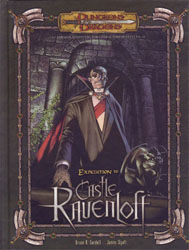
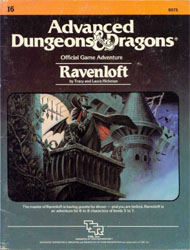
I6 RavenloftI’ve recently been reading my way through I6 Ravenloft and Expedition to Castle Ravenloft. Although I haven’t finished the latter, I am so far impressed with the way in which it remains faithful to the original module while expanding the material in interesting ways. (It even includes functional notes for stripping out the extra material in order to return the module to something very close to its original form if a shorter adventure is desired.) I am less impressed with the textual bloat which has become endemic in most modern adventure modules. Much of this text seems to be included in the name of being useful (reminding the DM of basic rules like how trip attacks are adjudicated), but it has the practical effect of making it more difficult to rapidly gloss the truly necessary information at the game table.

But I digress.

What really inspired this little post is the Weird Happenings table on page 15 of Expedition to Castle Ravenloft. It’s a nice little table, the first entry of which reads:

The sound of a voice screaming comes from somewhere in the castle; it sounds exactly like one of the PCs.

As I normally do when reading module text, I immediately visualized how I would handle that at the gaming table. It would go something like this:

1. Randomly determine the PC. (Let’s say a ranger named Afrau.)

2. Hand that player a note reading, “Write two sentences on this note and then hand it back to me.”

3. Take the note back.

4. Say, “You suddenly hear the sound of screaming coming from somewhere in the castle. It sounds exactly like Afrau.” (point at Afrau’s player)

Expedition to Castle RavenloftIn doing this, I would be practicing something that could be called “metagame special effects”. The idea is that I’m using purely metagame activities in order to influence the players’ perceptions of the game world.

In the case of this Weird Happening, I specifically want to create for the players the uncertainty, fear, or paranoia which would be experienced by their characters if they suddenly heard their companion (standing right next to them) screaming from some distant corner of a haunted, vampire-ridden castle.

1. I’m secretly rolling dice without any apparent reason for doing it. This creates uncertainty and curiosity in the players. Why am I doing that? What am I hiding from them? Is something about to happen? What?

2. By exchanging notes with a player, I’m specifically creating the awareness that there is secret knowledge being exchanged. That knowledge could be anything. In this particular case, it’s a bluff. What I’m creating is the legitimate possibility that the character may have been secretly teleported away and replaced with a double or an illusion.

Something happened. Only one of them seems to know what it was. And that character is now both (a) standing calmly beside them and (b) screaming from another part of the castle.

Without creating a legitimate atmosphere of doubt and uncertainty at the game table (however subtle it may be), the scream can be easily dismissed as “flavor text”. Some players may find it “spooky” or “creepy”. But they probably won’t take its deeper threat seriously.

EXTRANEOUS SPOT CHECKS

Another example of metagame special effects is my use of “extraneous Spot checks”. In my games, I will periodically call for Spot checks regardless of whether or not there’s anything interesting to be spotted. Newcomers to my games tend to get paranoid when their high rolls fails: “There must be something. What did we miss?”

Eventually, of course, all of my players eventually figure out that I’m frequently “crying wolf” with these checks. I don’t care. The more experienced heroes may no longer be quite so skittish or paranoid as they jump at imaginary shadows, but the tool is still useful: First, it obscures the metagame knowledge of “he’s called for a Spot check, must be something interesting”. Second, it can be a useful way to passively refocus attention on the game world when extraneous distractions and chitchat have derailed the players.

(I don’t simply make the Spot checks secretly because: (a) I’d rather avoid the hassle of needing to track the PCs Spot modifiers. (b) I’d rather have the players actively involved in that moment rather than passively waiting for me to roll dice. (c) It eliminates any arguments about, “Whaddya mean we got ambushed? Don’t I get a Spot check? Did you remember that I get a +3 versus spotting cyborgs?” (d) I really like the utility of being able to gently refocus attention through applying a game mechanic instead of saying, “Please focus.”)

FOCUS ON THE “HOW”

Lunch Money - First AidIn short, it’s not just enough to know the “what” you’re trying to communicate; you also need to give some thought to how you’re communicating it.

For example, here’s another Weird Happening from that Ravenloft table:

A random PC hears the soft giggling of a little girl; no one else can hear it.

How would you handle that at as a GM?

Untested: D20 Piggybacking

November 3rd, 2010

One of my long-standing concerns with the D20 system was the skewed probabilities of opposed group checks. For example, consider the example of a PC making a Move Silently check opposed by an NPC’s Listen check where both characters have the same skill modifier. In this scenario, a single PC attempting to sneak past a single NPC has a 50% chance of succeeding.

Compare this to a situation in which 5 PCs are attempting to sneak past 5 NPCs (with, again, all of the characters involved having the same skill modifiers). This effectively becomes a check in which the 5 PCs are rolling 5d20 and keeping the lowest result, while the NPCs trying to detect them are rolling 5d20 and keeping the highest result.

The average roll of 5d20-keep-lowest is 3. The average of 5d20-keep-highest is 17. That 14 point differential means that it’s virtually impossible for a party of characters to sneak past a group of evenly matched opponents. (And even sneaking past a single watchman is difficult as the average party roll of 3 is opposed by an average roll of 10.)

Of course, the odds are actually worse than this: A successful stealth attempt will also usually require a Hide vs. Spot check, so you need to succeed at not one but two checks at these outrageous odds. And this assumes that the PCs all keep their stealth skills maxed out (which in practice they won’t, particularly since it’s so pointless to do so).

The argument can certainly be made that this is realistic in some sense: A large group should have a tougher time sneaking past a sentry than one guy and more eyes means more people who can spot you. But I would argue that the probability skew is large enough that it creates results which are both unrealistic and undesirable.

In practice, the effects of the skew are obvious: Group stealth attempts quickly drop out of the game. When stealth is called for, it takes the form of a sole scout pushing out ahead of the rest of the group. And when the scout becomes too fragile to survive when the check finally fails, stealth stops being a part of the game altogether.

Since I’d prefer stealth to be a potentially viable tactic, a solution is called for.

QUICKIE SOLUTIONS

DISTANCE / DISTRACTION PENALTIES: A guideline that can really help the stealther is the -1 penalty per 10 feet that is supposed to be applied on Listen and Spot checks. Keep about a hundred feet away from the guy trying to spot you and you can quickly cancel out the probability skew of the dice.

Unfortunately, these modifiers become kind of wonky, particularly when it comes to Spot checks. On the open plains, for example, the “maximum distance at which a Spot check for detecting the nearby presence of others can succeed is 6d6 x 40 feet”. The minimum distance of 240 feet, therefore, is supposed to impose a -24 penalty and the maximum distance of 1,440 feet impose a -144 penalty.

I’ve tried a few different ways of fixing these modifiers, but am currently just using an ad hoc sense of what the range of the check is.

TARGET NUMBERS: Instead of making these opposed checks, set a target number for the PC’s skill check of 10 + the NPC’s skill modifier. (This essentially halves the probabilty skew.)

GROUP CHECKS: Make only one check for each group. But what skill modifier to use? Using the average value is cutesy, but impractical at the game table. Using the lowest value still effectively takes group stealth off the table. Using the highest modifier means that everyone except the rogue ignores the stealth skills entirely and also creates issues with determining surprise.

And how big can a group be? One guy with a decent Hide check shouldn’t be able to sneak an army of ten thousand soldiers under the nose of a watchtower, but where do you draw the line?

Maybe you could limit the number of people covered by a check to equal the skill leader’s skill ranks? Or impose a -2 penalty per person in the group?

COMBINE STEALTH / PERCEPTION SKILLS: I’ve been folding Hide/Move Silently into a Stealth skill and Listen/Spot into a single Perception skill intermittently since 2002, so I wasn’t particularly surprised when both Pathfinder and 4th Edition went in the same direction. It cuts down on dice rolls and eliminates the undesireable “need to succeed twice” feature of stealth checks.

This does create some interesting oddities around trying to resolve invisibility, and while I haven’t found the perfectly elegant solution yet, this slight corner case is (in my experience) preferable to the constantly degrading effects of splitting the skills.

Using some combination of these solutions tends to mitigate the problem, but I’ve generally been unsatisfied with the hodgepodge fashion of it all. So taking my unified Stealth and Perception skills in hand, I’ve been looking for a more elegant solution.

GUMSHOE’S PIGGYBACKING

Esoterrorists - GUMSHOEI found the roots of what I think may prove a usable mechanic in the GUMSHOE system:

When a group of characters act in concert to perform a task together, they designate one to take the lead. That character makes a simple test, spending any number of his own pool points toward the task, as usual. All other characters pay 1 point from their relevant pools in order to gain the benefits of the leader’s action. These points are not added to the leader’s die result. For every character who is unable to pay this piggybacking cost, either because he lacks pool points or does not have the ability at all, the Difficulty Number of the attempt increases by 2.

Obviously the point-spending mechanics which underlie the GUMSHOE system can’t be translated directly into the D20 system, but the basic structure of a lead character making a check onto which others could “piggyback” was inspiring.

D20 PIGGYBACKING

When the whole group needs to perform a single task collectively (like sneaking past a guard or using group-climbing techniques to scale a cliff) they can make a piggybacking skill check.

(1) One character takes the lead on the check. This character makes the skill check using their normal skill modifier, just like any other skill check.

(2) Other characters can “piggyback” on the lead character’s check by succeeding on a skill check. The Piggyback DC of the check is equal to half its normal DC. (So if the leader is making a DC 30 check, the other characters must make a DC 15 check to piggyback on the check result.)

(3) The lead character can reduce the Piggyback DC by 1 for every -2 penalty they accept on their check. (They must make this decision before making the check.)

(4) The decision to piggyback on the check must be made before the leader’s check is made.

OPPOSED PIGGYBACKING CHECKS: The DC of the check is set by the lead character’s check. Just like any other piggybacking check, only characters who succeed on the piggybacking check benefit.

(To simplify the resolution, you can start by rolling only the lead characters’ checks. After you’ve determined which lead character succeeded, you can call for the necessary piggybacking checks. Anyone piggybacking on the failed check, of course, will fail no matter what their piggybacking check would have been.)

Archives

Recent Posts

Recent Comments

Copyright © The Alexandrian. All rights reserved.