The players in my OD&D open table periodically ask me, “Are there any magic items for sale?” Not certain of how I want to handle that, up to now I’ve been fairly content to simply say, “Not yet.”
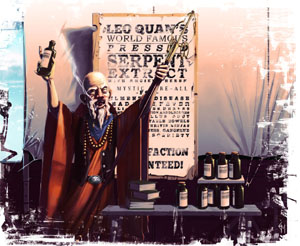 It’s a question I’ve also struggled with in my Ptolus campaign: On the one hand, positing a setting where wandering mercenaries go delving into dungeons in order to pull out vast hordes of wealth which frequently include magical treasures, allowing the PCs to sell those treasures, and then concluding that there’s no way to buy magic items seems unreasonable. (Although running a campaign where the PCs really are the sole sellers of magic items in the whole world seems like it could be potentially fascinating, albeit completely different from a typical D&D campaign.) On the other hand, I think it can be quite evocative to see what the “competition” has been bringing in.
As far as Ptolus goes, I’ve largely been handling it in an ad hoc fashion. And I feel like it’s been a mild success in evoking the wider sense of a setting in which delvers are plumbing the depths of the vast catacombs beneath the city. But I’ve also longed for a better/systematic way of handling it, and now my OD&D campaign has raised the demand to a figuratively fever pitch.
The method described below hasn’t been heavily tested yet, and it does require a fair bit of prep for larger communities. (Although there are some methods for breaking that prep up into manageable chunks if you find yourself needing to generate it on the fly.)
THE LOCAL MARKET
The local market can vary quite a bit. While it could be a generic “magic mart” there are lots of other options: In small communities, it might be nothing more than Bob who has a couple of magical items stuffed in a trunk that once belonged to his adventuring grandfather. Local churches might have a supply of divine items. It might be an eclectic collection of antiquities dealers, pawnshops, down-on-their-luck magicians, and the like. It might be a secretive cult of black-robed alley-dwellers. The local mage’s academy might buy up all the items that come into town and then re-sell them (along with new creations) at a mark-up. There might be specialty fences trying to evade the local prohibitions on the dissemination of dangerous magical weaponry.
THE LOCAL SUPPLY: You can determine the initial supply of items in a community by randomly determining magical treasure once per 1,000 inhabitants. (So in a community of 40,000, you would make forty checks.) If appropriate, you can vary this according to the treasure type of the predominant population. Or you can just go with a flat 50% chance.
In OD&D, for example, a typical human settlement of 30,000 people would use Treasure Type A (40% chance of any 3 magic items) and you’d made the check 30 times.
For AD&D1, you might want to use Table II.B on pg. 120 of the DMG in combination with the random check.
For D&D3, you’ll need to figure out what level to roll using the tables on pg. 52-53 of the 3.5 DMG. (You might try randomizing that by rolling 1d20.)
(Note: You’re not generating a list of every single magic item in town. You’re just generating the stuff that’s currently available for sale.)
THE MARKET LIST: When you’re done, you’ll have a list of items currently available for sale in town. Where the PCs will need to go (or what they’ll need to do) in order to procure a particular item on the list is up to your discretion.
MODIFYING THE MARKET LIST: Obviously, anything the PCs buy should be removed from the market list and anything they sell should be added to the list.
Adding Items: At set intervals (either once per session or once per some set amount of time in the game world), roll on your treasure tables again once per 10,000 inhabitants. (So if you rolled 40 checks originally, the market fluctuates using 4 checks on a periodic basis.) Items generated in this fashion are added to the local market — either due to new finds from local adventuring parties or new creations from local wizards.
Removing Items: Count the number of items you just added to the market. Modify that number by (1d10 – 1d10) and then randomly remove that number of items from the market.
(For example, if you generate 8 new magic items and then roll (9 – 3 =) 6, you would remove (8 + 6 =) 14 items from the market. If you had rolled (2 – 6 =) -4, then you would have removed (8 – 4 =) 4 items from the market.)
NOTES
In practice, generating the initial list of items may be a bit time-consuming for larger communities. But keeping the list updated after that point shouldn’t take more than a few minutes.
If you find yourself needing to use this system on the fly, you can de-centralize the local market for magic items and reduce the load by generating only the supply available at each potential “outlet”. If the PCs don’t find what they want from Aldric One-Eye, of course, they might go check with the local fences from the Thieves’ Guild… but that should give you time to generate the short list of what the Thieves’ Guild has on hand. (Simply jot down which items can be found where on your market list for future reference as necessary.)
Of course, the entire process can also be considerably sped up by using one of the numerous automatic generators that can be found scattered around online.