The Alexandrian

Archive for the ‘Roleplaying Games’ category

The Art of Rulings

March 29th, 2011

Banksy - The Grin Reaper

In response to the Update from the Crypt of Luan Phien, Poe asked me:

Out of curiosity, do you rely solely on the players’ expertise when developing maps or do you use some form of skill checks to indicate a character’s expertise in determining what’s going on with an unusual map situation like this one?

In the case of that particular map, it was primarily player expertise that crunched out the workings of the crypt. But Poe’s question got me thinking about the wider question of how GMs make rulings while running a roleplaying game.

First, I prefer to use systems which offer broad mechanical support for GM rulings. Some people prefer pure GM fiat, but I like having a mechanical base to make rulings from because:

  1. It allows me to make a ruling of uncertainty. (Instead of saying “that definitely happens” or “that definitely doesn’t happen”, I can say, “That sounds likely, let’s see if it happens.”)
  2. It allows for varying character capacity to have a meaningful impact on events.
  3. It can provide guidance when I’m not certain how to rule.
  4. The mechanical outcome is an improv opportunity, often spurring me to create things which I would not have created otherwise.
  5. It provides a consistency to similar rulings over time.

And so forth. In general, badly designed rules act as unreasonable straitjackets. Good rules, on the other hand, enable new forms of play and expand the scope of the game.

With all that being said, my general approach to making rulings as a GM basically looks like this:

  1. Passive observation of the world is automatically triggered.
  2. Player expertise activates character expertise.
  3. Player expertise can trump character expertise.

PASSIVE OBSERVATION IS AUTOMATICALLY TRIGGERED

Passive observation may include stuff that’s obvious to everybody (like walking into a room with a giant ball of flame hovering in the middle of it), but it might also include reactive mechanics for determining whether or not characters notice something that isn’t automatically apparent. In OD&D this would include surprise tests. In D&D 3rd Edition, this would include Listen, Spot, and Knowledge checks (although these skills can also be used in non-reactive ways.)

(Why am I including Knowledge skills here? Imagine that the characters walk into a room with a large heraldic shield painted on the wall. Do the characters recognize that as the archaic heraldry of King Negut III of Yrkathia? If they do, the players shouldn’t have to ask if they recognize it — they just recognize it.)

But now we get to the real heart of the matter. This is where a player says, “I want to do X.” And you need to make a ruling about how to resolve the outcome of X.

PLAYER EXPERTISE ACTIVATES CHARACTER EXPERTISE

What I mean by this is that the characters don’t play themselves. With the exception of purely passive observation of the game world, players have to call for an action which requires a skill check in order for the skill to be activated.

If we consider a simple example, like:

Player: I check the chest for traps.

GM: Make a Search check.

This may seem self-evident to most of us. On the other hand, I have seen games where GMs will respond to “I open the chest” by calling for the Search check. You may have also heard players say things like, “My character is a 12th level rogue. She would have known better than to open a chest without checking it for traps first!”

I can see the potential legitimacy of the philosophical question being raised. Regardless of which approach we take, there is a point at which the player’s control of the character seems to stop. Consider that simple Search check again: The player decides to check the chest for traps, but then we’re allowing the mechanics to determine how, based on the character’s expertise, that search happens. But could we not, with equal validity, say that when the player decides to open the chest, we should allow the mechanics to determine how, based on the character’s expertise, that happens?

In general, however, I would point out that an integral part of roleplaying is, in fact, playing your role — i.e., making choices as if you were your character. When you turn meaningful choices over to the game mechanics instead of making them yourself, I would argue that you are no longer roleplaying.

Of course, on the other end of the spectrum you have a variety of pixel-bitching. Here you’re never allowed to turn the resolution of an action over to your character and searching the chest becomes a litany of detail:

Player: I check the chest for traps.
GM: How do you do that?
Player: I check under the chest for a pressure plate.
GM: How do you do that?
Player: I run my fingers around the perimeter, looking for any edges. Then I’ll pour some water around to see if it sinks into any sort of depression. Then I’ll very carefully lift one corner of the chest just high enough that I can slide a piece of parchment under there and see if it strikes any sort of spring-loaded trigger that’s rising with the chest.

(Or, if you’re playing with GM bastardy: “I check under the chest for a pressure plate.” “You lift the chest to look, triggering the pressure plate!”)

There is certainly some art in figuring out where the “sweet spot” is for activating the character’s expertise. But 99 times out of 100 it’s going to be fairly self-evident. When in doubt, look for the meaningful choice. Or, rather, never assume that a character is doing anything which requires a meaningful choice unless the player makes that choice.

PLAYER EXPERTISE CAN TRUMP CHARACTER EXPERTISE

On the other hand, you also don’t want to negate meaningful choices by insisting that certain actions must be handed off to the character’s expertise. That’s why I say that player expertise can trump character expertise.

Sticking with our chest-searching motif, consider a scenario in which there is a hidden compartment in a chest which can be accessed by lifting out the bottom of the chest. We’ve determined that the hidden compartment requires a DC 17 Search check to discover. The player says:

  • “I search the chest.”
  • “I check the bottom of the chest for hidden compartments.”
  • “I take my axe and smash open the bottom of the chest.”
  • “I check the chest for traps before opening it.”
  • “I check the lid of the chest for hidden compartments”.

The first example is vanilla. You’ve handed the resolution over to the mechanic and you get a flat Search check against the DC of the hidden compartment. A success could generate a number of different responses (ranging from “yup, there’s a hidden compartment” to “you notice that the exterior of the chest is several inches deeper than the interior of the chest“).

The second example is more specific (and happens to coincide with what’s actually there to be found). I would tend to grant some kind of bonus to the Search. If there were other things to be found in the chest, I might also allow the Search check to find them (but since you’re specifically looking for something else, such a check might have a penalty applied to it).

In the third example you’ve taken an action which would automatically find the compartment. No Search check is required. (Player skill has completely trumped the mechanic.)

The fourth and fifth examples demonstrate that trumping character skill isn’t always a good thing. In the fourth example, you have no chance of finding things hidden inside the chest if you’re limiting your search to the exterior. Similarly, in the fifth example you’re specifically looking in the wrong place.

As another example, consider a hallway with a pit trap in it. The pit trap has a 50% chance of activating whenever someone steps on it and it requires a DC 17 Search check to find it. The player says:

  • “I search the hall for traps.”
  • “I proceed carefully down the hall, tapping ahead of me with my 10-foot pole.”
  • “I summon a celestial badger and have it walk down the hall in front of me.”
  • “I pour a waterskin onto the floor to see if it runs down any seams or gaps.”

The first example is, once again, a straight forward Search check. The second and third examples bypass the Search mechanics, and instead grant a 50% chance that the pole or summoned creature will trigger the trap.

The fourth example, on the other hand, could be handled in several ways. One could easily rule that such a technique would automatically find the trap (particularly if the player specifies exactly which section of corridor they’re checking). If not, I’d probably at least grant a hefty bonus (say, +10) to the Search check for using an appropriate technique.

In many ways, this comes back to meaningful choice: We assumed before that characters don’t take actions which require meaningful choice unless the player makes that choice. Here we assume that any choice the player makes is probably meaningful and take the specificity of those choices into account when we make our ruling.

THE CRYPT OF LUAN PHIEN – AN EXAMPLE FROM REAL PLAY

Let’s consider the specific example of mapping the Crypt of Luan Phien, a segmented dungeon in which each section periodically rotates independently in order to change the layout of the dungeon.

At the high end, we can imagine a player saying, “I make a Knowledge (dungeoneering) check to make a map of the dungeon.” To which my answer would be, “No.” (They’ve failed to achieve the necessary specificity to activate their character’s expertise.)

In actual play, the mapping of the dungeon was solved almost entirely through player expertise. They simply observed which rooms connected to each other and slowly built up an understanding of the possible configurations of the dungeon. (The sole exception would be late in the process, when they started checking corridors to find the wall seams which would confirm their understanding of where the breaks between segments lay.)

But I can think of several ways that they could have activated their character’s skills:

  • Check the curvature of the stone walls that periodically blocked various hallways in order to determine (at least roughly) the circular diameter of each section.
  • Try to determine the direction in which each section was rotating.
  • Try to figure out how much stone would slide past an open corridor between sections in order to determine how far each section was rotating.
  • Use a compass or spell to determine orientation before and after a shift.

And so forth.

Go to Part 2

THE ART OF RULINGS
Part 2: Intention and Method
Part 3: The Fiction-Mechanics Cycle
Part 4: Default to Yes
Part 5: Skill and Difficulty
Part 6: Fictional Cleromancy
Part 7: Vectors
Part 8: Let It Ride
Part 9: Narrating Outcomes
Part 10: Fortune Positioning
Part 11: Narrative vs. Action Resolution
Part 12: Hidden vs. Open Difficulty Numbers
Part 13: Hidden vs. Open Stakes
Part 14: Group Actions
Part 15: Making Plans

Addendum: Let It Ride on the Death Star

Rulings in Practice: Gathering Information
Rulings in Practice: Perception-Type Tests
Rulings in Practice: Social Skills
Rulings in Practice: Sanity Checks
Rulings in Practice: Traps

FURTHER READING
The Art of Pacing
The Art of the Key
Gamemastery 101

One interesting side effect of using an encumbrance system simple enough that it actually gets used is that it tends to highlight places where the underlying mechanics don’t actually work right.

These problems, generally speaking, can be mostly seen in the largest creatures. For example, rocs are supposed to serve as mounts for storm giants. But rocs can only carry up to 7,456 pounds while flying and storm giants weigh 12,000 pounds according to the Monster Manual. (And that’s assuming that the storm giant is naked.)

I often have a strong desire, once I start tinkering with a sub-system like this, to tweak things in an effort to find solutions for these sorts of problem. But this can be something of a primrose path: Fixing the underlying problem here requires changing the design of the roc, the storm giant, or both. It’s not something that can be solved at a systemic level, and while the abstraction of the encumbrance by stone system fixes some of these problems; it also introduces others.

One tweak you might want to look at, though, is allowing flying creatures to carry up to a medium load when using the encumbrance by stone system in order to give them a larger margin of error when dealing with the abstraction of the system. (On the other hand, this really only seems to be a problem with Huge or larger mounts carrying Large or larger riders due to the cubic weight gain of larger creatures. Since this is a situation which rarely applies to PCs or their mounts, it can probably be safely sweeped under the rug labeled “I Don’t Really Care” ninety-nine times out of a hundred.)

Now, if you’re really tired of reading about encumbrance rules at this point… you’re in luck! I’m all done. My next post will have absolutely nothing to do with encumbrance.

But first:

Luke and Yoda

Luke Encumbered

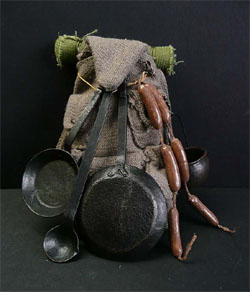
That backpack looks pretty full, so call it 3 stones. And Yoda can probably be classed as a halfling at 2 stones. Call it 5 stones and Luke is moving at 9″.

It’s so easy!

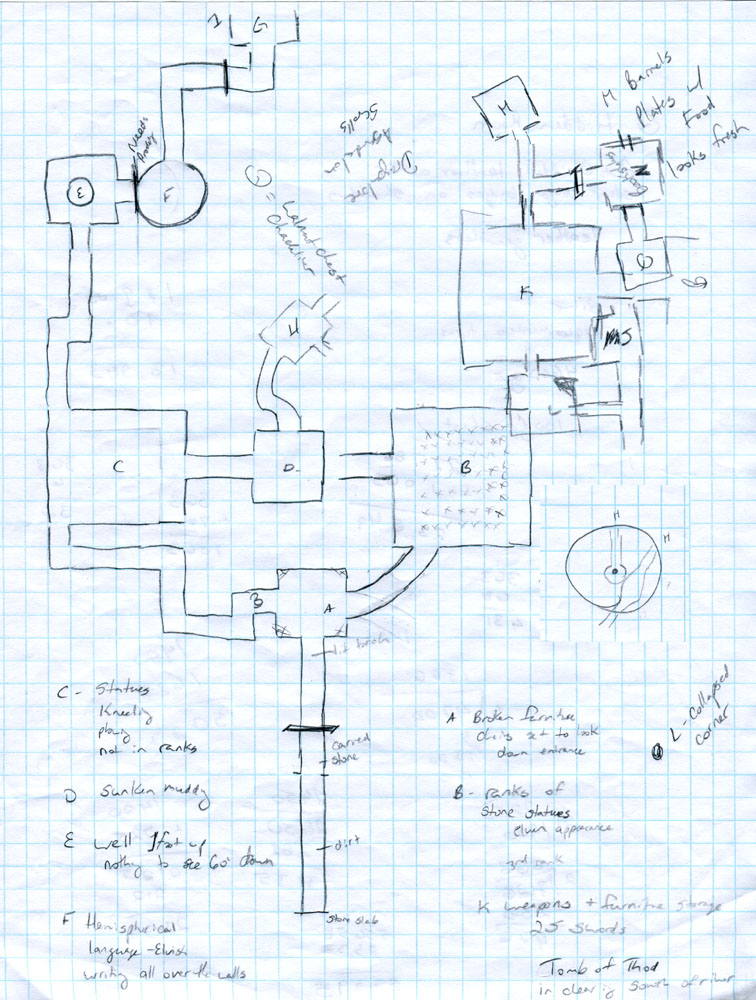
A couple days ago I described the first foray of my PCs into the Crypt of Luan Phien, a segmented dungeon which periodically rotates and rearranges its internal layout. As part of that post, I included the maps they drew.

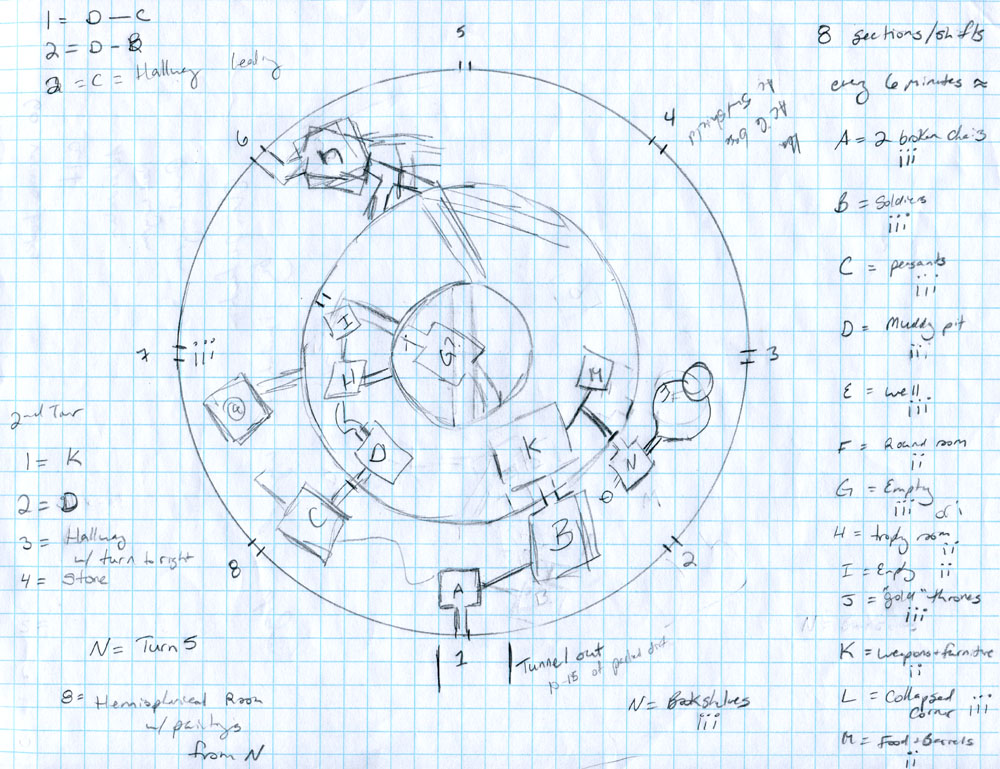
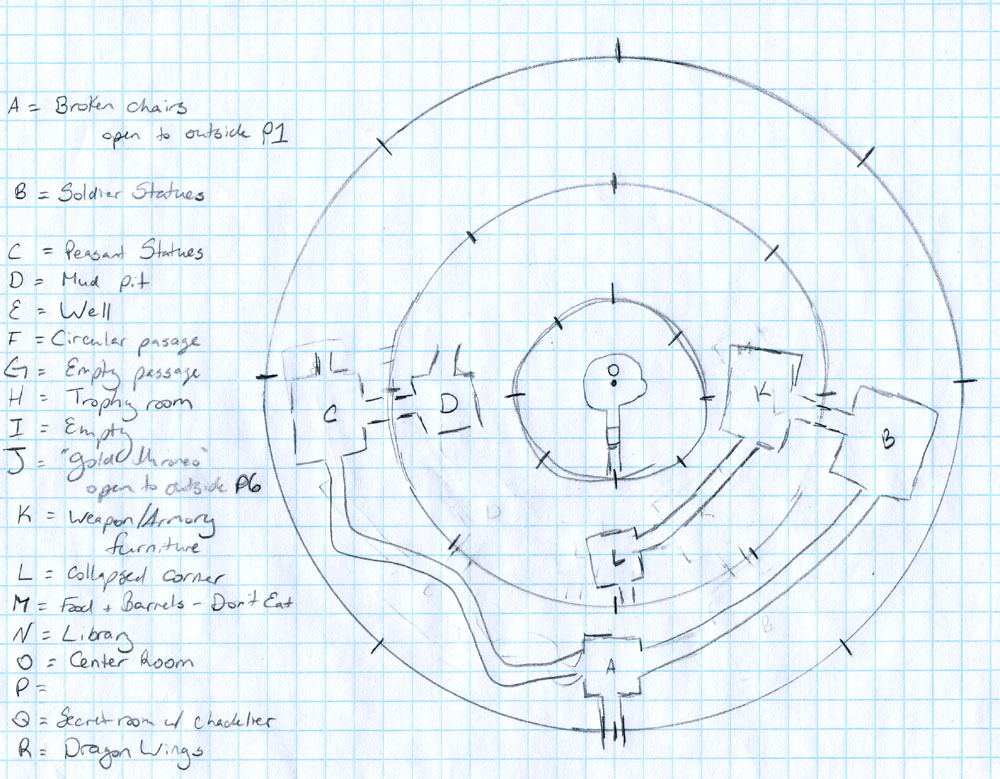
Since then, there have been three return expeditions to the cairn hill, each allowing them to further perfect their understanding of the complex. Because of the unusual nature of the dungeon, I thought people might be interested to see how their maps have evolved:

Crypt of Luan Phien - Player's Map 1

This is the refinement of their first expeditionary map. Basically charting out their path through the dungeon, while also trying to figure out where the breakpoints in the rotation scheme lay. Analyzing this map allowed the mapper to produce this:

Crypt of Luan Phien - Player's Map 2

This map, representing the first effort to spatially understand how the segments linked together, went through several revisions, but quickly proved accurate enough to allow them to begin moving through the complex with purpose and intent (instead of hope and abandon).

After their last expedition, the mapper felt she had achieved a deep enough understanding of how the complex was working to further refine the map, resulting in this work-in-progress:

Crypt of Luan Phien - Player's Map 3

You can see larger versions of each map by clicking on them.

For reference purposes, the letters correspond to the original map as follows: A = 1, B = 2, C = 8, D = trap north of 13, E = 7, F = 12, G = unkeyed area next to 14, H = 13, I = area south of 13, J = 6, K = 10, L = 9, M = 11, N = 4, O = 14, Q = 3, R = 5.

If you’re curious about my peculiar variances in the dungeon, you can also check out my current key for the dungeon in PDF format:

Hex P8 – Crypt of Luan Phien

Samwise Gamgee's Backpack

ENCUMBRANCE BY STONE

Encumbrance by Stone for OD&D
OD&D Equipment Sheet

Encumbrance by Stone for 3E / Legends & Labyrinths
3rd Edition / Legends & Labyrinths Equipment Sheet

5E Encumbrance by Stone

DESIGN GOALS

Basically, the entire point of the Encumbrance by Stone system is to simplify the encumbrance rules to the point where they can be used to meaningful effect on-the-fly during actual gameplay.

All the way back in 1974, this type of gameplay was discussed. In Volume 3: The Underworld & Wilderness Adventures, for example, we can read:

If the adventurers choose to flee, the monster will continue to pursue in a straight line as long as there is not more than 90 feet between the two. (…) Distance will open or close dependent upon the relative speeds of the two parties, men according to their encumbrance and monsters according to the speed given on the Monster Table in Volume II. In order to move faster characters may elect to discard items such as treasure, weapons, shields, etc. in order to lighten encumbrance.

But in actual practice the encumbrance rules are such a pain in the ass that either (a) they’re not used at all or (b) the amount of calculation required to adjust your encumbrance is sufficiently huge that no one is going to try to do it in the middle of a chase scene.

But in the half dozen sessions since I’ve introduced the encumbrance by stone rules, I’ve had explicit encumbrance-based play crop up twice. And although “encumbrance-based play” may not sound all that exciting at first glance, being forced to throw away your favorite shield or abandon several weeks worth of rations on the pack horse actually provides a great deal of interest. (Going back to get your shield, for example, can be a unique motivator. Running out of food because you had to leave them behind can throw your plans completely out of whack.)

The real root of my desire to find a workable encumbrance system, however, lies in the open table wilderness explorations my campaign is currently moving towards: Encumbrance can make a big difference in how you supply yourself for a particular expedition and that, in turn, will lead to a lot of interesting strategic decisions down the road. Similarly, being forced to leave potentially valuable treasure behind because you can’t carry it will drive interest in revisiting locales.

THINKING ABOUT STONES

Roughly speaking, for the purposes of estimating the stone weight of larger items:

OD&D 1 Stone = 15 lbs.

D&D3 1 Stone = 10 lbs.

But in practice you can just assume anywhere from 10 to 20 pounds. Although eventually set by British law at 14 pounds, the stone historically varied depending on the commodity being traded and the location in which it was being traded. (For example, the 1772 edition of the Encyclopedia Britannica states that a stone of beef was eight pounds in London, twelve pounds in Hertfordshire, and sixteen pounds in Scotland.) This makes it fairly ideal to provide a system which uses crude approximation in an effort to vastly simplify the bookkeeping involved with tracking encumbrance. And the slightly archaic nature of the terminology is immersive for a fantasy world. (“I’m carrying about eight stone.”)

In terms of performance, the system will give you a result fairly homogenous with 3rd Edition up to around Strength 25 and then it begins to fall behind the actual tables when performing a straight conversion of stone-to-pounds.

I’m generally okay with that performance for a few reasons: First, most characters won’t reach those levels of strength.

Second, the bundling system tends to be friendly towards the characters. Each bundle is supposedly around 10 pounds, but many common bundles will actually weigh more than that. (Other bundles will under-perform, of course, but I suspect the opposite will more often be true.) And if you’re carrying 40+ stone, then you have to be carrying 150+ bundles (or a lot of really bulky items).

Third, speaking of 150+ bundles, bulk does become an issue at some point. You may be super-strong, but there are only so many places for you to strap stuff to your body. The exception to that is when you’re just lifting a single, heavy object in your hands (which is why I included a separate column for lift).

Fourth, I just don’t care that much. If I did care that much, I would just use the full-fledged, count-every-single-pound method of encumbrance.

SPECIAL THANKS

The design of this system is heavily influenced by Delta’s D&D Hotspot and Lamentations of the Flame Princess.

Go to Part 1

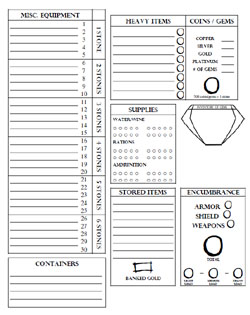
This is an equipment sheet designed to be used with the Encumbrance by Stone rules for Legends  & Labyrinths / 3rd Edition I posted yesterday. (It’s similar to the sheet for OD&D, but with a couple key differences.)

Encumbrance by Stone - L&L Equipment Sheet
(click for PDF)

USING THE SHEET

Using the sheet is really where this system comes alive, because it basically makes tracking encumbrance as easy as listing what you’re carrying.

Encumbrance Rule: You can write down your character’s encumbrance rule (based on their Strength score) in the spaces provided in the lower right corner.

Armor/Shield/Weapons: The assumption is that your currently equipped armor, shield, and weapons will be listed for reference on the front of your character sheet. You can jot down the current encumbrance values for these items in the spaces provided in the lower right hand corner of the sheet.

Coins/Gems: These are listed in the upper right and their encumbrance calculated as shown. (To quench the “I have one coin and it apparently weighs a ton” complaints, you can allow PCs carrying 20 coins or less to list them as “loose change” in the miscellaneous equipment section.)

Heavy Items: This section is for listing anything that qualifies as a heavy item (i.e., weighs 1 or more stones all by itself).

Miscellaneous Items: The heart of the sheet. Simply list everything you’re carrying in bundles of 20 or less. When you’re done, you can immediately see how many stones of miscellaneous equipment you’re wearing. Bam.

Add Misc. Equipment + Heavy Items + Coins/Gems + Armor + Shield + Weapons = Total Encumbrance. In practice this is all single digit arithmetic and adjusting your encumbrance on-the-fly during an adventure is practically automatic.

Moved equipment to your horse? Picked up a bunch of treasure? Throwing away your shield in order to run away from the goblin horde at your heels? It can all be done in seconds.

TIPS AND TRICKS

Stored Items: This section of the sheet is for anything you own that isn’t currently being carried by your character.

Inventory of Gems: These are tracked separately to make calculating coin/gem encumbrance easier.

Containers: This area is used for listing containers in use (which don’t count against encumbrance). Empty containers should be listed as miscellaneous equipment. There are two easy methods for tracking which items are in which container:

(1) List miscellaneous equipment slot numbers next to the container.

(2) Put a symbol (star, circle, square, etc.) next to the container, then mark items in the container with the same symbol.

Tracking Supplies: The intention is that you list your supplies in the miscellaneous equipment section, but you can quickly check off supplies used on the trackers. At some point of convenience, you can go through your equipment list, adjust the totals, and then erase the supply checklists to start anew.

The Blank Space: After making the sheet I kept expecting something to crop up that I’d forgotten. (At which point I’d have this convenient blank space to slot it into.) After a half dozen sessions, nobody has suggested anything. (Let me know if you think of something.)

Go to Design Notes

Archives

Recent Posts

Recent Comments

Copyright © The Alexandrian. All rights reserved.