The Alexandrian

Archive for the ‘Roleplaying Games’ category

The malero (meaning “the taking of sin”) is a religious ritual of cleansing.

Its origins lie in the auto da fes performed during the Years of Heresy by the Imperial Church. In these public processions, those found guilty of heretical crimes would be marched through the streets of a city before being led to a place of judgment where many would be tortured or executed.

The first bearer of the malero was Saint Alesia of Malthusta, who received a holy vision to lift the burden of sin from her town and bear it herself before performing a mighty geas to cleanse her own soul of its weight. Similar maleros were performed throughout the Years of Heresy, allowing those accused of heretical crimes to instead go free.

The practice of malero continues today in a lessened form: Holy warriors and knights are given tasks by the church in order to periodically cleanse their communities of the “vestige sin” which accumulates wherever men gather in great numbers.

More rarely, a malero be assumed in an effort to lift a curse or blight from a particular region.

THE MALERO IN YOUR CAMPAIGN

A malero can serve as a convenient scenario hook. Knights, paladins, and clerics associated with the church may be called on directly to perform them. In other cases, churches may put out a general call for anyone willing to undertake a malero. (This is particularly true for smaller churches with more limited resources.)

Notably, maleros are often called for in the wake of great tragedies. Have the PCs just captured a serial killer? We’ll need a malero to cleanse the community of such weight sin. Did they just save the village from some natural calamity? The gods must be cursing us with such times of trouble because of our sins; must be time for a malero.

A failed malero is a particularly weighty manner. If Sir Godric has taken on the community’s sin and has fallen before it could be cleansed, that means that the sin has merely been concentrated and is now free to roam once more. Who knows what mischief such sin might get up to? Once the players are familiar with the concept of the malero, you can use a failed malero to crank up the stakes for them.

You shouldn’t forget to play up the ritualistic component of the malero, either. Functionally it may not be much different from a guy hiring them at the local tavern; but the devil is in the details, and you can imbue the malero with a lot more unique flavor than that: Anoint them with oils. Make them swear a holy oath. Let them receive a proper blessing.

Make the malero significant.
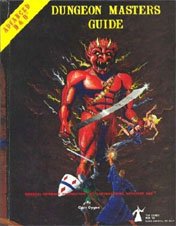
 

Dungeon Master's Guide - AD&D 1st EditionI’ve been spending quite a bit of time delving through the 1st Edition Dungeon Master’s Guide recently. Which means I’ve spent more than my fair share of time staring at the cover… which I have always hated.

The poses are stiff. The composition boring. The anatomy problematic. It is, in short, a disappointing and amateurish piece of work.

And this is particular true when you compare it to the back cover of the same book, which depicts a glorious, panoramic shot of the City of Brass which seems to invite you to a world of adventure in a dozen different ways.

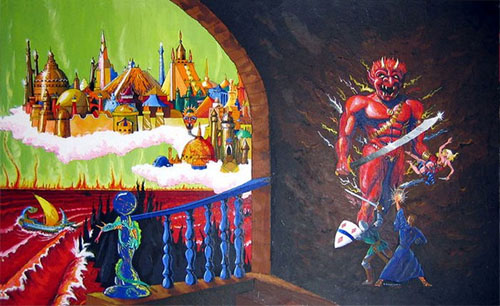
The interesting thing, of course, is that these are both the same piece of art. It’s a panoramic cover that wraps around the spine. Because of its composition, however, this can be rather difficult to appreciate unless you can look at the whole thing all at once:

Dungeon Master's Guide - Full Cover

I really like the framing effect which the fully visible arch has on the City of Brass. That half of the painting is great.

Sadly, seeing the full piece in context only makes the other half of the painting look even worse. I mean, the composition of the efreeti and the adventurers was already suffering from some internal problems with its perspective. But once you put them into the context of the larger scene, where exactly are they supposed to be standing?

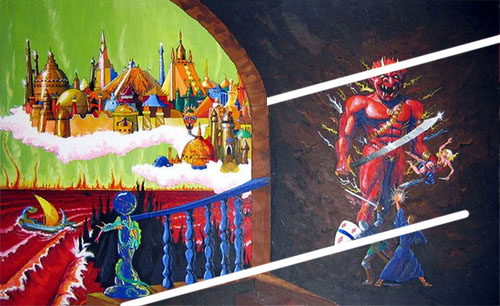
Look at what happens when you draw in the perspective lines of the wall:

Dungeon Master's Guide - Full Cover with Perspective Lines

As far as I can tell, the efreeti is standing in the wall.

I’m as much a fan of non-Euclidean geometry as the next guy. But this just looks sloppy to me. And it actively repulses my eye.

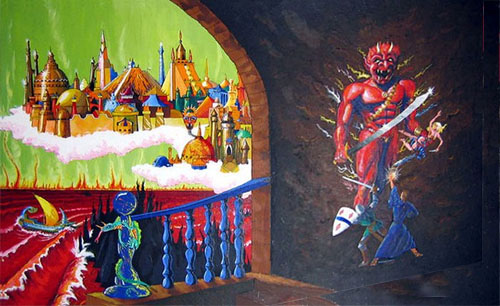
EDIT: Those of you suggesting in the comments that the efreeti and possibly the adventurers have actually been painted on the wall have an interesting theory. But if that were actually the case, we would expect the cover to look something like this:

Dungeon Master's Guide - Distorted Wall Mural

Which, of course, it doesn’t.

I suppose one could argue that this is a painting of another painting which has been painted in order to appear 3D from the position which the meta-painter has placed his easel… But, honestly, there comes a point when you’re just making excuses for sub-standard art.

RPG Art Thru History

May 11th, 2011

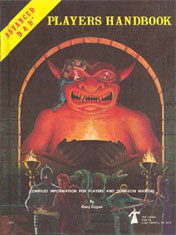
Player's Handbook - AD&D 1st EditionCommon meme: Art is eating our RPG books. The number of illustrations have been increasing per page.  Customers won’t buy books without a lot of art in them. And this is totally new. Didn’t used to be this way. Back in the day we were willing to buy books even if they didn’t have any art at all.

Really?

Fact check time.

OD&D White Box: 44 illustrations, 116 half pages = 0.37 illustrations per page (0.75 per full page)

AD&D1 PHB: 35 illustrations, 128 pages = 0.27 illustrations per page
AD&D1 DMG: 50 illustrations, 240 pages = 0.20 illustrations per page
AD&D1 MM: 246 illustrations, 112 pages = 2.19 illustrations per page
AD&D 1st Edition Total: 0.61 illustrations per page

AD&D2 PHB: 95 illustrations, 256 pages = 0.37 illustrations per page
AD&D2 DMG: 81 illustrations, 192 pages = 0.42 illustrations per page
AD&D2 MM: 326 illustrations, 384 pages = 0.84 illustrations per page
AD&D 2nd Edition Total: 0.60 illustrations per page

D&D3.5 PHB: 68 illustrations, 317 pages = 0.21 illustrations per page
D&D3.5 DMG: 71 illustrations, 320 pages = 0.22 illustrations per page
D&D3.5 MM: 203 illustrations, 320 pages = 0.63 illustrations per page
D&D3.5 Total: 0.36 illustrations per page

D&D4 PHB: 67 illustrations, 317 pages = 0.21 illustrations per page
D&D4 DMG: 48 illustrations, 221 pages = 0.22 illustrations per page
D&D4 MM: 208 illustrations, 288 pages = 0.72 illustrations per page
D&D4 Total: 0.39 illustrations per page

Exact counts may vary.  (For example, I didn’t count the 23 illustrations on pg. 21 of Volume 3 of the White Box depicting various types of construction as separate illustrations. I just counted the whole pageonce.) But the conclusion is self-evident: The number of illustrations per full page in D&D’s core rulebooks has actually decreased over time. If we want to talk about black-and-white art vs. full color art or the merits of border art, let’s have it. But RPGs have been art-rich literally since day one.

“But, Justin,” you say. “That’s just D&D. What about Traveller? The little black box practically had no illustrations at all!”

True. The original Traveller black box only has 3 illustrations in 150 half pages. On the other hand, the relatively recent Shock: Social Science Fiction has 3 illustrations in 90 two-third pages. Books that feature stark, austere layouts haven’t exactly vanished off the face of the planet.

Now, if there is one trend that has appeared in the last 20 years its the technique of putting a big piece of art behind the text. And I think we can all agree that this technique should be taken out into the desert and left to die.

But if you want to complain about how much gosh-darn art there is in roleplaying games these days?

Check your facts.

Go to Part 1Go to Map

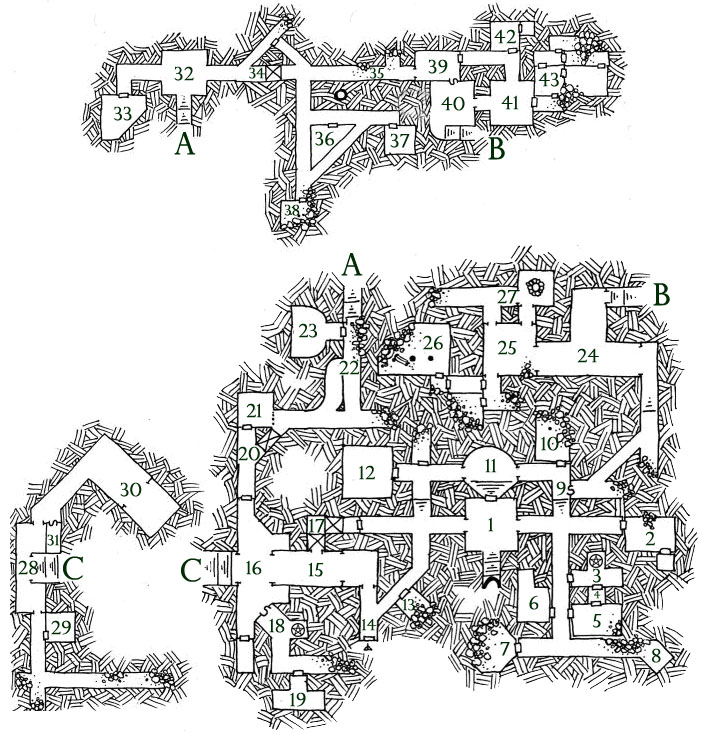
The key posted over the last several days for the Ruined Temple of Illhan represents the temple as it was discovered by my players. If you’re interested in running through the temple in the days after that hardy group of wanderers passed through it, you’ll want to make the following changes:

AREA 9: The secret door has been wedged open with iron spike.

AREA 20: The stone block has been propped up with three iron chests, holding it far enough off the ground for halflings and unarmored characters to crawl under.

AREA 21: Portcullis has been raised (using the control level in area 23).

AREA 26: The ceiling of this room has collapsed, leaving behind a solid wall of rubble in the doorway.

AREA 30: The iron chests and treasure have been removed.

AREA 36: Spear has been removed.

AREA 43: All of these doors have been chopped through with axes.

Thanks again to Dyson Logos for giving me permission to share his re-keyed map. I very much recommend checking out his site; he’s got a plethora of terrific stuff over there ripe for pillaging.

The Ruined Temple of Illhan - Dungeons

Go to Part 1Go to Map

AREA 32: Empty chamber.

AREA 33: The angled wall has the chipped remnants of what must have once been an extravagant mural; but it is now too damaged to make out any pertinent details. On the wall opposite the mural there is an iron rod bracketed to the wall about seven feet off the floor and running perpendicular to it.

AREA 34 – PIT TRAP (30’ deep): 1 in 6 chance of opening when crossed.

AREA 35: These rubble piles will shift ominously as people walk over the top of them (but there’s no real risk).

AREA 36: A metallic pole covered in runes stands upright from the floor in the middle of this room.

Pole: The runes are arcane. The pole is actually a +1 spear of charged lightning, which can hurl 1d6 lightning bolts which deal 4d6 points of damage each. When the charges on the spear are exhausted, it remains a +1 spear but cannot discharge lightning again until it has been returned to the depression in this chamber. The weapon can be used normally by any follower of the Norse or Neo-Norskan pantheon (despite being a bladed weapon).

Each time the spear is used (whether to throw lightning or in melee) by a character who does not worship the Norse or Neo-Norskan pantheons, there is a 1 in 6 chance that its curse will be revealed: Black lightning will run up the spear and into the arms of the character wielding the spear. The black lightning will sap the strength from their limbs, inflicting a -4 penalty on attack rolls on damage until the spear has been returned to this chamber or they have received a blessing from a Norse cleric.

AREA 37: Empty room.

AREA 38: Partially collapsed chamber.

AREA 39: Room is empty. Door is wooden.

Secret Door: On the wall here there are two small, concealed lenses. (See area 40.)

AREA 40: On one wall of the chamber there is a kind of iron coffin or sarcophagus which is flush with the wall (where the secret door is indicated). On the other side of the room, a set of open stairs goes up, takes a turn to the left across a short landing, and then heads up another flight (to area 24).

Iron Coffin: This is hinged and can be opened if six clasps down the opposite side are removed. Affixed to the wall within the cavity of the sarcophagus are a set of “viewing glasses” (similar to binoculars or opera glasses), which look through the lenses into area 39. If the viewer is sealed inside the sarcophagus (with all six clasps being shut from the outside), the view in area 39 will shift to show the same room several hundred years ago when the complex was still in use.

Vision: Three maidens wearing blindfolds (one of crimson red, one of royal purple, and one of pale blue) sitting around a large brass bowl filled with burning incense. Priests of Illhan will enter, drop tokens of intricately carved wood into the burning incense, and ask questions. There’s no sound, but those who can read lips will be able to decipher a prophecy describing the temple’s destruction.

AREA 41: An empty room.

AREA 42: In the center of the room there is a large pile of dry wood. (Those looking through it will discover the remains of broken furniture.)

Closet: The wooden door on the far side of the room has been hit with an axe several times, but is still mostly intact. The closet beyond it has a skeleton slouched in one corner; it has a small, badly rotten pouch with 6 sp and 76 cp.

AREA 43: All of the rooms in this little complex are empty. The doors are made of wood, several of which have swelled from moisture and jammed shut (3 in 6 chance).

Continued tomorrow…

(Original cartography by Dyson Logos.)

Archives

Recent Posts

Recent Comments

Copyright © The Alexandrian. All rights reserved.