Like my review of The Paxton Gambit, this review was also posted to the Amber DRPG mailing list. What I can’t remember is whether I originally wrote it for the mailing list and then recycled it later for use on RPGNet (as I had done with the Paxton Gambit review), or if I wrote it for RPGNet and then posted it simultaneously to the mailing list. I guess we can add that to column of Mysteries Nobody Actually Cares About.
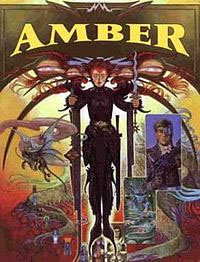 Amber: The Diceless Role-Playing Game (ADRPG), based on the series of novels by Roger Zelazny, was the first diceless RPG. While some games may claim to be “diceless” role-playing and actually cop out and use cards or coins or a stopwatch to resolve actions, Amber truly is diceless: the only thing determining whether or not the actions of the players succeed is the GM.
What this means of course, is that the players have to trust their GM — in who final authority lies. Any group who has an antagonistic relationship will not have any fun.
Player: I punch him in the face!
GM: You missed. He whips out his gun and shoots you. You’re dead.
The game also requires — in my experience — GMs and players who have a bit of poetry and storytelling blood in their veins. If you play RPGs in order to fight badguys, then dice provide a neutral challenge to the situation — if you play such a scenario in Amber you know that your GM probably won’t kill you, and if he does you’re going to feel bad about it. (Although this doesn’t mean you can’t die in ADRPG. If it serves the story and everyone is mature enough to handle it, it’s fully capable of happening.) Nor is Amber particularly good for those who play RPGs in an attempt to accurately simulate reality — reality is random, and dice introduce that element to the game.
No, Amber is designed solely for the storytellers.
The system is a good one for what it attempts to do — simulate the environment of the Chronicles of Amber by Roger Zelazny. Everything is based off of four attributes — Strength, Endurance, Warfare, and Psyche. Strength is a measure of both physical power and skill in unarmed combat. Endurance is a measure of how long a character can do things before collapsing. Warfare is a measure of a character’s armed combat and tactical skill. Psyche is a measure of a person’s psychic ability and mental acuity. While for some situations this would seem to be a gross and inefficient generalization, for Amber characters it actually works perfectly.
These attributes are purchased through an “auction” — all players start the game with 100 points to build their characters with. During the first phase of character creation they bid, with the GM as auctioneer, for their ranks in the four attributes. Those who bid highest get 1st rank and the best ability. Those who don’t bid at all get “Amber” rank in the attribute — meaning you’ll trounce any mortal who comes wandering along without any effort whatsoever. After the auction you are able to purchase up by spending points equal to those who bid for actual ranks, although you will never be as good as the people who actually bid for those ranks (if you spend as many points as the person who claimed first rank, for example, you are actually rank “1.5”). To get more points you can lower your attributes to Chaos rank (-10 points) or Human rank (-25 points). There is also an alternate system for simply spending points on the various attributes and skipping the auction — but the auction is actually quite a bit of fun, and, in fact, once again creates the feel of the Amber universe quite effectively.
Skills? As Wujcik says, Amberites live so long they can be skilled in anything they like. Plus, due to the realities of shadow, if you aren’t skilled in something you can jump to a shadow where time runs much faster, train for a decade, come back the next day local time and hit the ground running. How do you build a skill system to represent that? Answer: you don’t. As long as its consistent with your character background, you can do anything like a pro.
So, besides attributes, what else can you spend points on? Well, there’s the powers. Pattern Imprint, Logrus Mastery, Trump Artist, Sorcery, Conjuration, Power Words. Everything from both the first and second series of books, plus a few extra things. You can also spend points on creatures and artifacts — things with similar abilities to Corwin’s sword Greyswandir or the horse of Julian in the books.
And the system for resolving actions? The GM looks at the character’s attributes and determines if he’s skilled enough or strong enough to accomplish the task. What about when two characters go head-to-head? Compare the attributes of the two characters in question. Equal? They’ll fight to a standstill. Little different? It’ll be a long, drawn out conflict. Big difference? It’s going to be short.
Although I make light, the system is — in fact — extremely elegant. As I said before this is a game for storytellers and when the GM is looking at an attribute to see if the character is capable, more often than not he is also asking the question: “Will it make for a good story?” The system really shines in combat, and the book goes into extensive details on how to run it. The chosen attributes play off each other with amazing alacrity. You may be better at swordplay than the other person (Warfare), but if they’ve got a better Strength then they can always try to close within fighting distance — unless you’ve got a significantly better Warfare, in which case you can avoid their attempt to grapple with you. If you’re both fairly even in your skill, then the person who can last longer (Endurance) is going to take the day. Psychic attacks, of course, can always figure in as well — and since you need to be in physical contact to make those work, they balance with the other attributes as well. Add in the powers and you have an exquisite interplay of elements which means that success is in more than just the numbers — the tactics you choose to employ become as crucial to your success as the size your attributes.
The game has two serious weaknesses, however, which mar its perfection:
First, despite the fact that the overall system is perfectly matched to its source material, some of the details fall flat. It is a well-reputed fact that the power systems as the game describes them raises the eyebrows of readers of the books — “Where did Eric Wujcik get that from?” You can play the game quite happily with what is there, however, so this is not a serious problem — particularly since there are highly-detailed alternatives to this system sprinkled across the web. Since Amber is a very freeform RPG it is also very easy to simply say: “Describe what you want to do, and I’ll assign a point cost for it.” No stats means that all you need is an idea and a description.
The other problem, I think, actually springs from that freeform quality of the system. It’s not well laid out and the presentation is inferior to other games on the market today. Fortunately the system is so simple that working around the lay-out isn’t a serious problem — you can literally read through the book once and have all the major rules memorized without any effort whatsoever. Only some of the specifics of the powers get more complicated.
In addition to all this, the book also provides stats for all the main characters from the First Chronicles of Amber and a plethora of ideas for campaigns, plus a handful of more fully developed scenarios to put your players through.
To sum it up: The central system is fantastic, and is probably the best adaptation of a specific work I’ve seen in RPGs (with the possible exception of the Star Wars RPG from West End Games). The power system, like the central system, is well balanced and works perfectly — but it falls down in the adaptation department. The entire game suffers from a poor lay-out, but there’s a lot of raw material in there.
Definitely worth the $23 if you’re at all interested in either the works of Roger Zelazny or in seeing a marvelous piece of system design.
Style: 3 (Average)
Substance: 4 (Meaty)
Author: Eric Wujcik
Company/Publisher: Phage Press
Cost: $22.95
Page count: 255
ISBN: 1-880494-00-0
Originally Posted: 04/20/98
Amber: The Diceless Role-Playing Game (ADRPG), based on the series of novels by Roger Zelazny, was the first diceless RPG. While some games may claim to be “diceless” role-playing and actually cop out and use cards or coins or a stopwatch to resolve actions, Amber truly is diceless: the only thing determining whether or not the actions of the players succeed is the GM.
What this means of course, is that the players have to trust their GM — in who final authority lies. Any group who has an antagonistic relationship will not have any fun.
Player: I punch him in the face!
GM: You missed. He whips out his gun and shoots you. You’re dead.
The game also requires — in my experience — GMs and players who have a bit of poetry and storytelling blood in their veins. If you play RPGs in order to fight badguys, then dice provide a neutral challenge to the situation — if you play such a scenario in Amber you know that your GM probably won’t kill you, and if he does you’re going to feel bad about it. (Although this doesn’t mean you can’t die in ADRPG. If it serves the story and everyone is mature enough to handle it, it’s fully capable of happening.) Nor is Amber particularly good for those who play RPGs in an attempt to accurately simulate reality — reality is random, and dice introduce that element to the game.
No, Amber is designed solely for the storytellers.
The system is a good one for what it attempts to do — simulate the environment of the Chronicles of Amber by Roger Zelazny. Everything is based off of four attributes — Strength, Endurance, Warfare, and Psyche. Strength is a measure of both physical power and skill in unarmed combat. Endurance is a measure of how long a character can do things before collapsing. Warfare is a measure of a character’s armed combat and tactical skill. Psyche is a measure of a person’s psychic ability and mental acuity. While for some situations this would seem to be a gross and inefficient generalization, for Amber characters it actually works perfectly.
These attributes are purchased through an “auction” — all players start the game with 100 points to build their characters with. During the first phase of character creation they bid, with the GM as auctioneer, for their ranks in the four attributes. Those who bid highest get 1st rank and the best ability. Those who don’t bid at all get “Amber” rank in the attribute — meaning you’ll trounce any mortal who comes wandering along without any effort whatsoever. After the auction you are able to purchase up by spending points equal to those who bid for actual ranks, although you will never be as good as the people who actually bid for those ranks (if you spend as many points as the person who claimed first rank, for example, you are actually rank “1.5”). To get more points you can lower your attributes to Chaos rank (-10 points) or Human rank (-25 points). There is also an alternate system for simply spending points on the various attributes and skipping the auction — but the auction is actually quite a bit of fun, and, in fact, once again creates the feel of the Amber universe quite effectively.
Skills? As Wujcik says, Amberites live so long they can be skilled in anything they like. Plus, due to the realities of shadow, if you aren’t skilled in something you jump to a shadow where time runs much faster, train for a decade, come back the next day local time and hit the ground running. How do you build a skill system to represent that? Answer: you don’t. As long as its consistent with your character background, you can do anything like a pro.
So, besides attributes, what else can you spend points on? Well, there’s the powers. Pattern Imprint, Logrus Mastery, Trump Artist, Sorcery, Conjuration, Power Words. Everything from both the first and second series of books, plus a few extra things. You can also spend points on creatures and artifacts — things with similar abilities to Corwin’s sword Greyswandir or the horse of Julian in the books.
And the system for resolving actions? The GM looks at the character’s attributes and determines if he’s skilled enough or strong enough to accomplish the task. What about when two characters go head-to-head? Compare the attributes of the two characters in question. Equal? They’ll fight to a standstill. Little different? It’ll be a long, drawn out conflict. Big difference? It’s going to be short.
Although I make light, the system is — in fact — extremely elegant. As I said before this is a game for storytellers and when the GM is looking at an attribute to see if the character is capable, more often than not he is also asking the question: “Will it make for a good story?” The system really shines in combat, and the book goes into extensive details on how to run it. The chosen attributes play off each other with amazing alacrity. You may be better at swordplay than the other person (Warfare), but if they’ve got a better Strength then they can always try to close within fighting distance — unless you’ve got a significantly better Warfare, in which case you can avoid their attempt to grapple with you. If you’re both fairly even in your skill, then the person who can last longer (Endurance) is going to take the day. Psychic attacks, of course, can always figure in as well — and since you need to be in physical contact to make those work, they balance with the other attributes as well. Add in the powers and you have an exquisite interplay of elements which means that success is in more than just the numbers — the tactics you choose to employ become as crucial to your success as the size your attributes.
The game has two serious weaknesses, however, which mar its perfection:
First, despite the fact that the overall system is perfectly matched to its source material, some of the details fall flat. It is a well-reputed fact that the power systems as the game describes them raises the eyebrows of readers of the books — “Where did Eric Wujcik *get* that from?” You can play the game quite happily with what is there, however, so this is not a serious problem — particularly since there are highly-detailed alternatives to this system sprinkled across the web. Since Amber is a very freeform RPG it is also very easy to simply say: “Describe what you want to do, and I’ll assign a point cost for it.” No stats means that all you need is an idea and a description.
The other problem, I think, actually springs from that freeform quality of the system. It’s not well laid out and the presentation is inferior to other games on the market today. Fortunately the system is so simple that working around the lay-out isn’t a serious problem — you can literally read through the book once and have all the major rules memorized without any effort whatsoever. Only some of the specifics of the powers get more complicated.
In addition to all this, the book also provides stats for all the main characters from the First Chronicles of Amber and a plethora of ideas for campaigns, plus a handful of more fully developed scenarios to put your players through.
To sum it up: The central system is fantastic, and is probably the best adaptation of a specific work I’ve seen in RPGs (with the possible exception of the Star Wars RPG from West End Games). The power system, like the central system, is well balanced and works perfectly — but it falls down in the adaptation department. The entire game suffers from a poor lay-out, but there’s a lot of raw material in there.
Definitely worth the $23 if you’re at all interested in either the works of Roger Zelazny or in seeing a marvelous piece of system design.