The Alexandrian

Archive for the ‘Roleplaying Games’ category

In a thread on the RPGsite (see post #15), Barbatruc proposes an interesting method for tracking torches and lanterns. He later mentions being inspired by Intwischa’s method for tracking ammo. Talysman drops in a little later (post #26) to mention that he does something similar with wands. (Which, I’ll note, is very similar to Numenera‘s artifact depletion roll.)

For my own reference, I’m going to archive these methods here briefly:

LIGHT SOURCES: In OD&D, set aside a d6 for each lit torch and a d24 for each lit lantern. At the beginning of each turn roll all the dice set aside: Anything that comes up 1 goes out and gets marked off the character sheet. (This results in torches and lanterns having by-the-book durations on average, but introduces an element of uncertainty and variability. More importantly, it simplifies bookkeeping.)

INTWISCHA’S AMMO: The PC has an “ammo die” of a size determined by the amount of ammunition they’re carrying. They roll this die with each attack roll and if it comes up 1, their die type decreases by one size. If they purchase ammunition or find a stash of it during the adventure, they can increase the die size instead.

ALTERNATIVE AMMO: Have your PCs buy ammo in lots equal to the die size of the system you’re using. (d20 in 3.5, for example.) When you roll a 1 on your attack roll, mark off one lot of ammo. (Trail of Cthulhu uses a similar mechanic in pulp mode, but when you roll the 1 you’re actually clicking on an empty cylinder and automatically miss. I’m ditching the “critical failure” aspect of the mechanic and just using it to track ammo.)

WANDS: Roll percentile dice. On a roll of 1 or 2, the wand has run out of charges. (Note: This system doesn’t work if you want the PCs to have some method of determining exactly how many charges are left in a wand.)

What I’m seeing here is a cluster of techniques that I think can be trivially generalized to cover any form of consumable that are likely to be carried in large quantities for frequent use. I suspect it’s particularly useful if you can incorporate it into a general resolution mechanic (instead of rolling a separate die on every single check).
Nick Fury - Agent of S.H.I.E.L.D.

My general approach to handling “canon” when it comes to using fictional settings in an RPG generally follows the “World War II Doctrine”: Gaming in an established, fictional setting is no different than playing a game that’s set during World War II.

With that being said, there’s a broad spectrum of ways in which you can set a game in World War II at the gaming table:

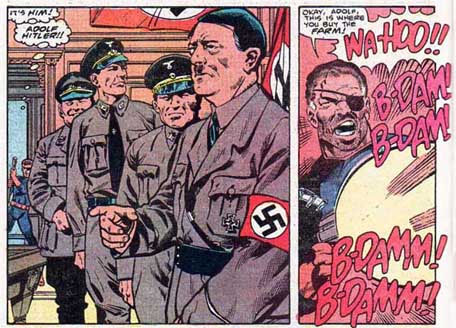
A) The events of World War II as they happened historically can’t be changed, but primarily exist as a backdrop. You’ll hear about the events of the war, but you’ll never actually meet Hitler or change the outcome of the Battle of Midway.

B) You can meet Hitler, but you can’t shoot him. If you do shoot him, it will turn out you shot a double and history continues along unperturbed.

C) You can totally shoot Hitler.

There’s also the semi-tangential issue of the Alternative History Remix: This is the one where you decide that in your version of World War II, Germany is led by a guy name Hans Strauber and they’re fighting the White Alliance of Brittania and Charlegmania. (Or whatever.)

There’s also a second, rarer spectrum in which the PCs are actually canonical characters. Let’s call it the “Dragonlance Spectrum”:

A) You are playing the members of Hitler’s cabinet, but you’ll create an original character (replacing their historical analogs).

B) You are playing the actual, historical members of Hitler’s cabinet, but you’re free to take whatever actions you want (even if those contradict the historical reality of what the cabinet did).

C) You are playing the actual, historical members of Hitler’s cabinet and you’re going to be railroaded into experiencing World War II exactly the way that they did.

(Actually, this one is probably a little less of a clear spectrum. You could theoretically play non-canonical characters who are nonetheless being railroaded through the same events.)

Ken Levine proffers (and comments upon) a Mike Nichols quote:

Every scene is either a fight, seduction, or negotiation.

Levine points out some caveats with the claim and Mark Evanier (who originally linked me to Levine’s piece) offers a few more, but I thought the simplicity of the fight / seduction / negotiation triad was an interesting conceptual tool when thinking about scene-framing. As I discussed in the Art of Pacing, there’s a lot of different ways you can think about the creative elements that you put into a scene and a lot of different structures you can use (or abuse)

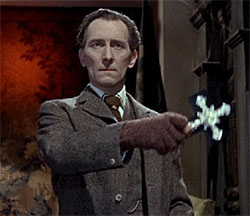
Van Helsing - Peter CushingDH Boggs at Hidden in Shadows has put together an absolutely fascinating bibliographic analysis of the earliest versions of the turn undead ability in D&D.

The short version: Virtually no explanation of the “turn undead” ability was provided in the original edition of D&D. Boggs makes a strong case that the ability was only being used by Arneson’s Blackmoor group in Minneapolis and not being used by Gygax’s Greyhawk group in Lake Geneva. Gygax, therefore, gave the ability short shrift in compiling the 1974 rulebooks; this short shrift, in turn, resulted in people interpreting the ability in a way that was much more powerful than Arneson intended (or the Blackmoor group was experiencing). And the legacy of that power-up is something that the game is still dealing with 5+ editions later.

This is a great example of the “Ur-Game” of D&D, as I described it in my Reactions to OD&D several years ago.

What’s also interesting to me is how closely Boggs’ reconstruction of Arneson’s original rules mirror the house rules for turning that I posted here on the Alexandrian back in 2007. (These rules are still being regularly used in my 3.5 Ptolus campaign. And they’re great: Streamlined resolution paired with a range of effects which is less overpowered and, simultaneously, more interesting in the results it produces.)

Back to Reactions to OD&D

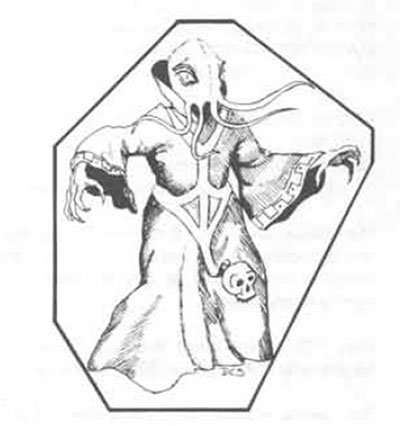
Hack & Slash posted On the Visual History of the Illithid the other day and pointed out that, in the original Monster Manual, the portrait of the mind flayer was surrounded by an irregular octagon that was completely unique within that tome:

Mind Flayer - Monster Manual (1977)

“Although several creatures in the monster manual have borders, most are square. Only two other creatures, the Bugbear and Type V demons have octagonal borders and both of their borders are more regular. Each pane of the mind flayer border is of a different length, no two matching.” Which feels oddly appropriate, given the dimension-rending origins of the mind flayer in many versions of their mythos.

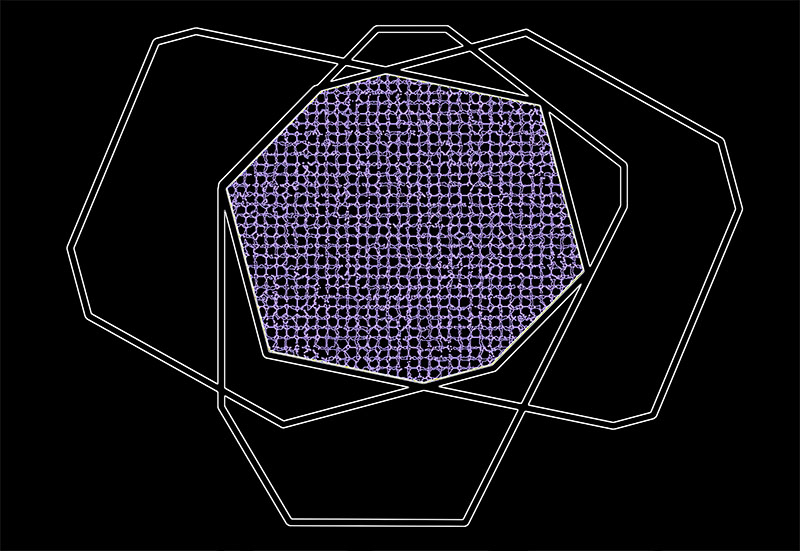
I was struck by the idea that you might be able to take that octagonal border and turn it into an iconic symbol or badge. An Icon of the Flayer. A couple dozen minutes of fiddling around in Photoshop gave me this:

Icon of the Flayers

Archives

Recent Posts

Recent Comments

Copyright © The Alexandrian. All rights reserved.