The Alexandrian

Archive for the ‘Reviews’ category

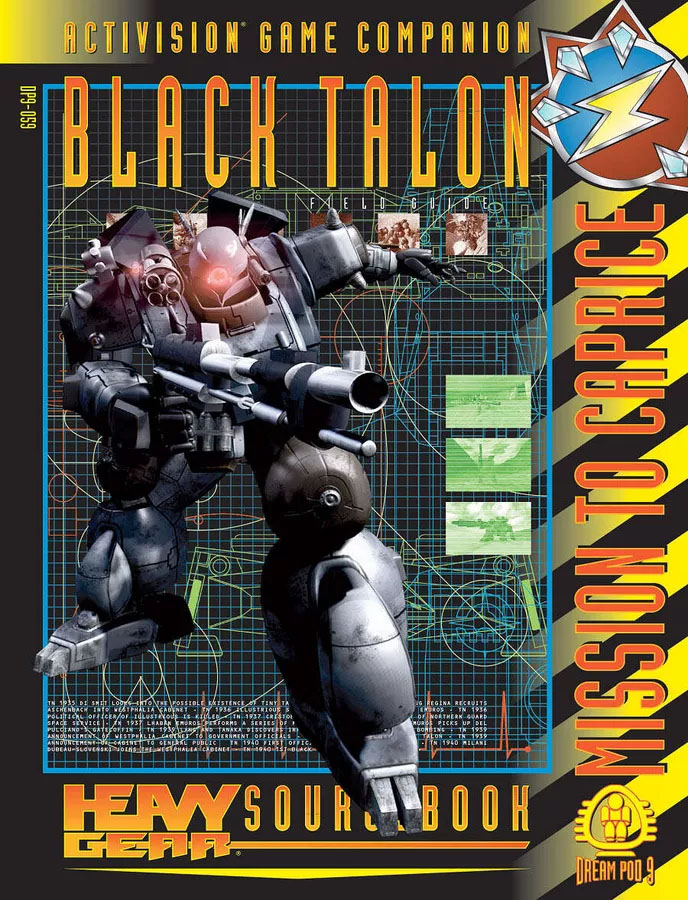
Heavy Gear - Black Talon: Mission to Caprice

Review Originally Published in Games Unplugged (July 2000)
Republished at RPGNet – May 22nd, 2001

Heavy Gear is headed for the stars.

Activision’s Heavy Gear II computer game focuses upon the trial by fire of the 1st Black Talons, the inaugural squadron of a new Terranovan fighting force designed to take the fight against the Terran aggressors back to Caprice. The Black Talon Field Guide, designed as a companion to this game, serves as a massive campaign resource for setting your own Heavy Gear games within the auspices of the expanding Black Talon program, or the wider struggle against Earth as a whole. The book is more than capable of standing on its own, but will be strengthened for some campaigns with the use of Tactical Space Support (detailing specialized rules for space combat) and Life on Caprice (the core sourcebook describing the planet of primary operations for the Black Talon program).

The only serious weakness of this book is a slight confusion over the time period when the material is set – the book is primarily presented as taking place after the events of the Heavy Gear II computer game, but some sections of the book instead seem to slip back to a time period just before the first Black Talon mission was launched. This is combined with numerous instances of copyediting errors and typos, which continue to make their debilitating presence felt in Dream Pod 9 products.

But these minor flaws are far outweighed by the sheer wealth of material which is present here. Some sections of the text will be familiar to veteran Heavy Gear players (but this is to be expected since the book is designed for new players brought to Heavy Gear by the computer game), but even they will be able to wade hip-deep in this one. When you can turn the page of a roleplaying supplement and say, “My god, there’s more?!” you know you’ve got a winner. This one’s a winner.

Grade: A

Writers: Marc-Alexandre Vezina
Publisher: Dream Pod 9
Price: $20.95
Page Count: 128
ISBN: 1-896776-63-9

This review is shorter than my typical reviews because it was written as a non-featured review for Games Unplugged magazine and I was writing for a very specific word count. One of the interesting things about GU reviews is that they would publish short recap versions of the review in subsequent issues, providing a much larger wealth of information in each issue. These recaps were written by the original review authors. Here’s the one I wrote for this review:

Recap: Heavy Gear is headed for the stars. The Black Talon Field Guide, serving as a companion to Activision’s Heavy Gear II computer game, serves as a massive campaign resource for setting your own Heavy Gear campaign within the auspices of the expanding Black Talon program. A sheer wealth of material makes this a highly desirable book for neophytes and veteran players alike.

I found that the recaps were an art in themselves: How to capture the key points in a VERY limited space, while still being a comprehensible to new readers.

Revisiting these older reviews really makes me want to run all the Heavy Gear campaigns I never got a chance to when I was younger.

For an explanation of where these reviews came from and why you can no longer find them at RPGNet, click here.

Grades

Long ago I wrote a guide to grades here at the Alexandrian, but at the time I was mostly focused on reviewing narrative works (books, films, etc.). I use the same scale and same basic principles when providing review grades for RPG books, but people are sometimes confused about why I might give an adventure I liked a grade of B- or the like. So I wanted to update the grading guide to discuss how I grade RPGs, supplements, and adventures.

Broadly speaking, here’s how I think of the letter grades:

A – Excellent
B – Good
C – Average/Mediocre
D – Poor
F – Worthless

To get a little more specific, let’s first talk about how I use grades for roleplaying games:

A — This game is brilliant. I think it’s destined to become a classic. I’m excited to play it and I think you should play it ASAP. Even if it’s not the genre or type of game you might usually play, you might still want to check it out.

B — This game is very well designed. I recommend it.

C — This game is okay. If it’s in a genre you particularly like and if the mechanics sound like the sort of thing you usually enjoy playing, you’ll probably find something to enjoy here. But there are a lot of problems that will likely detract from the playing experience. Expect to use a lot of house rules here.

D — This game is seriously flawed. I wouldn’t refuse to play it, but there’s not enough here for me to recommend it on any level. Approach with extreme caution.

F — Complete and utter waste of time. Unless someone is paying you to play this game, don’t bother.

And for supplements:

A — This supplement is essential. Assuming you have interest in the topic covered by the supplement, it’s a no-brainer to use it in your game.

B — This is a very good supplement. I recommend it, and you’ll likely find it enhancing your game in a lot of ways.

C — The supplement is functional. It’s giving you the rules or setting information you need for whatever the topic of the supplement is. But there’s also probably a bunch of stuff you’ll want to ignore, tweak, or need to expand to make it usable.

D — This supplement is seriously flawed. I think you’ll end up ignoring most of it, but there a few gems hiding in here that might be worth prying out.

F — Complete and utter waste of time. Whatever the supplement is talking about, you’d be better off designing from scratch.

And for adventures:

A — This adventure is a classic. It makes me want to drop everything else and start running it for my players ASAP. Everyone should play this one.

B — This adventure is very good. I’d be willing to run this adventure without making any changes (although, in practice, I probably will).

C — This adventure was okay. It would be fun to run, but there are significant issues that I would feel compelled to fix before trying to run it.

D — This adventure is seriously flawed. It’s not a complete waste of time and if the concept sounds intriguing it may still be worth checking out. But there’s not enough here for me to recommend it, and you’re probably going to have put in a lot of work to make it playable. Approach with extreme caution.

F — Complete and utter waste of time. Probably not even worth strip-mining.

CONCLUDING THOUGHTS

Pluses and minuses generally modify or color the grades described above. An A- would be an excellent adventure, for example, but have a few flaws you might want to address before running it. A B+ adventure, on the other hand, would be a really good adventure with a really awesome elements (characters, scenes, situations, concepts, etc.) scattered about.

An A+, it should be noted, is reserved for a game or adventure that immediately finds its way onto my personal Top 50. This isn’t an exact science, since I don’t actually keep a precise Top 50 list, but if I’m giving it an A+ it’s because it compares favorably with Ten Candles, Technoir, Alice is Missing, Blades in the Dark, Suppressed Transmissions, Masks of Nyarlathotep, Banewarrens, Eternal Lies, Dracula Dossier, and City of Lies.

The basic theory of this grading system is Sturgeon’s Law: 90% of everything is crap. I figure if something falls into that 90% range, then it’s not worth wasting the time determining exactly how crappy it is — all of that stuff is just graded F. The other grades deal entirely with the 10% of stuff that’s in any way worth taking our time to consider.

Ex-RPGNet Review: D&D Gazetteer

January 14th, 2026

D&D Gazetteer (2000)

Review Originally Published May 22nd, 2001

Every so often I read an RPG supplement and I just can’t figure out what was going through the head of the editor who green-lighted it. This is one of those books.

The D&D Gazetteer is, essentially, a 32 page excerpt from the Living Greyhawk Gazetteer which was released several weeks prior to the Living Greyhawk Gazetteer.. And I mean that literally: Every last scrap of information to be found in the D&D Gazetteer is to be found in the Living Greyhawk Gazetteer. Every last bit. Honest. Scout’s honor. (Would I lie to you?)

So the question which ran through my mind as I sat down to review this product was simple: Why would you release two products with the exact same information in them?

To get an answer I went to Ryan Dancey (a VP at WotC who was previously in charge of the D&D product line), and his answer was simple: There is a segment of the D&D market which doesn’t want fully developed campaign worlds: They want a gazetteer-style product which just briefly covers the highlight of a campaign world – something which gives them a common gaming environment, but also lets them fill in the details.

Okay, I can buy that. Sort of. It still leaves questions in my mind as to why the confusingly similar names were used for the two products (especially since the Living Greyhawk Gazetteer isn’t, strictly speaking, a gazetteer), not to mention the release schedule which seemed to scream “we’re trying to rip people off who aren’t following our upcoming release schedule like a hawk” (since the unwary consumer would most likely pick up the D&D Gazetteer without realizing that the much more complete Living Greyhawk Gazetteer was coming).

But I can buy it. So, if you’re one of those people who prefer a less-developed campaign world, this is the book you want – not the Living Greyhawk Gazetteer.

So what is this, anyway?

Well, as most of you probably already know, Greyhawk is – arguably – the original D&D campaign setting; designed and developed by Gary Gygax himself and originally released in a product with a very similar format to the D&D Gazetteer itself. During the last years of TSR, however, Greyhawk – which had been steadily losing ground to the extremely popular Forgotten Realms setting – was canceled. When WotC bought out TSR, however, one of the first things they did was announce the return of “the original campaign” and, with the release of Third Edition, Greyhawk was made the de facto standard of the D&D game once more.

The D&D Gazetteer is a 32 page pamphlet which, basically, serves as a broad introduction to Greyhawk – a campaign world with nearly three decades of development behind it: The history of the world is covered in broad strokes; the significant stats of the major kingdoms are given and they are briefly described (an average of three paragraphs or so is devoted to each); major geographical forms are detailed; and major power groups are given a similarly distilled treatment. A full-color map of the world is also included. All of this is done extremely well.

In other words, the D&D Gazetteer does exactly what it’s supposed to do. I just don’t have that much confidence that a large segment of the market really has a desire for what it’s doing. I, personally, would be happier with the Living Greyhawk Gazetteer – but your mileage may vary.

One thing I have considered doing with the Gazetteer, however, is using it as a player resource. My read-through of the material here didn’t turn up any deep, dark secrets of the world which I wouldn’t be comfortable with my players knowing – and the low price point would make it comparatively easy for me to pick a copy up for all my players (or for them to pick one up for themselves). As a result, the D&D Gazetteer could, essentially, serve as  “player’s guide” to Greyhawk – although you might want to preview the material yourself before okaying it for your own campaign.

Writers: Gary Hollan, Erik Mona, Sean Reynolds, Frederick Weining, Skip Williams, Ed Stark
Publisher: Wizards of the Coast
Price: $9.95
Page Count: 32
ISBN: 0-7869-1742-3
Product Code: TSR11742

I remain confused about the decision to publish both a D&D Gazetteer and D&D Living Greyhawk Gazetteer just a few weeks apart. It actually kind of echoes my confusion with Wizards’ release schedule at the tail end of 2025, when they released two different starter sets a few weeks apart, followed by two different campaign settings in back-to-back months.

I remember even in response to this review there were people saying stuff like, “Wait… this ISN’T the Living Greyhawk Gazetteer?” and, “There’s two of them?!”

I also found the decision to make Greyhawk the “official” setting of D&D 3rd Edition, but then only releasing a single setting supplement (or, I guess two setting supplements) to be a weird one. The official explanation, if I recall correctly, alternated between “this way the DM can feel like it’s a setting they can do anything they want with” and “we’re leaving it for organized play to use,” which were basically diametrically opposed. Ultimately, I’m guessing there was just some weird internal politicking going on as a result of Dancey’s decision to ruthlessly (albeit necessarily) slash the number of D&D settings that were being published, and these weird product decisions were the result.

For an explanation of where these reviews came from and why you can no longer find them at RPGNet, click here.

Blades in the Dark: Deep Cuts (John Harper)

I’m a huge fan of Blades in the Dark, and I was very excited for Deep Cuts, a major expansion designed by the game’s original creator, John Harper, with additional design and writing by Sean Nittner, Pam Punzalan, and James Mendez Hodes. I backed the crowdfunding campaign for the book and, once I held it in my hands, I was immediately sucked in and read the whole thing cover to cover.

Then I settled in and started doing some deep thinking about Deep Cuts.

The book can be roughly divided into two parts: The first adds a bunch of new material to the post-apocalyptic steampunk setting of Doskvol. The second radically revises the rules of the game, effectively offering a sort of do-it-yourself kit for assembling an ersatz second edition of the game.

SETTING

The setting material is a goulash of goodness. Blades in the Dark is, of course, designed to be a modular, sandbox game, and Deep Cuts is basically just expanding the toybox full of goodies that you can drop into your game.

Innovations provide a selection of new equipment, including rare items like a Bolton Autocycle or a Sparkrunner Rig that could easily become the target of a score or an Acquire action. I really like the presentation of most of these items as new technology in the setting itself: Part of the steampunk aesthetic is that technology is marching forward. You can take this stuff and feed it into your campaign one or two items at a time, blaring it as headline news, lightly seasoning it as background detail, or framing it up as a surprising new threat in the middle of a score.

Squeezed into the middle of the Innovations section is a whole new calendar that renames the six months of the year. This really reflects how Deep Cuts is just a semi-random collection of stuff John Harper created for his home games. There’s not a single, unifying theme or thesis here. It’s really just a guy saying, “Hey! Look at this cool thing I made!”

Next up are twenty-five new Factions. If you’ve run multiple campaigns of Blades in the Dark over the past decade (as I have), then these are a welcome breath of fresh air. You and your players may have become intimately familiar with the Crows and Red Sashes, but now you can frame up whole new starting situations with factions like the Ink Rakes, Ironworks Labor, and Rowan House.

My only reservation with these new factions is that so many of them are “infrastructure.” The firefighters, cabbies, and railworkers are an important part of the city, but a multitude of faction goals like “modernize the guild” and “formalize their union” really underline that they’re more bureaucratic functionaries than sources of adventure. Nonetheless, there’s a lot of good meat in here, too, and perhaps inspiration will strike and turn stuff like the fire brigade’s PR campaign into your campaign’s Chinatown.

Also tucked away in this section is a 30-year plan to expand Doskvol, pushing out into the ghostlands and adding four new districts. This is an incredibly cool concept, immediately driving all kinds of internecine strife while also providing a long-term scaffolding for evolving the setting in a game that encourages time-skips and decompressed downtimes.

Heritages and Backgrounds then provide a wealth of new information about the wider world beyond Doskvol, while also giving players new structures for adding depth and color to their characters. Did you come from a family of Blood Cullers or Lockport Scummers? Before you joined the crew, were you a roof runner or a farmhand? Being able to flip through these sections and have concepts like “refugee occultist” or “electrochemist from a family of lightning couriers” leap off the page is delightful. (In fact, the only thing I might do differently is put them on random tables so that players looking for inspiration can just roll-and-combine.)

THE CAMPAIGN CATALYST

SPOILERS FOR THE DEEP CUTS CAMPAIGN FRAME

Wrapping up and also tying together the new setting material is a campaign frame: Fractures in reality have connected Doskvol to another reality. Strangers from this other world are slipping through into Doskvol, bringing with them strange technology and magic. Others are vanishing from this world and passing into the other. Factions are slowly beginning to learn the truth about what’s happening and are secretly moving to take advantage of it.

This is a fun concept with (if you’ll pardon the pun) a lot of dimensions to be explored. Harper weaves it into faction clocks and NPCs, then fleshes it out with mission profiles for every crew type. Combined with the structures for emergent play which are the backbone of Blades in the Dark, this all primes the pump and gives you almost everything you need to introduce the Others and hit the ground running. It is, very literally, a catalyst — something you can inject into your campaign and initiate a run-away chain reaction.

The only problem here is that Harper wants to leave the precise nature of the other world up to the individual GM. He offers several possibilities:

  • Victorian Earth
  • Mirror Universe
  • Demonic World
  • Time Travel
  • Lady Blackbird

Or any number of other possibilities you might imagine.

On the one hand, it’s great to offer this kind of flexibility. On the other hand, the practical effect is that nothing attached to the catalyst can have any kind of specificity. It, by necessity, ends up as just vague handwaving and a few encouraging, “You’ve got this!” cheers shouted to the GM.

For example, the members of Rowan House are secretly descended from the Others. Does that mean they’re demon-spawn or that their grandmother was from 1810 London? It’s a radical difference. And because the book can’t give you an answer, they end up being… nothing at all. Deep Cuts has to avoid making strong, interesting choices over and over again.

So the catalyst is a really cool idea and it demonstrates the broad outlines of how you could implement big, widespread events like this into your Blades in the Dark campaign. But it also leaves you with all the hard work of making it playable.

SYSTEMS

At this point we transition to the back half of the book, which is loaded up with dozens of changes to the core mechanics of Blades in the Dark. To be clear: Very little of this is new mechanical systems. It’s almost entirely changes to the existing mechanical systems.

Let’s deep cut to the chase here: I did not like this section of the book.

There are a few interesting nuggets buried in here, but the vast majority of the material makes the game significantly worse. If a second edition of Blades in the Dark were published with these changes implemented, I would not play it or run it.

Let’s break down a few examples.

EFFECTS & CONSEQUENCE

Let’s start with something I really liked: On page 101, Deep Cuts includes a unified Effects & Consequences table providing escalating adjectives and mechanical effects for Limited, Standard, Great, and Extreme effects. (For example, a standard effect of Intimidated might be downstepped to a limited effect of Hesitant or upstepped to a great effect of Afraid or an extreme effect of Dominated.)

This table is incredibly useful, particularly for a new GM trying to wrap their noggin around the concepts of position, effect, and consequences.

LOAD

I also liked the expanded system for Load, which not only finesses the handling of exceptionally heavy objects in the system, but also uses Load as a way of managing encumbrance gains and complications during a job.

HARM

John Harper saw that some players in actual play videos would forget to apply the penalties from Harm to their die rolls, so he produced a revised system in which Harm has no inherent mechanical effect. Instead, it becomes a tag system that the GM can choose to invoke to create complications, reduce position/effect, or… apply a penalty to the die roll. When the GM chooses to invoke the condition, the player gets to mark XP.

Ugh.

First, I’m not generally a fan of dissociated tag systems where the reality of the game world only meaningfully exists when someone arbitrarily chooses to “invoke” it.

Second, the response to players being unable to keep track of a dice modifier for their characters should NOT be, “Well, I guess there’s just no choice but to require the GM to keep track of every individual wound suffered by every single PC and also be responsible for invoking them in way that’s fair and effective in some nebulously undefined way.”

This is part of a long trend in RPGs of making the GM responsible for everything that happens at the game table. I strongly feel that the entire hobby needs to break away from laying this immense burden on the GM’s shoulders, not needlessly multiply it.

TRAUMA

This module lets the players mark XP if they use their Trauma in a way that creates a problem or complication for them during play, which is a great way of reinforcing it as a roleplaying prompt.

Trauma is also modified so that it’s no longer permanent, with options given for recovery. This, obviously, blunts the core game’s relentless march to character retirement, which makes it a nice option for groups that don’t want as much character turnover. Another module gives options other than prison time for removing the crew’s Wanted Levels, to similar effect.

Personally, I think there’s a significant drawback here: The original game created a low level of character churn, which systemically encouraged players to create multiple characters. This, in turn, put the narrative focus of the game on the crew, rather than the individual characters, and diversified the player’s experience and interactions with the game world. Moving away from this also means moving away from one of the things that made Blades in the Dark unique and distinguished it from other RPGs.

ACTION

Which brings us to the Action module, in which Deep Cuts overhauls the entire core mechanic of the game.

And, frankly, Harper makes a dog’s dinner of it.

Take Devil’s Bargains, for example. In the original game, the GM could offer a devil’s bargain: The player could gain extra dice on an action roll by accepting an additional cost — collateral damage, Harm, Coin, sacrificing an item, starting a clock, betraying a friend, adding Heat, etc. In Deep Cuts, on the other hand, the term “devil’s bargain” now refers to any time the GM requires the players to make a roll. But also the extra dice thing. And also you can offer a devil’s bargain to let them skip the dice roll entirely.

A useful term of art is turned into a mess, while at the same time trying to position it as a central axis around which the game turns.

This all ties into the new concept of Threat Rolls, which essentially replace action rolls. When using this new core mechanic, instead of setting position and effect, the GM simply sets the negative consequence that will happen on a failed roll and then tells you what action rating to roll: On a 6+ you avoid the consequence. On a 4/5 you suffer a reduced consequence. On a 1-3 you suffer the full consequence.

This whole mechanic essentially waves a white flag at those who want to run Blades in the Dark exactly like D&D (with the DM telling the players what to roll and what the result will be). Good for them, I guess. But, once again… Ugh.

I’m just not interested in Blades in the Dark being turned into generic mush.

DOWNTIME

Deep Cuts also heavily revises the Downtime system. This is more of a mixed bag.

On the one hand, there’s a cool new Debt mechanic and new rules for using Banks. The new guidelines for Heat — which take a base rate based on Tier and then modify it by Target, Chaos, Death, and Evidence — are also great, along with the supporting guidelines for modeling actions to reduce or mitigate the Heat from a job.

There’s a similarly revised set of guidelines for Payoffs. These are also useful, although it’s worth noting that they significantly increase the amount of Coin the PCs will earn per job.

On the other hand, there’s stuff like the new Entanglements system, which is designed to remove random dice rolls. The overall effect, though, seems to greatly flatten the experience: Outcomes become predictable and routine. There are no surprises and no variations from one Downtime to the next. It also removes a lot of the procedural content generation aspects that make Blades in the Dark such a fun sandbox engine.

CONCLUSION

I don’t like Deep Cuts.

I loathe the mechanical changes. They’re disastrous and, honestly, pretty depressing. It’s always sad to see a game heading in the wrong direction, and that’s even more true when the game was something truly special like Blades in the Dark. If the book was limited to its mechanical content, I’d probably give it an F-.

However, almost half of the book is the new setting material, and while that has a few duds and some missteps, there’s a ton of useful stuff in there that will definitely enhance and expand your Blades campaigns. Therefore, with the book only costing $25, I think dedicated fans can just barely justify picking up a copy for the setting material alone.

GRADE: D

Designer: John Harper
Additional Design & Development: Sean Nittner, Pam Punzalan, James Mendez Hodes, Allison Arth, Sharang Biswas, Sidney Icarus

Publisher: Evil Hat
Cost: $25
Page Count: 128

A Knight's Tale

Review Originally Published May 21st, 2001

One of the first scenes in A Knight’s Tale is that of a crowd chanting and stomping their feet to Queen’s We Will Rock You while watching a medieval jousting tournament. Throughout the film – telling the story of a young peasant who dons armor and competes as a knight while falling in love with a princess – rock music will appear again and again, along with other anachronistic elements such as: Geoffrey Chaucer using WWF-style language while acting as the knight’s herald; a medieval dance which transforms itself into a dance party; and a host of modern colloquialisms.

When I was leaving the theater, I heard the couple behind me utter the following:

Girl: I liked it.
Boy: Yeah, but the music wrecked it.
Girl: Yeah.

These two people, my friends, are idiots. The music in A Knight’s Tale does not ruin the movie. To the contrary, the music saves it.

Let’s get one thing straight: From a certain point of view, A Knight’s Tale is cliched, trite, and predictable. From the moment you see the previews you already know everything which is going to happen in this film: The main character is going to succeed brilliantly as a knight, he’s going to win the heart of the princess, the bad guy is going to get beaten, and there’s going to be a happy ending.

End of story. Done deal.

But the minute that crowd starts stamping its feet and chanting We Will Rock You something magical happens: A Knight’s Tale imbues itself with what I can only describe as an ineffable energy – an excitement which permeates every performance, every scene, every moment.

Perhaps the only analogy that really suits is that of the roller coaster: Before you ever get on the roller coaster you know exactly what’s going to happen – you’re going to go up, you’re going to go down (really fast), you’ll probably do a couple of loop-de-loops, and then you’ll end up right back where you started. But you still get on the roller coaster because the ride is fun

The ride in A Knight’s Tale is fun. Sure, you know where you are every step of the way. “Oh,” you say, “This is the scene where the handsome young knight makes a fool of himself in front of the princess, and she is bemused.” Or: “This is the scene where the villain establishes himself as superbly talented, but cruel and heartless.” But at the same time you’re enjoying yourself.

The real key here is that A Knight’s Tale isn’t trying to fool anybody. We Will Rock You is, quite simply, the filmmaker’s way of saying: “Look, you know and I know you’ve seen this plot a dozen times. But, look, I’m not taking myself too seriously here. Kick back, relax, and let’s have fun, okay?”

The couple behind me probably thought this movie was historically accurate except for the bizarre musical numbers. This movie ain’t for them – they don’t get the joke.

And, of course, most of use have already heard from the historians who are so tightly wound up that Shakespeare in Love gave them a aneurysm. This movie ain’t for them, either – they couldn’t get a joke if it can labeled with a disclaimer.

This movie is for people like you and me, who can kick back and enjoy something on its own terms. For us, this movie is pure fun. So go grab yourself a ticket, a bucket of popcorn, and a large soda.

Style: 4
Substance: 4

Director: Brian Helgeland
Writer: Brian Helgeland
Distributor: Sony Pictures

A Knight’s Tale is like a fine wine: Every time you come back to it, you can savor it in new ways.

This movie review came out of the same gestalt as my previous review of The Mummy Returns: I was moving a forum discussion into a review. At the time I considered doing more of these film reviews for RPGNet, but I ended up drifting away from them instead. Checking the Reviews page, it looks like it’s been a hot minute since I did a movie review here at the Alexandrian, too.

For an explanation of where these reviews came from and why you can no longer find them at RPGNet, click here.

Archives

Recent Posts

Recent Comments

Copyright © The Alexandrian. All rights reserved.