The Alexandrian

Rappan Athuk – Maze 6-2A

November 18th, 2005

I still need to clean-up that Rappan Athuk sub-level I mentioned on Tuesday, but in the meantime I thought I’d offer up some other supplemental material for the Rappan Athuk modules. There will be some obvious spoilers here, so I encourage anyone who might be playing  in these modules to ignore the next few posts.

On Level 6 of Rappan Athuk, there are four mazes (each keyed as area 6-2). These mazes are left essentially undetailed with a basic suggestion that the DM should have a mustard jelly attack the party before simply feeding random information to the players for an hour of game time before allowing them to escape each section of the maze. As an alternative, I’ve prepared four maze sections:

Area 6-2A — The maze between areas 6-1 and 6-17.
Area 6-2B — The maze between areas 6-1 and 6-3.
Area 6-2C — The maze between areas 6-3 and 6-4.
Area 6-2D — The maze between areas 6-3 and 6-16.

The first of these, area 6-2A, uses the suggested mustard jelly attack. The others, which I’ll post over the next couple of days, have more unique themes and elements. I should also note that these mazes use the style of my personal campaign notes, rather than any official style guide. In particular, you’ll note the short descriptions of creature abilities designed to jog my memory at the gaming table. The halls in each maze are 10 feet wide.

This material is covered by the Open Gaming License.

AREA 6-2A – THE MUSTARD JELLY MAZE
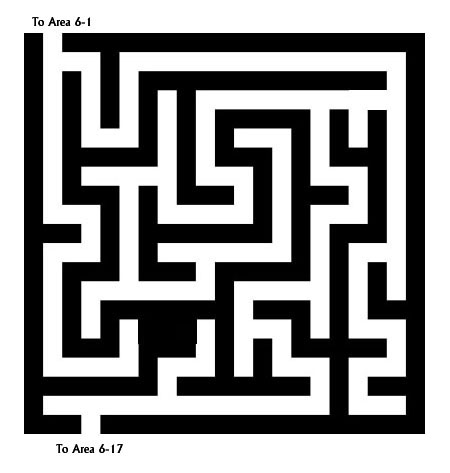
Maza 6-2A

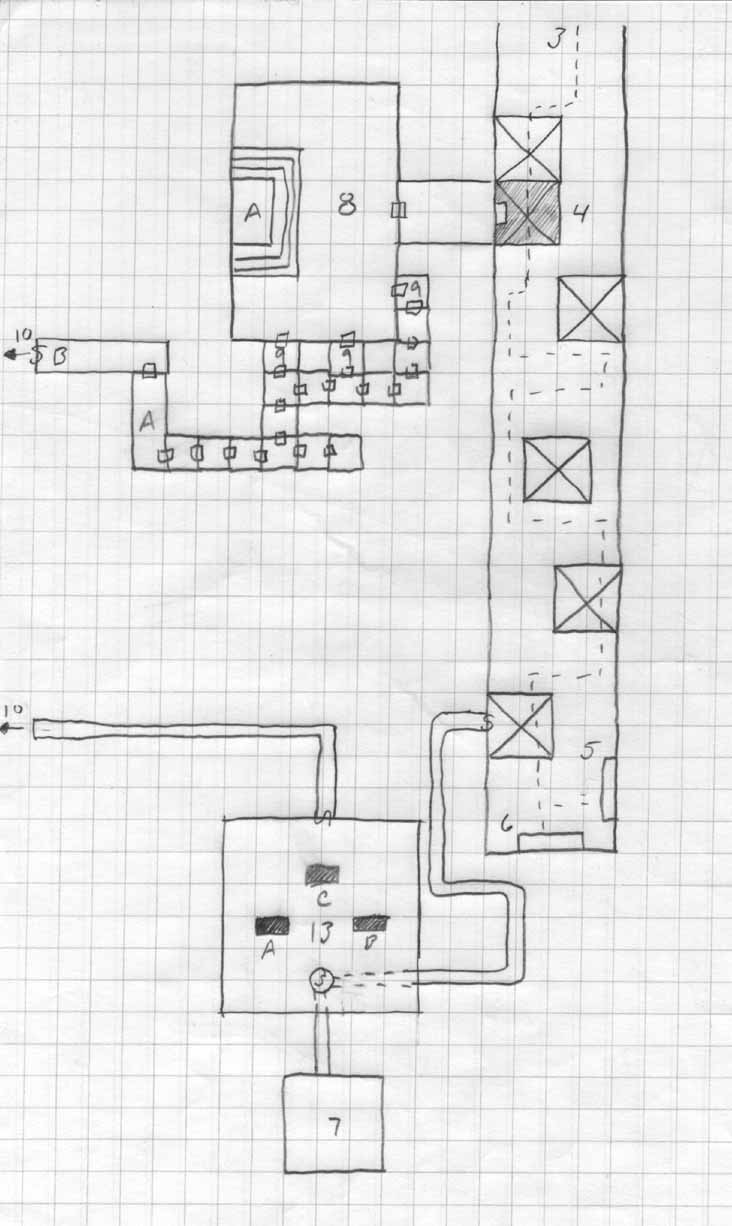
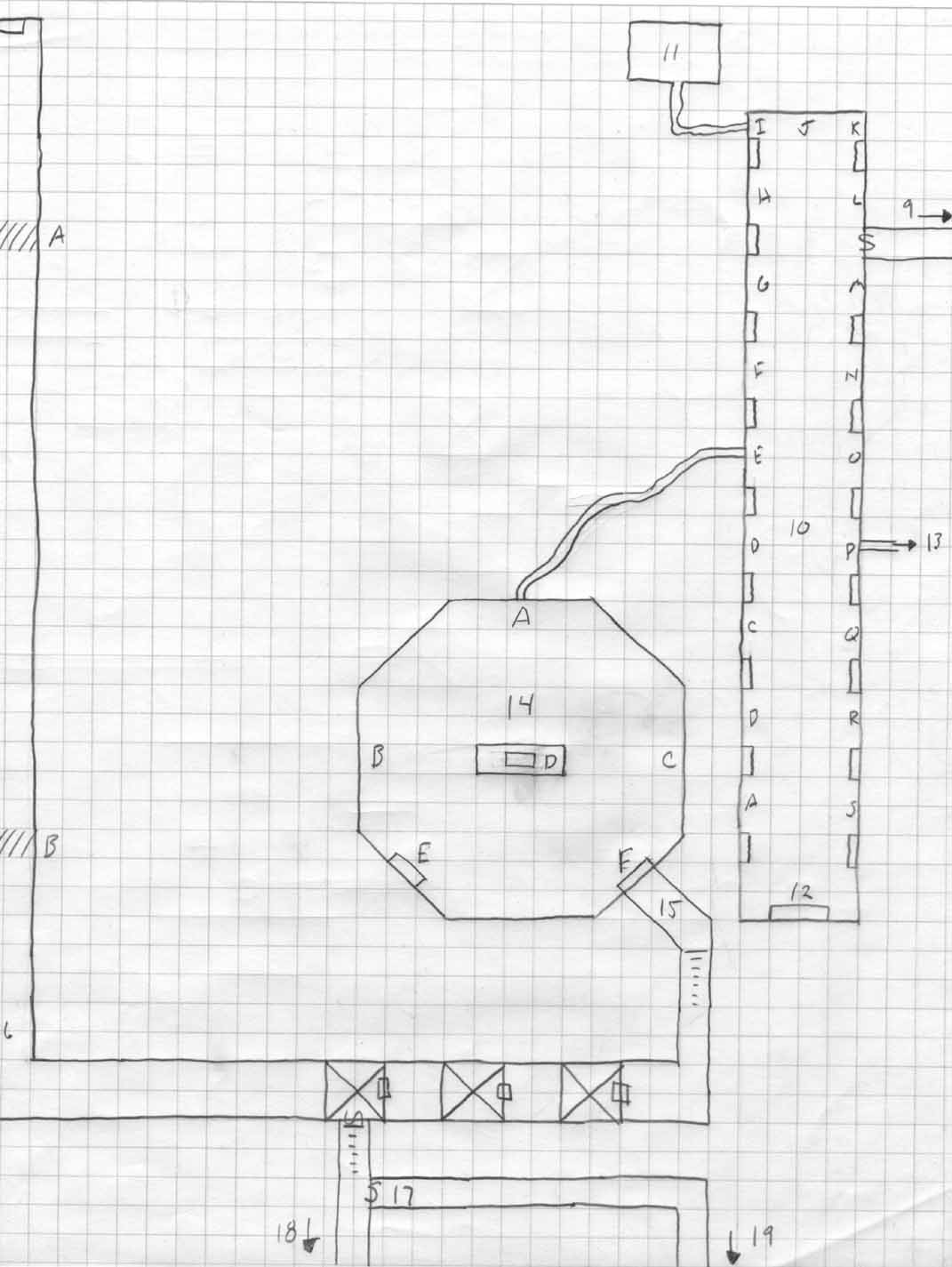
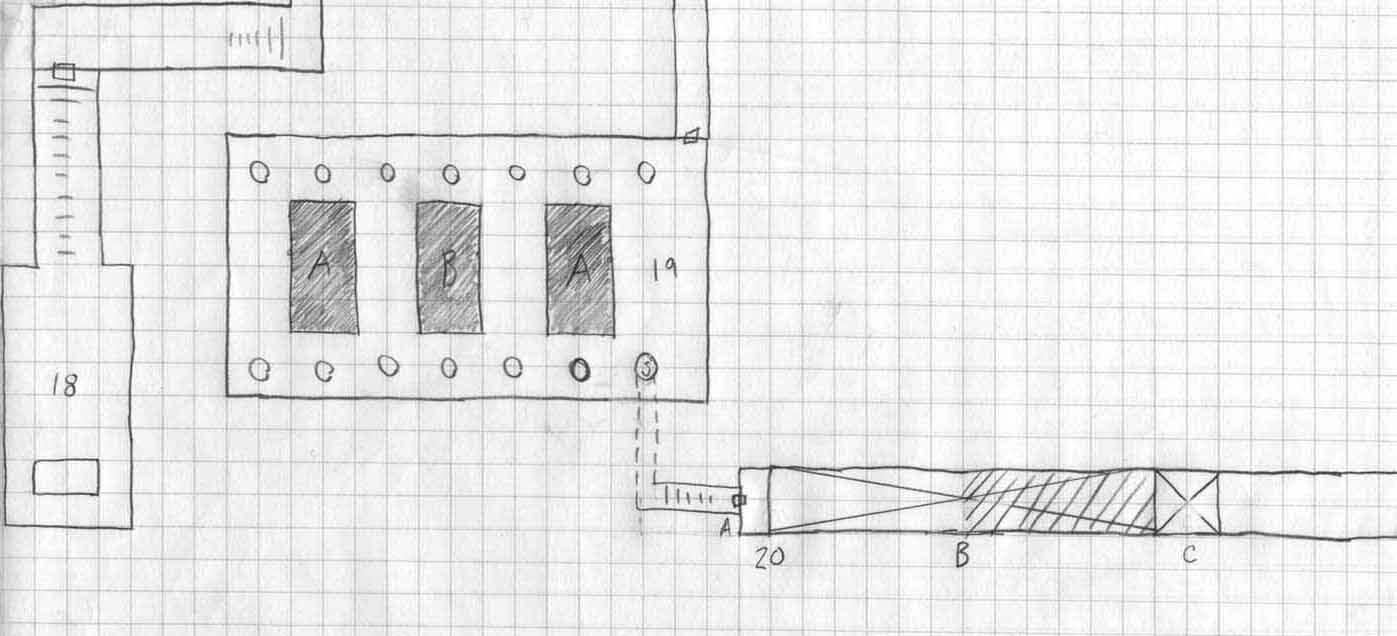
This maze is the hunting ground of a mustard jelly. It knows the maze like the back of its hand (or it would if it had one) and will track the PCs down 1d10 rounds after they enter the maze. If necessary, it will then instinctively split into two parts, with one circling around through the maze to cut the PCs off from behind. (It doesn’t like it when its prey manages to escape.)

PILES OF BONES: In various places around the maze, the PCs will find piles of scattered, acid-scarred bones. The mustard jelly has favorite little corners it likes to digest in. None of these piles have anything valuable left in them.

MUSTARD JELLY: Large Ooze; CR 7; HD 7d10+29; 67 hp; Initiative -5; Spd 10 ft.; AC 4 (-1 size, -5 Dex), touch 4, flat-footed 4; Base Attack +4, Grapple +11; Atk +6 melee (2d4+3 and 1d4 acid, slam); Space/Reach 10 ft./10ft.; SA improved grab, acid, poisonous aura, constrict 2d4+3 and 1d4 acid; SQ damage reduction 10/magic, blindsight, SR 13, cold and electrical immunity, split, ooze qualities; SV Fort +4, Ref +3, Will +3; Str 15, Dex 1, Con 15, Int –, Wis 1, Cha 1.

IMPROVED GRAB: After slam, automatic grapple check to hold.
CONSTRICT: If holding, automatic damage each round
ACID: Dissolves only wood and flesh
POISONOUS AURA: 10 ft. radius, affected as by slow cast by 12th level sorcerer (Will save, DC 15, negates)
SPLIT: Any physical or electrical attack deals no damage, instead causing the mustard jelly to split into two identical creatures, each with half of the original creature’s hit points. A jelly with only 1 hp cannot be further split and is destroyed.
OOZE QUALITIES: Immune to mind-influencing, poison, sleep, paralysis, stunning, and polymorphing. Not subject to critical hits.
Go to Maze 6-2B

The Tomb of Horrors

November 15th, 2005

The Tomb of Horrors - E. Gary Gygax

I’ve spent most of my free time for the past two weeks prepping what I hope will turn out to be a really fantastic D&D campaign. It started life as an Order of the Stick-inspired desire to do some old school dungeon-crawling. I’ve been aching to return to Rappan Athuk, one of the greatest dungeons ever designed, ever since I ran a very successful one-on-one session with my good friend Dave Blackmer a couple years back. So I picked up my Rappan Athuk modules and started prepping a barebones setting to drop the dungeon into.

As  I worked, though, it didn’t take long for my quick, barebones preparation to become increasingly elaborate and detailed. In addition to a plethora of original work, the campaign now includes material incorporated from The Crucible of Freya, The Vault of Larin Karr, The Tomb of Abysthor, Demons and Devils, Demon God’s Fane, Beyond the Veil, and more. Putting the best of Necromancer Games and Monte Cook together in one room has created a truly remarkable synergy that’s really gotten my own creative juices flowing.

In a couple of days I’m hoping to have a new sub-level for Rappan Athuk that I’ve prepped converted into a “suitable for general comprehension” format so that I can share it here. But I’m in a roleplaying mood, so I thought I’d share something else with you.

On Halloween this year, Wizards of the Coast posted Bruce Cordell’s v3.5 conversion of Gygax’s classic Tomb of Horrors. For those of you unfamiliar with the Tomb, the module was first released in 1978 as one of the first modules available for the AD&D game, after being used for the Official D&D tournament held at the very first Origins convention. At the time it was a fairly innovative product: In addition to the “map and key” presentation which was standard for the time, Tomb of Horrors also came with a pamphlet of forty illustrations, each presenting some part of the module which could be shown to the players at the appropriate time.

But it wasn’t the illustrations which made the Tomb a classic: It was the deathtraps. No module has left more characters cowering in terror, unable to open the next door out of sheer fear of the doom that surely awaits them, than the Tomb of Horrors.

A couple of years ago I did my own v3.5 conversion of the infamous Tomb. My version went a bit further than Cordell’s has, largely because there is a very significant and very legitimate critique of the Tomb: There are many places where the module just doesn’t play fair. The Tomb is more effective if the players can look back and regret the choices they made because they could have made a different choice. The Tomb as written, unfortunately, features many junctions where death is simply capricious. Opening a random door with an undetectable and inescapable death trap isn’t as much fun as opening a door that triggers a trap you can desperately attempt to escape. My version of the module doesn’t make things any easier (in fact, it often makes it more difficult) — but it does play fair. So that, when death comes, the players will feel terror, not resentment.

In my version I also focused the module on its trademark traps: Combat, already rare in the original Tomb, is rarer still. And always a result of a trap or trap-mentality. Most importantly, I include boxed text — making it very easy to make sure you’re giving precisely the right information about each area to the PCs (and no more).

For the past couple of years, I sporadically tried to get various people interested in publishing an updated version of the Tomb. There didn’t seem to be any interest. So I’m delighted that Cordell’s version has seen the light of day. Even if I’m secretly bitter and resentful that it wasn’t mine. (Okay, there’s not really any bitter resentment. A little secret disappointment, perhaps.)

But rather than letting my version of the Tomb molder on my hard drive, I’m going to share it with you here:

The Tomb of Horrors (RTF)
Map 1
Map 2
Map 3
Map 4
Map 5
Map 6
Zip File (All of the Above)

You’ll also want to grab either the original module or Return to the Tomb of Horrors (which includes a facsimile of the original module) for the original handouts. These handouts can also be found in the Bruce Cordell version, interspersed throughout the text.

If you end up running my version, I’d be very interested in hearing how it went. This adventure can be a lot of fun when used a one-shot. I’ll frequently pull it out if some of my players can’t show up for the game.

To give you some idea of what you’ll find inside, let me present a sample area from the module:

AREA 7 – THE FORSAKEN PRISON

This chamber is a 15’ by 15’ shaft 100’ deep, carved out of solid granite. Characters teleporting to this area from the Arch of Mist (Area 5) materialize at the top of the shaft and automatically plummet to the bottom of the shaft, taking 10d6 points of falling damage.

[[HANDOUT #9]]

FIRST LEVER: At the bottom of the shaft is a lever built into the wall. The lever is marked with Acererak’s sigil. Pulling the lever causes the floor – which is a trap door – to drop away, opening up another 100’ shaft. Characters falling down the second shaft take 10d6 points of falling damage. The character who pulled the lever may make a Reflex saving throw (DC 15) to grab onto the lever, rather than falling down the pit.

TRAP DOOR: The trap door here is illusion protected and also requires a Search check (DC 25) to detect. There is no way to determine that the lever is the triggering mechanism, but the trap door itself can be prevented from opening with a successful Disable Device check (DC 25). After 1d10 rounds, the trap door resets itself and can only be opened by pulling the first lever (which is now on the other side of the trap door of solid stone).

SECOND LEVER: At the bottom of the second shaft is another lever built into the wall. This lever – in all ways – appears to be identical to the first lever above. Pulling this lever, however, opens a secret door in the ceiling of the shaft leading to a crawl space (see below).

FLOOR: The floor of the second shaft is also a trap door, illusion protected and requiring a Search check (DC 25) to detect. And there is also another 100’ shaft below this trap door. But there is not, in fact, any triggering mechanism which opens this trap door.

WALLS: The walls are carved straight out of the rock face and smoothed. Scaling them requires a Climb check (DC 30).

SECRET DOOR: To find the secret door in the ceiling of the shaft before opening it requires a Search check (DC 25). The door is a solid slab of granite about 2’ thick (360 hp, hardness 8) and can only be opened by pulling the second lever. After 1d10 rounds, the secret door will close itself and can only be opened again by pulling the second lever.

CRAWL SPACE: The crawl space beyond the secret door is very narrow. See Area 3 for a complete description.

Running Star Trek

October 25th, 2005

If I had the power to take over the Star Trek franchise at any time during its history, the moment I would choose would be just after Unification, Part I: TNG was at its height of popularity. Every thread had come together to form the seed of a vast, star-flung epic of interstellar war between the Federation and the Romulan Empire.

And then, with Unification, Part II, the producers and writers chickened out: The crisis was averted through a convenient deus ex machina, the character of Sela was conveniently shuffled off-stage, and Spock’s insurgent philosophies were wiped from the series’ memory.

Perhaps we’d lose the brilliance of “I, Borg”, “The Inner Light”, “The Chain of Command”, and a few other classics… but TNG could be turned from its eventual decline to a vibrant new life in which the political machinations of the Klingons, Romulans, and Cardassians would all be interwoven into a compelling saga.

If we wanted to get really daring, Picard would be promoted to Admiral – although his role on the series would continue (he would be the lynchpin which would allow us to get a wider perspective on the war without contrivance; and the Enterprise would be his pet ship for black ops assignments).

Then, when TNG had come to its natural conclusion along with the Romulan War, we would skip the ultimately stagnant waters of DS9, Voyager, and Enterprise – opting to take the franchise in a bold new direction: Hiring visionaries like Vernor Vinge and Iain Banks, we would re-imagine a future a hundred years in TNG’s future… in which all of the scientific devices and innovations we have seen on the series are taken to their logical conclusion.

Exercise Carpe Diem

October 21st, 2005

During my two months incommunicado with an internet connection best described as gulping-air-through-a-short-straw, I did three things of particular note: I bought a new car. I made significant contributions to the Wikipedia articles on “Dungeons & Dragon”, “Star Wars”, and “Expanded Universe (Star Wars)”.

And I started a new exercise program.

EXERCISE CARPE DIEM

My old exercise program was a brute force affair: Five times a week I would engage in a full suite of exercises involving stretches, sit-ups, push-ups, free weights, an exercise bike, and more. Or, rather, I should say that I attempted to do so five times a week.

The problem was that this exercise program took at least an hour, usually two, to complete. And I would sweat so heavily that I would need to take a shower after completing it. That’s a significant chunk of time, and there are only so many hours in the day. So if I had any kind of social commitment – or was just feeling lazy – the exercises wouldn’t get done. Eventually it would be one missed day… a missed week… a missed month…

… When was the last time I exercised, anyway?

And then your body starts feeling it: You’re lethargic. Your muscles ache after a normal day of activities. You’re so far out of shape that you don’t feel like exercising. (Plus, the exercise bike has become a shelving unit.) It doesn’t take long before that vicious cycle has pulled you right back to where you started.

So I decided to try something different. The problem I was having was that, with a busy schedule, it’s not easy to squeeze an hour or two hours or even half an hour of exercise into your daily routine. Plus, for a lot of exercises to be successful, you need to give your muscles a chance to rest, so you can’t do them every day. As a result, since you simply can’t do it every day, it’s difficult to make exercise habitual.

The concept I embraced was “carpe diem”, seize the day. Or, more accurately in this case, seize the moment. Rather than trying to design a half hour exercise routine to fit into my daily schedule, I found some simple exercises that could be done in a minute or two… and then squeezed them into all those little dead moments between one task and the next throughout my busy day.

Basics: I chose sit-ups and push-ups as my two simple exercises. I started with 10 sit-ups and 5 push-ups, and in less than a month I’ve built myself up to 25 sit-ups and 20 push-ups. I alternate between the two: On one day I’ll do push-ups; on the next I’ll do sit-ups. This gives my muscles a chance to recover and maximizes my results.

Schedule: I do one set first thing in the morning, and then I do another set every hour until the end of my work day. That ends up being eight or nine sets each day. So when I was first doing 10 sit-ups in each routine, I was actually doing 80 or 90 sit-ups each day. Now I’m doing 200 or 225 sit-ups each day.

The trick is not to fret too much about doing the exercises at a specific time. Rather, find those natural moments throughout the day when you’ve got nothing immediate to do or just want a quick break from what you’re doing, then drop down and do a quick set of push-ups.

For example, I try to get a set of “8 o’clock push-ups”, a set of “9 o’clock push-ups”, and so forth. But I don’t worry too much about getting them done at 9 o’clock sharp. If they don’t happen until 9:15 that’s fine. If I’m in a meeting from 9 to 11, I’ll do them every half hour instead of every hour until 1 o’clock and then I’ll be caught up. If I’m having a particularly busy day at work, I’ll squeeze in a couple of quick sets after I get home. (Heck, if I feel like it, I’ll keep doing additional sets throughout the evening.)

Tips: Do the exercises seven days a week. I usually end up taking it a little bit easier on my days off – largely because I’m not as time conscious as I am at the office – but I still make a point of doing them. If you do them every day, it’ll become a habit to do them every day.

Got a desk job? Put a Post-It note on your monitor at work with a single word like: “Push-Ups” or “Sit-Ups” or “Exercise”. Whenever your eye happens to catch the Post-It Note, make a point of getting up and doing a quick set.

Increase the number of repetitions slowly. The best time to make a judgment is in your last couple of sets in a day: If you’re completing those without any real sense of burn, then it’s probably time to add another 5 reps to your routine.

Do you work in a setting or with a dress code that makes it difficult to drop to the floor for sit-ups and push-ups? Find some exercises you can do while still sitting at your desk. Buy some freeweights and set them next to your chair. Or find a nearby conference room you can retreat to for ninety seconds.

Cardiovascular: These carpe diem routines are going to build tone and push your body back into shape. But if you’re looking to lose weight, you’re going to need to burn some calories. And you need solid cardiovascular exercise to keep yourself fit in any case.

Effective cardiovascular exercise takes time; it’s not something you can squeeze into five minute blocks throughout the day. So what you want to do here is find a cardiovascular activity that you can incorporate into something you’re already doing on a daily basis. For most of us, watching television should do the trick.

I’ve got my exercise bike setup so that it faces the television. At the moment, I’ve got a DVD set of Naruto (a half-hour anime series) and another DVD set of Lost (an hour-long drama). These are both shows I really enjoy and that I really want to watch, but I’ve simply promised myself that I will only watch them if I’m peddling on my bike. These give me pre-built 25 minute and 45 minute exercise routines, and I’m eventually going to build up my endurance so that I can handle feature films in one sitting (giving me 90 minute and 120 minute routines, depending on the film).

Since these are shows I want to watch, I’ve got an immediate motivation to get me back on the exercise bike each day, since I want to watch the next episode. (Stuff with cliffhangers at the end of every episode is great.) And since it’s something I would be finding the time to do anyway, I don’t have to go out of my way to find time in my schedule. All I have to do is condition myself to sit on the exercise bike instead of the couch.

Computer Problems

October 20th, 2005

Well, that was fun.

For those of you who read the Forums, you know that I have spent more than two months since my last update trying to get my computer working. Basically, my boot drive was failing. It was probably a mechanical problem at heart, but it had corrupted key system files and was seriously degrading the performance of the machine. My plan was simple: Replace this aging 40 gb system drive with a new 80 gb drive, perform a completely fresh installation of Windows, and give my system a fresh start.

Needless to say, it wasn’t that simple. I replaced the drive, did a clean install of Windows 2000, and got the system to boot up… once. The next time I tried to boot up, I got a blank, empty screen where Windows 2000 should have been loading. So I tried reinstalling Windows. That didn’t work. So I went back to my old 40 gb. That had a different problem, but it wasn’t working now either.

And thus began the two month odyssey of computer repair. By the time it was done, I had replaced the hard drive, the power supply, the case, the CPU, the motherboard, the CPU again, the floppy disk drive, and the sound card. We also replaced the video card, only to conclude that the problem was not the video card, it was the AGP slot on the new motherboard… so we replaced the motherboard again and went back to the original video card. So, instead of replacing a single hard drive, I ended up essentially replacing the entire computer…. one component at a time.

On the positive side of the ledger, my (essentially) new computer is vastly superior to my old computer in almost every way. On the negative side, most of my creative work (including all the original files for this website) were stranded on hard drives which were essentially inaccessible to me between August 14th and October 18th. I was reduced to using a 2000 Thinkpad lacking not only the software but most of the actual projects I wanted and needed to work on. This would not have been an insurmountable problem, except that it always seemed as if my main computer was only “a few days” away from being fixed up, so it never made sense to invest the two or three days of effort needed to rig my aging laptop into something more functional.

So, if you’ve been reading the Forums, now you know the rest of the story (as Paul would say).

And if you aren’t reading the Forums,, you should start. You can get there from any of the “Comment? Click Here.” links scattered around the blog pages. Post something. Tell me how wonderful I am.

[[ The Forums were later removed from the site due to spam problems. ]]

Archives

Recent Posts

Recent Comments

Copyright © The Alexandrian. All rights reserved.