The Alexandrian

Okay, the Lensmen reaction I was talking about on March 26th isn’t happening. It’s simply been too long since I read the books for me to reconstruct a meaningful reaction out of my half-baked notes. Some day, when I read those books again, this reaction will be properly completed. For now, it will be naught but a place-holder.

In April and May of last year I got pumped up on Star Wars for the first time in years as a result of a blessed conjunction: Not only did I obtain the original versions of the original trilogy in widescreen, but I also watched the gloriously entertaining Clone Wars animated series. “Oh yeah,” I thought. “I remember why I love Star Wars.”

So, in preparation for Revenge of the Sith, I tackled a plethora of Star Wars tie-in fiction. These are the subject of the next six What I’m Reading, at which point the archives will be complete and you’ll start seeing new WIR material appearing on these pages:

40. Star Wars: Thrawn Trilogy – Timothy Zahn
41. Star Wars: Black Fleet Crisis Trilogy – Michael P. Kube-McDowell
42. Star Wars: The New Rebellion – Kristine Kathryn Rusch

I think there are five things I look for in an SF work:

Ideas
Plot
Characters
Storytelling
Prose

The quality and originality of the speculative IDEAS is very important when it comes to speculative fiction. Truly original ideas are generally better than simply giving old ideas new twists or exploring them in new ways, and that’s definitely preferable to simply rehashing old tropes in predictable ways (at some point that no longer truly counts as an ‘idea’ at all). The consequences of these ideas should be extrapolated and explored in as much depth as possible. And a bunch of different ideas all being played with at once is almost always greater than the sum of its parts.

A story’s PLOT should be exciting, intriguing, compelling, and/or powerful. It should put you on the edge of your seat, keep you pondering the possibilities, force you to turn the pages, and leave a deep impression upon you when all is said and done. It should never be contrived, forced, or (worst of all) boring.

The CHARACTERS should be well-drawn, believable, and distinct. If at least some among them are meaningfully changed during the course of the story, that’s all for the best. Characters should never be flat, forced, or dull.

The STORYTELLING needs to be clear, concise, and effective. Pick any two. Although having all three isn’t a bad thing, either. At its best, storytelling will enhance the characters and plot and ideas. At its worst, storytelling will interfere with the characters and plot and ideas.

An author’s PROSE should be beautiful, evocative, clear, and concise — or, at the very least, some effective combination thereof.

Confused by some of the distinctions of the five facets? The plot is what happens. The characters are the people to which it happens or who make it happen. The storytelling is the actual means by which the author communicates his plot and his characters to the audience (his choice of scenes, his narrative structure, his choice of where to begin and where to end). The prose is the actual language upon the page. The ideas permeate everything — although the speculative ideas which are the bedrock of speculative fiction are generally found exclusively in the plot and characters.

In truth, I think these five facets are important in any work of literature. Perhaps ideas do not need to be speculative in other genres, but I still think a work will benefit from charting a new course or playing with an original concept, rather than simply rehashing old tropes. For example, look at Sherlock Holmes or Harriet the Spy.

In the end, an effective book doesn’t necessarily need to excel in every facet. Rendezvous with Rama, for example, is one of my favorite books — despite the fact that its characters are just a few degrees away from inhabiting Flatland. The book succeeds because it is driven by a compelling plot and some ideas of epic scope, with transparent storytelling and prose that don’t get in the way. (And, actually, that last is not true: The storytelling is actually brilliant, albeit subtle. One of Clarke’s storytelling decisions is, in fact, responsible for Rendezvous with Rama being a classic rather than just a pretty good book. I am, of course, talking about the last line.)

The reaction to the Lensmen novels of E.E. “Doc” Smith I mentioned yesterday is taking longer to finish than I’d hoped. Instead, let me share some thoughts on the grading scale I use for the What I’m Reading reviews:

A – Excellent

B – Good

C – Average/Mediocre

D – Poor

F – Worthless

Or, to be a little more descriptive:

A – This book is a classic. You should definitely give it a try ASAP, and it’s probably worth reading multiple times.

B – This book is very enjoyable. I recommend it, and it might be worth a reread.

C – This book was okay. If it’s in a genre you particularly like, you’ll probably find something to enjoy here — but there are a lot of things that will distract and detract from your reading experience. Definitely not worth a reread.

D – This book was seriously flawed. It wasn’t a complete waste of time, but there’s not enough here for me to recommend it on any level. Approach with extreme caution.

F – Complete and utter waste of time. Unless someone is paying you to read this book, don’t bother.

Pluses and minuses generally modify or color these grades. An A- is an excellent book with a few flaws. A B+ is a good book with some memorable moments of genius peeking through.

Most of the grades you’ll see from me will probably be in the A or B range. The reason for this is simple: I’m generally pretty good at picking what books I want to read. Since I’m not reading a lot of crap, I’m not in a position to review it.

An A+, it should be noted, is reserved for a book which immediately finds its way onto my personal Top 50. That isn’t an exact science, since I don’t actually keep a precise Top 50 list, but if I’m giving a book an A+ its because I think it compares favorably with Asimov’s Foundation Trilogy, Kuttner’s Fury, Cherryh’s Cyteen, Howard’s Hour of the Dragon, Banks’ Use of Weapons, Tolkien’s Lord of the Rings, Bujold’s Memory, or Bester’s The Stars My Destination. Take that as you will.

The basic theory of this grading system is Sturgeon’s Law: 90% of everything is crap. I figure that if something falls into that 90% range, then it’s not worth wasting the time to determine exactly how crappy it is — so all of that material is simply graded F. The other grades deal entirely with that 10% of the pile which is worth our time to consider.

A Guide to RPG Grades at the Alexandrian

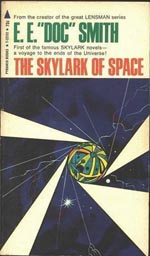
The Skylark of Space - E.E. "Doc" SmithAny type of rational analysis of these novels would be forced to conclude that they just don’t work, plain and simple. Smith’s setting is improbable, his plot is riddled with clichés, and his characters are laughably drawn in the extreme. When you learn for example that Richard Seaton is the best physicist of his generation… and the best magician… and the best gunman… Your willing suspension of disbelief threatens to cry out and drop dead on the spot. These people aren’t human!

Ah! There we go.

These characters aren’t human: They’re demigods strutting across the cosmos. And you can either choose to rebel at the sheer improbability of it all, or you can accept Seaton for what he is and thrill at what he can accomplish.

Whether by chance or by design, Smith embraces a mythic tone and tells an epic legend of the spaceways. And, on that level, these are fun little books even by the standards of today.

But they become particularly impressive if you can cast your mind back to the time when they were written and imagine reading them in the pulps of the 1920s. If you can do that, then you get to watch as E.E. “Doc” Smith almost single-handedly creates science fiction as we know it today. It is not an exaggeration in the least for me to say that I cannot recall the last science fiction novel I read which was not, in some way, influenced by the ideas and concepts which Smith introduces in the original Skylark novels. (At the very least you have to give Smith justice and remember that he didn’t write clichés; he created ideas of such enduring power that they became clichés.)

Let’s talk a little about the individual volumes:

Skylark of Space is almost certainly the least satisfying entry in the series. It’s a first novel, and it shows a lot of the inconsistency which is typical for a first novel. Perhaps the biggest problem, however, is that it seems to take Smith a while to settle down into the mythic pace that makes the series work. It’s one thing for Seaton the Demi-God to accomplish three impossible things before breakfast; it’s quite another for Seaton the Merely Human to do so.

What Skylark of Space does have going for it, however, is that it’s the first. Not just the first Skylark novel, but the first space opera; and the first interstellar voyage; and the first… Well, you get the idea. So the degree to which you enjoy this novel will depend a lot on how much of a thrill you can get out of reading a literary revolution.

In any case, it’s with the second volume – Skylark Three – that this series really hits its stride: The mythic quality of the series has found consistency; Smith’s epic vision of intergalactic space opera has been fully realized; and the plot is firing on full jets now. So even if you try Skylark of Space and find nothing more than a clunky  and out-dated piece of cliché, I’d still recommend giving Skylark Three a chance to change your mind.

Once Smith has found his rhythm in Skylark Three, he brings it to a brilliant crescendo in Skylark of Valeron.

One of the great things about this series is that Smith is never satisfied resting upon his laurels. With every passing chapter he’s raising the stakes, throwing out new ideas, and broadening his scope. The result is a rollercoaster ride which stretches the imagination and leaves you breathlessly turning the pages with anticipation.

Skylark DuQuesne, written about three decades after the blinding flash and deafening report of Skylark of Valeron, is a disappointment, however. The plot never quite gels and the action is frequently kept on track only by “virtue” of the author hooking it up to a locomotive and informing the reader that, in point of fact, the whole discordant mess will all tie together in the end. (Which it does… sort of. Although only by virtue of a magical deus ex machina. And I mean that literally.)

Skylark DuQuesne’s sole saving grace is that, once more, Smith conjures forth images of epic grandeur and startling creativity at a breath-taking pace. But, unfortunately, the foundation is lacking, and the result seems hollow.

I think it also needs to be said that Skylark DuQuesne brought into sharp and painful relief a problem that had been tickling at the back of my brain throughout the entire Skylark series: Viewed from any impartial angle, the heroes are genocidal fascists with a disquieting belief in the Cult of the Youthful Genius as the Natural Rulers of Civilization. The villains they oppose are distinguished only by being even MORE genocidal and fascist in their ideology.

In bizarre contrast to this, the novels also feature an equality of gender and skin color almost modern in its sensibility and profoundly progressive for the 1920s and ‘30s. (The only thing which dates the treatment is that Smith, quite rightly in my opinion, wasn’t willing to pretend that such equality was a fact of life in 1920’s America.)

Fortunately, the fast-paced action of the novels generally tends to minimize the genocidal and fascistic tendencies of the main characters. And a charitable interpretation would be that, in the situations they find themselves in, the characters simply have no choice: Their only salvation lies in decisions of an absolute and irrevocable kind. But every so often I would find myself thinking about the implications of what I was reading, and then I would be left with the disquieting sensation that I was reading a novel about brave Nazi super-scientists thwarting the tyrannies of Stalinist Russia by blasting the entire Asian continent off the face of the planet.

But I digress.

This was the first time I’ve read the Skylark novels. It won’t be the last. When E.E. “Doc” Smith is firing on all jets, reading his novels is just plain fun. And with Skylark Three and Skylark of Valeron, those jets are on full-blast. In fact, I had such a blast reading these novels that I’m going to pick up Smith’s Lensmen series next for a quick re-read.

GRADES:

SKYLARK: C+
SKYLARK THREE: A-
SKYLARK OF VALERON: A-
SKYLARK DUQUESNE: C
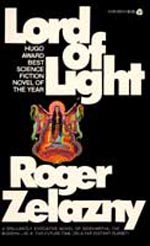
Lord of Light - Roger ZelaznyLord of Light is a story of myth and science and man, all wrapped and twisted about each other into an ineffable whole.

This would be an impressive novel if Zelazny had simply managed to craft a narrative of such epic scope which managed to be a grand vision of science fiction world-building; a potent myth tapping into fundamental truths; and a heart-touching character drama – each in turns. But what makes Lord of Light one of the greatest novels ever written is that it routinely succeeds at being all of these things at once.

One person will read a passage and be captivated by the depth of Zelazny’s future history.

Another, reading the exact same passage, will be awed by Zelazny’s uncanny ability to capture moments of mythic perfection upon the page.

And yet another, while reading the same passage as the other two, will be moved to tears or laughter or joy by the sheer, human passion of Zelazny’s characters.

And what’s truly special are those moments where your mind rises to Zelazny’s challenge and expands to encompass all three perspectives at the same time – rendering a passage resonant with myth and marvel and man.

On top of that, Lord of Light is ultimately a narrative of canny subtlety. To even the most casual reader, Zelazny will deliver a rip-roaring tale of unforgettable quality: Men walk as gods; titanic duels and mighty wars are fought with the unimaginable fires of science; and the fate of mankind balances somewhere inbetween. But the more attention you give it, the more rewarding it becomes – revealing layers and hidden depths and wheels within wheels.

Lord of Light appears at #4 on my list of all-time favorite science fiction novels. And it’s a place well-deserved.

GRADE: A+
Roger Zelazny
Published: 1967
Publisher: Eos
Cover Price: $12.95
ISBN: 0-06-056723-6
Buy Now!

Archives

Recent Posts

Recent Comments

Copyright © The Alexandrian. All rights reserved.