 In Rappan Athuk there are three groups of “lost goblins” in the upper levels of the dungeon. They’re found in areas 4A-3F, 6-16, and 7A-6. These groups serve as excellent foreshadowing for the lower levels of the dungeon, but they also present some troublesome problems for the DM. In short, their presence in the upper levels is not fully explained nor, even upon closer examination, particularly explicable.
For example, the goblins in area 4A-3F are said to have “come up from Level 12A via 7A and are afraid to go back because of the basilisks”. This is problematic because there isn’t a direct route between Level 12A and Level 7A, nor is there any particularly obvious indirect route they might have followed, either.
This group can be fixed relatively easily by saying: ” “These goblins were exploring up from 10A. They followed the river up to the hot springs on Level 9A, crossed the cavern, took the stairs up to 7A, became lost in the Minotaur’s Maze. Fled up the old rat tunnel to this level, where they emerged in the basilisk’s lair. They fled from that with three casualties (the goblin statues in 4A-2C) and are now holed up here.” (You’ll need to add the appropriate goblin statues to area 4A-2C.)
This explanation also neatly takes care of the goblins in area 7A-6: They could have easily been part of the group who tried to reach level 4A, only these goblins fled back down to Level 7A and are now stuck between a rock, a hard place, and another rock. (You simply ignore the text which suggests that this is some kind of “outpost” from which surface raids are conducted. Given the complete absence of any route to the surface from Level 7A, this explanation of the goblin’s presence never made any sense.)
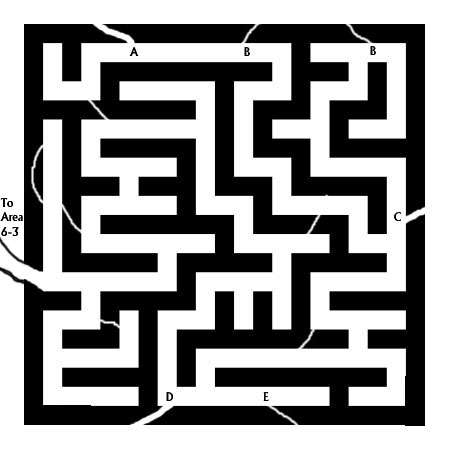
But the goblins in area 6-16 are simply intractable. The module says they “became lost in this level’s mazes and have been unable to escape”.
Not a bad theory until you take a look at the level. There are only four places they could have come from:
– Level 5. Impossible, they would have been coming from the upper levels of the dungeon through the Upper Temple and the Wight Catacombs.
– Level 7. Also impossible, because there’s no way for the goblins to reach that level. Sure, 11A is the “Gates to the Goblin City” — but those gates are “never used by the goblins” according to RA3 (for good reason). And there’s a chute to Level 12, but it’s not something the goblins are likely to be crawling up.
– Level 8. Not a bad place for them to come from, since there’s a goblin encampment on the far side of that level. But they would have had to pass through either the will-o-wisps or the white corridor. Neither seems particularly believable.
– Level 10A. Ah, there we go. They could have come up the stream right into 6-16. Except, if they did that, how did they become “lost in the Mazes”? All they’ve got to do is go right back down the stream.
Actually, that river path confuses me in general. On Level 10A, area 10A-5, we read: “PCs exiting Levels 6 and 7A via the river channel are deposited here.” Huh? The only river 7A comes from underground and then goes back underground. Similarly, when the course of the river on Level 6 is discussed in area 6-14, it makes no mention of the river passing through Level 7A before heading to Level 10A.
THE SOLUTION
THE RIVER: The river on Level 6 should be changed so that it flows down to area 7A-9, through 7A-3, and then down to 10A-5.
EXPLORATORY PARTY: About three weeks ago, a large goblin exploratory party came up from Level 10A looking for new mineral veins to explore. They were led by Shana, a Mining Captain, and Ubar, a goblin wizard. They followed the river up to the hot springs on Level 9A, crossed the cavern, and then took the stairs up to Level 7A. There, unfortunately, they became lost in the labyrinths of the Phase Minotaur King.
DISASTER: The party stumbled into area 7A-3 where they were attacked by the phase minotaurs and suffered heavy casualties. As they fled in a near-rout, the group split: One half of the group, with Shana, fled south back through the mazes. The other group, led by Ubar, fled north along the river.
UBAR’S GROUP: This group followed the river all the way to area 6-16. Ubar attempted to lead the goblins out of this cave, but was badly beaten by the mustard jelly in maze 6-2A. The group retreated back to 6-16 where they’ve been holed up ever since. See the module description of this encounter. Ubar is an evil and xenophobic goblin, making him automatically hostile and inimical to any outsiders.
SHANA’S GROUP: Shana’s group reached area 7A-5 and attempted to flee up the rat tunnels to Level 4A. There, unfortunately, they emerged into the basilisk lair (area 4A-2C). Three goblins were petrified by the basilisks, sending the group into a new panic. Six of the goblins fled deeper into Level 4A (ending up in area 4A-3F). Shana led the bulk of her group back down to Level 7A… where they are slowly starving to death in area 7A-6.
INFORMATION: The goblins can tell the PCs about the goblin city on Level 12A and the goblin mining camps on Level 10A. They can also tell them of their cursory experiences on level 9A. They can also warn the PCs about the phase minotaurs, of course.
Ubar’s group believes that Shana’s group was entirely wiped out by the phase minotaurs. Ubar’s group also knows about the will-o-wisps in 6-12 and the mustard jelly in 6-2A.
Shana’s group knows that Ubar’s group escaped up the river. They also know about the basilisks on Level 4A (and won’t hesitate to use those basilisks as a trap for unwary PCs). They think its possible that a few of their number might have escaped the basilisks.
The lost goblins in area 4A-3F know that the rest of Shana’s group escaped back down to Level 7A.

 Diaspora is science fiction at its purest.