
The Three Clue Rule states:
For any conclusion you want the PCs to make, include at least three clues.
The underlying theory behind the rule is that having three distinct options provides sufficient redundancy to create a robust scenario: Even if the PCs miss the first clue and misinterpret the second, the third clue provides a final safety net to keep the scenario on track.
This logic, however, also leads us to the inversion of the Three Clue Rule:
If the PCs have access to ANY three clues, they will reach at least ONE conclusion.
In other words, if you need the PCs to reach three conclusions (A, B, and C) and the PCs have access to three clues (each of which would theoretically allow them to reach one of those conclusions) then it is very likely that they will, in fact, reach at least one of those conclusions.
And understanding this inversion of the Three Clue Rule allows us to embrace the full flexibility of node-based design. Here’s a simple example:
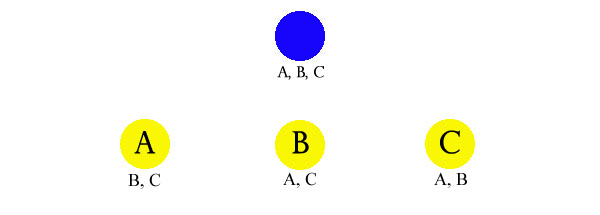
The scenario starts in the blue node, which contains three clues – one pointing to node A, one to node B, and one to node C. Following the inverse of the Three Clue Rule, we therefore know that the PCs will be able to conclude that they need to go to at least one of these nodes.
Let’s assume they go to node A. Node A contains two additional clues – one pointing to node B and the other pointing to node C.
At this point the PCs have had access to 5 different clues. One of these has successfully led them to node A and can now be discarded. But this leaves them with four clues (two pointing to node B and two pointing to node C), and the inverse of the Three Clue Rule once again shows us that they have more than enough information to proceed on.
Let’s assume they now go to node C. Here they find clues to nodes A and B. They now have access to a total of seven clues. Four of these clues now point to nodes they have already visited, but that still leaves them with three clues pointing to node B. The Three Clue Rule itself shows that they now have access to enough information to finish the scenario.
(Note that we’re only talking about clue access here. That doesn’t mean that they’re guaranteed to find or correctly interpret every single clue. In fact, we’re assuming that they don’t.)
Now, compare this node-based design to a comparable plotted approach:
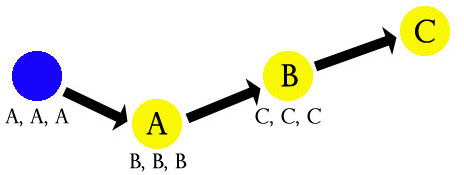
Note that the plotted approach can also be broken down into distinct nodes. And in terms of preparation, the plotted approach requires the exact same resources: Four nodes and nine clues. But the non-plotted design is richer, more flexible, and leaves the PCs in the driver’s seat. In other words, even in the simplest examples, node-based design allows you to get more mileage out of the same amount of work.
Of course, this entire discussion has been rather dry and technical. So let’s put some flesh on these bones.










ARCHIVED HALOSCAN COMMENTS
Noumenon
Dry and technical my ass, that was amazingly clearly explained and the visual aid worked great.
Monday, May 31, 2010, 8:42:14 PM
Justin Alexander
Keith, I think you’re looking for “[Xandering] the Dungeon”, which starts here: https://thealexandrian.net/wordpress/13085/roleplaying-games/xandering-the-dungeon
Hasn’t been converted to the new site yet, but I’m steadily working my way towards 2010 as time allows.
Wednesday, April 20, 2011, 3:41:37 AM
Keith Davies
Ah, excellent. That is in fact the article I was looking for. Thanks!
Friday, April 22, 2011, 12:09:04 AM
Keith Davies
ISTR seeing an article similar to this where you deconstructed a dungeon level to show that the map didn’t really offer the number or kind of choices it appeared to. IIRC you reduced it to a set of nodes, then transformed the node set to make it interesting and changed it back to a map.
Or something like that, I remember I didn’t have an opportunity to read it at the time… I think it was a few months ago, but I’m just not finding the article now.
Tuesday, April 19, 2011, 9:50:41 AM
Gravity
Great stuff – not at all that complicated but nice to see it structured in this way.
Just read Glory, the GM-screen pack scenario for Eclipse Phase, and the research phase of that scenario reminded me of this. Donät have it in front of me so cannot say for sure if it strictly followes the 3 clues rule, but it has three nodes, all pointing at each other.
Tuesday, June 01, 2010, 3:06:35 AM
This article is pure gold, simple and elegant. I’m using it right now to prepare my first gaming session in several years, and it’s really easy to apply. Basically I took 3 published linear adventures, one about a Goblin invasion, the second about a Necromancer and the third about vampires. Using these I managed to tie them all together nicely into an open scenario where the 3 are working together(plus a bandit organization) and I’m using these articles to prep the entire thing.
It makes it really easy, in just a few hours I managed to create an open scenario where the players can engage in any way they want.
Thanks you very much for these series! Now onto the challenging part of running it :), but I’m a lot more confident knowing that I have a toolbox ready to improv instead of trying to figure out every possible contingency already knowing that it’s impossible. If they thwart or kill any one of the factions, all I have to do is figure out how the others will react according to their goals.
I think there’s an extra benefit of this method you don’t put enough emphasis: it makes the GM roleplay as well. In a linear scenario, even if everything goes according to plan, you’re just following a script. You’re just a referee. Sure, it might be entertaining to write but, but running always made me nervous, what if I forget to say this or that? What if they go into that door first? Etc.
Now instead of being just a referee, I can roleplay the villains and have fun like the players do. I don’t know about the end results, but I’m a lot more optimistic, relaxed, confident and looking forward to have more fun at the table using this method.
Wow, that’s powerful tool. I spent hours to write down everything I could think of in a total mess and reorganising it into nodes with inverted 3 clues rule make it so easy to organise.
I’ve made a simple diagram and could almost already start playing right away from it while maintaining a cohesive story.
Thank you very much ! <3
Over the last 5 years, I’ve used the inverted 3 clue rule as a way to run convincing, player driven time travel in TTRPGs.
Suppose an event happens and there are 3 different causes that you know but your players don’t. Then later, the characters go back in time to a period where they could do any of those 3 things. When they do, it becomes the explanation for the original event and when the players connect those two events, they feel as if they freely chose an event that somehow affected gameplay that had already happened.