This is the second in a series of biographical profiles from alternate histories.
Go to Part 1
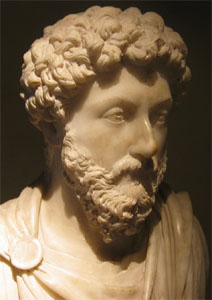 By the time he was twenty-five Aurelieus had established himself as a philosophical genius, composing several important works which survive to the modern day. More importantly, however, was his ability as a military leader, because the year was 430 B.C. and the first skirmishes in the Peloponnesian War were just beginning. Under his adept leadership (using tactics which would later be immortalized in his Art of War) the Athenian forces quickly overwhelmed those of Sparta, cementing Athens preeminence in Greece for centuries to come.
Aurelieus died in 398 B.C., but he left behind him a unified Grecian state based around the power of Athenian rule. Within a hundred years Greece had come to dominate the eastern Mediterranean. In the third century, the Greek general Pyrrhus would invade the burgeoning Roman state. In reference to that campaign, the phrase “Pyrrhic Victory” has come to signify tremendous success, as Pyrrhus and his forces crushed any and all resistance. The only block to Athenian hegemony over the entirety of the known world was in the city-state of Carthage. Greece would eventually crush Carthagenian resistance during the Punic Wars, despite the tremendous success of Hannibal (who succeeded, through the use of his elephant-mounted troops, at coming to the very walls of Athens before being driven back).
Next: William Boulle, The Man Who Would Be President
Filed under: Roleplaying Games | Comments (2)
Fourteen or fifteen years ago, Steve Jackson Games put out an open call for Who’s Who 2: More of Histories Most Intriguing Characters. The concept of the supplement was to provide background information for time-traveling campaigns, but what they were looking for with the open call were 200-400 word entries that could be dropped into the sidebar as “Who Might Have Been? A Who’s Who of Those Who Never Lived”. In other words, short bios of notable people from alternate histories.
My entries didn’t make the cut, but I’ve always had a soft spot in my heart for ’em. So I present them here for what passes as posterity…
 The year is 1932. Germany’s government is being crippled by debts incurred from the Versailles Treaty. The people, starving and unable to find food, turn desperately to a populist leader who can give them someone, anyone to blame. In a startling uprising at the polls they elect this leader, and his party, in an unprecedented landslide. Within a few short weeks this charismatic, influential man has solidified his grip on the center of German political power. The world pauses and catches its breath, waiting to see what course of action this man will take. His name is… Hans Adolpho.
Adolpho was born in 1899. He fought in the Great War and was sickened by the violence and death he saw all around him. After the war he travelled to Austria and then Italy, returning to Germany in 1925. There he joined the Einheit Party (German for Unity) and quickly rose through the ranks. His political message was simple: The German people should look to themselves for where the blame lay in their plight. Only by coming together in unity could they hope to save themselves. In 1932 he was elected Chancellor.
In 1935 he peacefully reunited Germany and Austria, forming the United Austro-German States. Using threat tactics in the Rhineland he succeeded in breaking the debt burdens imposed by the Versailles Treaty, then withdrew the troops and busied himself with rebuilding Germany. By 1941, when the Japanese attacked America at Pearl Harbor, Germany was a booming industrial economy who willingly assisted America in defeating Japan by early 1943. Adolpho’s last action before leaving office in 1952 (he was re-elected to the national office half a dozen times) was to form the Allied Force of the Springtime Invasion of Stalinist Russia, wiping Communism off the map by the end of the year.
Next: Aurelius, Emperor of Athens
Filed under: Roleplaying Games | Comments (3)