The Alexandrian

Archive for the ‘Roleplaying Games’ category

The casting of magical rituals was once a lengthy and time-consuming process; one which often required the combined efforts of entire covens or wizard circles to complete. All of that changed, however, when wizards first discovered spells.

The earliest spells were dangerous and unstable — parasitic horrors from a primordial proto-plane of raw magical essence which feasted memetically upon the sanity of those they infected. But whether by accident or design, a small band of wizards managed to tame the spells to their own purposes. With proper training, they learned that these living parasites could hold complex rituals in a state of pressurized memetic potential. And then, by infecting themselves, they discovered that they could release the entrapped rituals upon command.

Magical rites that had once taken hours, days, or even months to cast could now be unleashed in minutes. (And later, as their arts improved, in mere moments.) The world was transformed.

The parasites, of course, were consumed in their casting. And so, every morning, wizards find themselves preparing fresh spells and then infecting their minds with them. It takes years of practice to perfect the finely honed balance required to sustain even a single spell-parasite in your mind without being driven mad by its thought-consuming proclivity. The ability to sustain multiple spells in that state of mind-rending follows more quickly, but it is always a delicate balance between power and madness for those who would follow such a path.

Generations passed before the spell parasites mutated again: Those possessed of rich, magical bloodlines began to be born infested with the parasites. Women died in horrific, unspeakable childbirths… the nature and fate of their spawn better left unspoken. Fears of plague and mass extinction followed.

But then a state of symbiosis was once again found with the new form of the parasites: Some children were born infested with parasites, but appeared otherwise normal. Some felt that the parasites had mutated into a more benign form. Others whispered worries, hurled epithets, and named them plaguebearers.

Time, however, would eventually name them sorcerers: Unlike their wizardly brethren who were forced to carefully prepare each spell before infecting themselves with it, the roiling mass of parasitic entities running rampant through their bloodstreams allowed these sorcerers to unleash extemporaneous magical assaults. Some found that they could literally “burn out” their infections by simply expending their parasites in overwhelming magical onslaughts. (Unfortunately, not all of these outbursts were controlled ones.) But other sorcerers discovered that as long as they were careful not to burn out all of the potential of the parasites they hosted, a symbiosis of sorts could be maintained as the parasites regained their strength each day.

Some name the world a better place for the perfection of these magical arts. Others still watch the plaguebearers warily, worried that some greater horror may emerge from the thought-eating worms which roam unchecked through the minds of all magicians.

And then there are others who whisper that spells may be but a lesser order of beings from that distant proto-plane of magic. If so, what greater terrors might be unleashed from such a place?
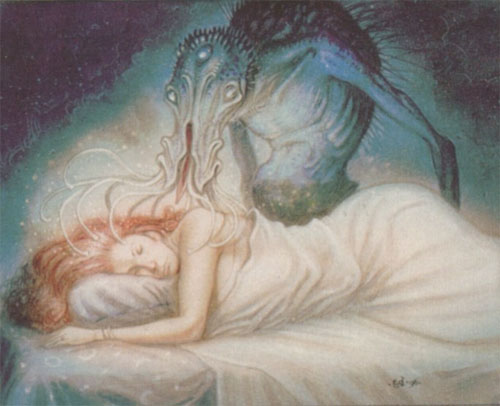
Urborg Mindsucker - Magic the Gathering

Untested: NPCs On-the-Fly

March 12th, 2011

While bantering with Zak at Playing D&D With Porn Stars (NSFW; EDIT: Zak turned out to be a missing stair and then a very well known serial abuser years after this was posted), I came up with a quick-and-dirty system for handling 3rd Edition NPCs:

(1) Give them an arbitrary number of HD. (Let’s say in d8s.)

(2) Assign them an array of ability scores.

(3) Figure out their AC. (Assign a number or do armor + Dex.)

(4) Figure out how much damage their attacks do. (Assign a number or do weapon + Strength.)

(5) Done.

In play, pertinent stats can be easily calculated off HD:

Melee Attack: HD + Strength modifier
Ranged Attack: HD + Dexterity modifier
Saving Throws: 1/2 HD + ability modifier
Skills: HD + ability mod

You could also, obviously, precalculate these values if you were feeling fancy. But where this is really useful is when you’re trying to keep up with your PCs on-the-fly. If you can quickly jot down:

HD 7; Str 16, Dex 12, Con 14, Int 11, Wis 10, Cha 8; plate, longsword

Then you’ve got enough information to run the NPC.

If you want to class up the joint a little bit, it’s pretty easy to slap a few class abilities on there. And here’s how you do spellcasters:

(1) Look up how many spell slots they have.

(2) Write those numbers down.

(3) Open your PHB to the spell lists and pick spells as they cast ’em.

So you might jot down:

Wizard 8; Str 8, Dex 14, Con 10, Int 18, Wis 14, Cha 11; 4/4/3/3/2

And that’s enough to run the encounter.

It’s a pity that old school monsters didn’t include ability scores, because otherwise this system would allow you to instantly convert them on-the-fly.


“Dice of Destiny” was one of my earliest professional sales. Written in late 1999, it was published in Pyramid on June 16th, 2000. It proved remarkably popular and, until I wrote “D&D: Calibrating Your Expectations” and “The Three Clue Rule“, was the single piece of writing for which I received the most feedback from readers. In fact, enough people told me that they specifically re-upped their subscription to Pyramid on the basis of that article that I am absolutely positive that the $170 Steve Jackson Games paid me for it was money well-spent.

Part 1 – Introduction
Part 2 – Qualities
Part 3 – Examples of Application
Part 4 – Adaptation

Reading the article from a distance of eleven years, I am forced to occasionally twinge at particularly awkward bits of writing. I have, however, resisted the urge to rewrite it. With the exception of noting that Feng Shui is now available from Atlas Games (when the article was written, Feng Shui was a recent smash success that had driven its original publisher out of business because they were reportedly losing money on every copy sold), the article remains unchanged.

I’m also struck, however, by how misleading the published works of an author can be. “Dice of Destiny”, for example, clearly demonstrates my early appreciation of the fact that roleplaying games are improv structures (among other things). It would seem to be totally of a piece with my recent musings on wandering monsters as a mode of procedural content generation.

But if you had actually asked Justin the Younger about wandering monsters, he would have scoffed at the crudities of a primitive and bygone age. Wandering monsters made their way back into my game when I started using them to model “living complexes” that were too large for me to track every individual NPC group in real time, and it was only from there that I eventually realized that a properly constructed wandering monster table is a great improv structure.

In a further bout of irony, it was only a few months after this article was published that the 3rd Edition of D&D was published. Dice pool systems had dominated my gaming during the late ’90s, but for the past decade D&D has taken their place. In fact, I’m not sure I’ve actually GMed even so much as a single session of a dice pool system since this article was published. (Although I’m sure something will probably occur to me as soon as I hit the “publish” button.)

Perhaps because of that, one of the things that particularly caught my eye on this read-thru was the idea of using die qualities while generating ability scores to give you some idea of what a score really means. It really is incredibly easy to just pluck out keywords from the description of ability scores and assign them as qualities. To that end, here’s a quick table you can use when generating D&D characters.

Ability Score
Qualities
Strength
Brawn, Power, Physique
Dexterity
Agility, Reflexes, Speed
Constitution
Vigor, Stamina, Endurance
Intelligence
Knowledge, Wit, Reasoning
Wisdom
Enlightenment, Common Sense, Intuition
Charisma
Persuasiveness, Beauty, Leadership


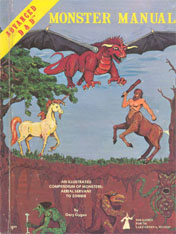
Monster Manual - AD&D 1st Edition

OBSERVATION

The monster lists in the 1st Edition Monster Manual are basically 100 pages long (page 6 to page 103).

CONCLUSION

Gimme a d100. Let’s see what’s lurking in these 124 miles of wild mystery.

Go to Part 1

Dice of DestinyADAPTATIONS

There are a number of simple modifications and adaptations of the basic concept found in this system. The Hit Locations system described earlier is one possibility. This section  of the article will try to point out a few more of these – even if complete mechanics for each of the adaptations are occasionally left up to the GM’s discretion, creativity, and personal needs.

RESOLUTION METHODS: Many games have different resolution systems depending on what type of action is being attempted or the circumstances under which the attempt is made. The most obvious and common of these is the distinction made between “normal” skill resolution and “combat” skill resolution.

Even when the two systems of resolution are practically or entirely identical in game terms the descriptive needs of the GM may alter drastically between, for example, combat and non-combat situations. The simplest adaptation of the systems in this article is to simply use different qualities at different times.

For example, a GM may feel that in non-combat situations he will be most aided by the qualities of Time Required, Outside Influences, and Finesse. On the other hand he might find Skill, Style, and Luck to be more useful for combat situations.

This modification is as easy as simply using those qualities at those times in which you will feel they will be most useful.

DAMAGEMany systems on the market today continue to follow the example of D&D and use a separate dice roll to determine the damage done by a weapon. In several cases multiple dice are used and it therefore becomes easy to create a list of “damage qualities” which would help you describe not only the severity of damage, but the type of damage done.

CHARACTER SCHTICKS: Not all characters are the same – and in several genres (particularly the pulp and superhero ones) each “type” of character is possessed of a very distinct, personal style. Superman, for example, behaves and operates in one manner, while Batman behaves and operates in a quite different manner. This system can be easily adapted to such situations.

Instead of having one set of universal qualities which all characters use, let each player decide on a “character schtick” – a set of qualities which he feels would best result in the type of descriptions he feel would be appropriate to his character. The GM, of course, would set schticks for NPCs as he so desired.

For example, in a game set in 1920s Chicago, your typical mob thug might have the qualities of Power and Luck. Al Capone, on the other hand, would have Style and Finesse. Elliot Ness might want Skill and Luck.

CHARACTER GENERATION: Although this is no longer true of many systems, there are still several systems out there that use dice for parts of or the entire character creation process. If you wanted to give even greater control to the dice during character creation it would certainly be a relatively easy task to create a list of qualities for any attributes or statistics which you roll for during character creation.

For example, when rolling 3d6 for Strength in AD&D you could have three different qualities: Muscle Mass, Power, and Physique. Although these would have little or no effect on actual gameplay, they would – just like the qualities for skill resolution described above – be hints as to how your character is strong, not just how strong he is.

DICE POOLS: Dice pools, used in many popular games such as West End Games’ Star Wars and the World of Darkness games from White Wolf Games, are a mechanic under which – instead of raising a number you roll against as you increase your character’s skill – you increase the number of dice which are rolled against a stationary target number as your character’s skill increases. Clearly the basic system described in this article does not work with such systems: you can’t assign a set of qualities to the dice if the number of dice is constantly in flux depending on what is being resolved. There are three ways, however, to alter this system to make it usable in games which employ dice pools.

First, and simplest, is to simply choose two qualities. Have two specially marked dice – each representing one of the two qualities – and make sure these are included in any role. On any die roll in which only one die is involved, ignore the qualities.

Second, you can expand this concept by having a laundry list of qualities. The first might be Skill, the second Style, the third Finesse, the fourth Outside Influences, and the fifth Power. If three dice were rolled you would use the Skill, Style, and Finesse dice. If five were rolled you would use Skill, Style, Finesse, Outside Influences, and Power.

Finally, you can create a “quality pool” from which players may select the qualities they want. Combining the second option above with variable choice you can either limit the choice to pre-campaign (like Character Schticks), or let the players decide on each roll which qualities they want. The only problem with this latter potential is that it can sometimes bog down the session as players deliberate over which qualities to pick (“Let’s see, do I want power and finesse – or finesse and style – or…?”).

CONCLUSION

The system is incredibly versatile and very effective as a tool that almost any Gamemaster can use effectively as an aid to his game. That being said, it is important to realize that this tool is not for everyone. Those who have no difficulty describing the results of action resolution will have no use for this system. There will be those who simply don’t find the system to be particularly helpful. Finally, I have found no way of adapting this system or some variant of it to resolution systems involving only a single die.

However, for those GMs who can use this system, and who find it useful, I think that it can be safely said that you will find your campaigns improved, and not lessened, for its inclusion so long as you remember that this is merely a system of guidelines, and not absolutes.

Reflections on “Dice of Destiny”

Archives

Recent Posts

Recent Comments

Copyright © The Alexandrian. All rights reserved.