The Alexandrian

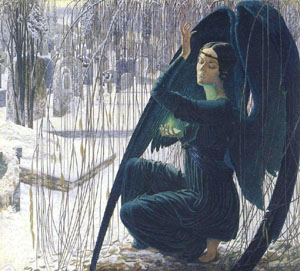
Carlos Schwabe - Death and the GravediggerThe earliest design goal for Legends & Labyrinths was to reveal the slick, tight, elegant system at the heart of 3rd Edition.

Like most RPGs, I’ve found that the secret to mastering 3rd Edition lies in finding the core principles on which the system is built — the essential mechanics from which everything else is built. And some of the first material ever developed for the game (even before it was a game) was written for online messageboards where I was attempting to share this mastery by demonstrating the simple, flexible core of the game in concrete terms.

In other words, Legends & Labyrinths was born out of a simple methodology: If it’s not a core mechanic, it’s not in the game.

This methodology naturally led me to re-examine character creation. Although 3rd Edition had created a system which made it possible to customize your character in myriad ways, if I wanted to design a game that was specifically friendly to new players then I knew it was important for Legends & Labyrinths to feature a streamlined character creation system. (This is something I’ll talk about more in the future, but it’s a design goal which only grew in importance once I started running an open table.)

After many tribulations and the pursuit of more than a few false ideals, I eventually brought the classic trio of character creation to Legends & Labyrinths: (1) Roll ability scores. (2) Pick class and race. (3) Buy equipment.

Character creation, however, led me inexorably to monster creation. Just as the designers of 3rd Edition had given players unprecedented control over their characters, they also gave DMs an unprecedented suite of tools and rules for creating and modifying monsters. It’s an impressive and powerful system, but it can also be overwhelming and time-consuming.

My initial impulse, as with character creation, was to simply roll back the clock: Strip out all of the advanced guidelines 3rd Edition offers for monster creation, include a bestiary of a few hundred nasty creatures, and then just leave it up to the DM to eyeball whatever stats looked appropriate when creating new beasties. That’s basically the way it was handled back in my original Basic Set, after all.

After some initial playtesting, however, it became clear that some sort of system for monster creation was necessary. This system went through several iterations and design cycles (being completely scrapped and restarting from scratch on at least two occasions). The system as it exists today, however,  is heavily influenced from my experiences running the 1974 ruleset. What particularly struck me was that by simply setting a monster’s HD you immediately knew everything you needed to know about the monster’s stats. All you had to do was toss on a unique power or two and — blammo! — you had a monster. It was a process that took seconds, making it easy to spontaneously improvise entirely new creatures right at the game table without missing a beat.

It was out of this revelation that the Challenge Rating Table was born. (You can find it on page 123 of the Black Book Beta rulebook.) This table lies at the heart of the monster creation system in Legends & Labyrinths, and it led directly to the creation of what I came to think of as the “Three Pillars” of the game.

THE THREE PILLARS

The Three Pillars of Legends & Labyrinth are the monster creation system, the hazard/trap creation system, and the stunt system.

Let’s start with the monster creation system. Creating a monster in Legends & Labyrinths is a four step process:

  1. Pick a challenge rating.
  2. Select powers.
  3. Assign ability scores.
  4. Pick skills.

The CR of the creature determines is hit dice, armor class, attack bonus, attack damage, save bonus, the save DC for its special abilities, and the number of power ranks it receives. Powers are purchased using the monster’s power ranks, but the intention is that you pick a handful of significant powers and then quickly dump the rest into generic adjustments.

It should be noted that ability scores don’t modify any of the core stats determined by the monster’s CR. They only become relevant for ability score checks and skill checks. Nor are there any particular rules for picking the skills a monster gets: It’s assumed that the DM will exercise their best judgment in what skills a monster should possess.

(Playtest Tip: You want a copy of the Challenge Ratings Table on your DM screen. Just like the old “To Hit” tables, the CR table lets you pick a monster’s CR and then have all of its stats at your fingertips.)

When this simple, streamlined system finally clicked into place it was a major revelation. And I realized that its basic structure could be used to solve the problem I was having with traps. Here we come to the Second Pillar, in which hazards and traps are designed in a four step process:

  1. Pick a challenge rating.
  2. Define area/targets.
  3. Define effect.
  4. Define defense.

(For traps you also need to define a trigger.)

As the monster creation system is based in the Challenge Ratings Table, the hazard/trap creation system is based around the Hazards table. This table is one-half old school and one-half 4th Edition’s page 42. It contains general check DCs, trained check DCs, save DCs, attack bonuses, attack damage, repeating damage, and one-shot damage for every challenge rating.

Finally, we have the stunt system. The Legends & Labyrinths stunt system is a flexible method for allowing characters to perform unusual maneuvers during combat. A stunt can allow a character to apply a bonus to another character (or themselves), apply a penalty to another character, boost their speed or the speed of an ally, force opponents to move, or apply a variety of conditions to opponents. Resolving a stunt is a three step process:

  1. Define the effect of the stunt (which determines the DC).
  2. Perform the stunt by making the appropriate action check (usually a skill check).
  3. If successful, the target of the stunt may attempt a stunt save to negate its effect.

The DC of the stunt save is determined by the level or CR of the combatant performing the stunt, as shown on the Stunt Difficulty Class table.

USING THE THREE PILLARS

I started thinking of these systems — monster creation, hazard/trap creation, stunt creation — as the Three Pillars when I realized that the Challenge Ratings Table, the Hazards table, and the Stunt Difficulty Class table were all fundamentally joined. Not only do these tables share elements all cross-referenced by challenge rating (save DCs, attack bonuses, etc.), at a very real level they collectively form a single meta-table which defines the spine of the 3rd Edition ruleset.

(In fact, I actually considered unifying them all into one table for awhile. But I realized that although it can be useful to think of them as a single meta-table, from a utility standpoint they’re more effective as separate tables.)

What’s a reasonable save DC for a 9th level character? What’s a good target number for a skill check intended for a 15th level character? Whether you’re running Legends & Labyrinths or any 3rd Edition game, the meta-table of the Three Pillars gives you the answer (which you can then, of course, tweak to your heart’s content).

But more than that, I came to think of these systems as the Three Pillars because they form an important part of the foundation which makes up Legends & Labyrinths. One half of this game is “3rd Edition without the noise”; but the other half of the game is a suite of powerful new tools which can be used to revolutionize any 3rd Edition campaign.

Legends & Labyrinths

CLIMB INTO YOUR LABYRINTH AND FORGE YOUR LEGEND TODAY!


George Wright - Horseman Fighting Giants

1. INTRODUCING NEW PLAYERS

Legends & Labyrinths is an ideal way to introduce new players to your existing 3rd Edition game: It gives them a simplified set of rules that are easier to learn and use. This is particularly true of character creation, which has been boiled back down to the classic trio (roll attributes, pick race and class, select equipment).

And because Legends & Labyrinths is 100% compatible with the advanced rules, you can just gradually add complexity until they’ve learned all the bells and whistle of your full 3rd Edition campaign.

2. MINIONS AND POTENTATES

These fast, easy templates can be applied to any 3rd Edition monster to create a horde of mooks or a powerful solo encounter. Actually, describing these as templates is probably misleading: Templates have traditionally involved a lot of fiddling math, but creating a minion or potentate is more like flipping a switch. Blink and you’re done!

3. ENCOUNTER BUDGETS

Ever get tired of trying to figure out what EL you’re dealing with when you’ve got an encounter featuring five CR 8 creatures, a CR 9 creature, a pair of CR 10 creatures, and a CR 14 boss just to round things out? Legends & Labyrinths includes a super-simple encounter budget system that makes prepping complex encounters a breeze.

4. FAST-AND-EASY NPC STATS

Remember the days when you could basically create a full-fledged NPC by just saying “he’s a level 9 fighter”? Legends & Labyrinths makes that a reality for your 3rd Edition gaming, stripping NPC creation back to the classic trio: Roll ability scores, pick race and class, select equipment.

5. TRAINING RULES

On-the-job training is great, but sometimes you just want a nice little training montage that ends with your character dancing on the stairs in front of the Cosmopolitan Museum for Magical Curiosities with their arms flung high in the air. You can do that with Legends & Labyrinths.

6. THE STUNT SYSTEM

Legends & Labyrinths simplifies the 3rd Edition combat system down to a lean, mean, fighting machine… And then makes it more dynamic than ever with a super-simple, super-flexible stunt system. Shove your enemies around, help your friends, and just generally do awesome stuff on the field of battle.

7. HAZARDS AND TRAPS

3rd Edition may have traps, but it doesn’t have Legends & Labyrinths’ slick hazard and trap creation system. This thing is so streamlined that you can create new hazards on the fly. The players want to drop a chandelier on your doppelganger? Your ogre wants to chop through the balcony’s supports and make it collapse? Bam. Legends & Labyrinths has you covered.

8. MONSTER CREATION RULES

Are you tired of turgidly building monster stat blocks instead of whipping them up? Creating slavering monstrosities doesn’t have to be an exercise in advanced calculus. The monster creation system in Legends & Labyrinths is going to cure all your woes. Combined with the encounter budgets and hazard creation system, creating complex, dynamic, and flexible encounters has never been this easy.

Legends & Labyrinths

CLIMB INTO YOUR LABYRINTH AND FORGE YOUR LEGEND TODAY!

Legends & Labyrinths will be using the Sidebar Reference System originally developed for Dream Machine Production’s line of Rule Supplements. Using this format, rules are presented exactly when and where you need them.

For example, consider the description of the entangle spell from the advanced version of the 3rd Edition rules:

Grasses, weeds, bushes, and even trees wrap, twist, and entwine about creatures in the area or those that enter the area, holding them fast and causing them to become entangled. The creature can break free and move half its normal speed by using a full-round action to make a DC 20 Strength check or a DC 20 Escape Artist check. A creature that succeeds on a Reflex save is not entangled but can still move at only half speed through the area. Each round on your turn, the plants once again attempt to entangle all creatures that have avoided or escaped entanglement.

There is key information missing from this spell description which will leave players flipping through their rulebooks: What are the effects of being “entangled”? How do you make a Strength check or an Escape Artist check? One could add this information to the description, of course:

Grasses, weeds, bushes, and even trees wrap, twist, and entwine about creatures in the area or those that enter the area, holding them fast and causing them to become entangled (they move at half speed, cannot run or charge, suffer a -2 penalty on attack rolls, a -4 penalty on Dexterity checks, and casting a spell requires a Concentration check). The creature can break free and move half its normal speed by using a full-round action to make a Strength check (1d20 + Strength modifier vs. DC 20) or an Escape Artist check (1d20 + Escape Artist modifer vs. DC 20). A creature that succeeds on a Reflex save is not entangled but can still move at only half speed through the area. Each round on your turn, the plants once again attempt to entangle all creatures that have avoided or escaped entanglement.

But this only makes the spell description even more difficult to parse and adjudicate.

Using the SRS system, on the other hand, we can simplify the presentation of this spell so that it looks something like this:

Grasses, weeds, bushes, and even trees wrap, twist, and entwine about creatures in the area or those that enter the area. The area is treated as difficult terrain and creatures that fail their Reflex saves are stuck and entangled. A creature can break free by making a Strength check (DC 20) or Escape Artist check (DC 20) as a full action. Each round on your turn, the plants once again attempt to entangle all creatures that have avoided or escaped entanglement.

In the sidebar, the red-highlighted keywords are given references like this:

difficult terrain, page 52: Movement through difficult terrain is made at half speed.

stuck, page 58: Cannot move away from the object or location.

entangled, page 56: Move at half speed, cannot run or charge, -2 on attacks, -4 to Dex, casting spells requires Concentration check (DC 15 + spell’s level).

Strength check, page 65: 1d20 + Strength modifier vs. DC

Escape Artist check, page 43: 1d20 + Escape Artist modifier vs. DC

The SRS puts all the information you need right at you fingertips. And, if you need more details, it gives you a page reference so that you can quickly find the full citation. Some of this information you may already be familiar with as a player, but it’s great for beginning players. (And I can’t be the only guy who, even after years of playing a game, will still need to double-check a reference.)

But the SRS also makes the text itself easier to parse. Partly because it removes all extraneous detail to the sidebar, but also because the references almost unintentionally provide a mechanism for quick comprehension. Look at the words highlighted in the entangle spell again: Difficult terrain. Stuck and entangled. Strength check or Escape Artist check. That tells you 90% of what you need to know about the spell at first glance, right?

More than that, the SRS both rewards system mastery and simulates system mastery.

For one who has mastered the system, for example, the term “difficult terrain” is a very quick, clear, and compact way of saying “characters can only move at half speed through the area”. Because the SRS  lets us just put the keyword in the text (with the full reference pushed to the sidebar), system mastery is rewarded by streamlining the main text. A system master can see the keyword “difficult terrain” and immediately understand the effect of the spell without wading their way through additional verbiage.

But the system also simulates system mastery. The system master sees the keyword “difficult terrain” and immediately knows what it means. With the SRS, however, the beginner can simulate that mastery by simply flicking their eye two inches to the left.

In many ways, the SRS is also teaching system mastery. Over time, the player will probably find themselves relying on it less and less. But when you need it, it will prove itself an invaluable time saver every single time.

Legends & Labyrinths

CLIMB INTO YOUR LABYRINTH AND FORGE YOUR LEGEND TODAY!
Command of Rigden Djapo - Roerich

Legends & Labyrinths features 100% compatibility with the advanced version of the 3rd Edition rules. This means that any stat block or mechanic usable in 3rd Edition can be used in Legends & Labyrinths without conversion.

USING ADVANCED RULES IN LEGENDS & LABYRINTHS

Perhaps the most important question is the degree to which the vast supplement library of 3rd Edition can be used in your Legends & Labyrinths game.

Spells: Although the grimoire entries for advanced spells include extra information used by the more complicated rules, these spells can be used in Legends & Labyrinth without conversion. Simply ignore the extraneous information.

Monsters and NPCs: There are two ways to use monsters and NPCs. First, as with spells, you can use their stat blocks without conversion by simply ignoring the extraneous information they contain.

Alternatively, the Legends & Labyrinths rules allow for very quick conversion. For example, the stat block for a fighter in Legends & Labyrinths requires only level, hit point total, ability scores, and equipment. So if you see an 8th-level fighter in an advanced supplement, you can either use the full stat block provides or you can just pull the pertinent information (hit points, ability scores, equipment) and run the NPC as an 8th-level L&L fighter. (This also allows for quick conversion of classes not included in L&L: If you see a samurai, ranger, or witch, for example, and their stat blocks don’t include enough information to run them as-is, it’s a simple matter to convert them on-the-fly to an appropriate L&L class.)

Monsters can be handled in a similar fashion. If you don’t want to use the advanced stat block provided for a monster, you can either do a complete conversion (recreating the monster from scratch using the Monster Creation rules) or you can easily do a partial conversion (using the appropriate core stats for a monster of the given CR, but using the powers listed in the monster’s advanced stat block).

Running Adventures: As detailed above, all of the spells, monsters, and NPCs in adventure can be run without conversion. The same holds true for traps, skill DCs, and treasure. You can pick up any adventure designed for the advanced 3rd Edition rules and run it seamlessly in Legends & Labyrinths.

Supplementing the Rules: Because Legends & Labyrinths is 100% compatible with the advanced rules, you can incorporate any core mechanic from the advanced rules into your Legends & Labyrinths game on an ad hoc basis.

For example, Legends & Labyrinths features a stripped-down combat system. But what if you really like the detailed combat mechanics of the advanced rules? Well, all you have to do is use them. Similarly, if you really like all the character creation tools the advanced rules give you (allowing you to tweak your character just the way you like), you can create your PCs using the advanced rules and then simply play them using the Legends & Labyrinths rules.

Legends & Labyrinths functions as the streamlined foundation of the game: Advanced rules can be added to it in whatever combination you desire.

Creating New Classes: You can use the advanced character creation rules to create new classes for Legends & Labyrinths. Simply select an advanced character class and make appropriate selections for its feats and special abilities. Do not select a 1st level feat.

USING LEGENDS & LABYRINTHS WITH THE ADVANCED RULES

Since you can easily add any or all of the advanced rules into your Legends & Labyrinths campaign, it follows that you can also take rules from Legends & Labyrinths and plug them into a campaign run with the advanced rules.

Transferring Characters: PCs created in Legends & Labyrinths can be transferred to the advanced rules at any time. Simply select a single 1st level feat for the character. (All characters in Legends & Labyrinth are assumed to gain the benefits of the Leadership feats in place of their 1st level feat.)

Fast NPC Creation: Because the classes in Legends & Labyrinths are pre-built, creating an NPC is as simple as picking ability scores, race, class, level, and equipment. This makes it much easier to prepare NPCs or even create them on-the-fly during a session. And since the resulting stat blocks are 100% compatible with the advanced rules, they can be used seamlessly in a campaign using the advanced rules.

Hazards, Traps, and Monsters: Hazards, traps, and monsters created in Legends & Labyrinth can be used in an advanced campaign. As with NPC creation, these streamlined systems allow for rapid, on-the-fly improvisation during a game session.

Stunt System: The Legends & Labyrinths stunt system gives a unified mechanic for adjudicating ingenuity. It can be seamlessly integrated into a campaign using the advanced rules.

Other Original Elements: Legends & Labyrinths also includes rules for minions and potentates, a Fly skill, social ranks, training rules for advancing characters, and other innovations. Because the game is 100% compatible, all of these original elements can be easily used in the advanced game.

Legends & Labyrinths

CLIMB INTO YOUR LABYRINTH AND FORGE YOUR LEGEND TODAY!

Legends & LabyrinthsI’m continuing the story from yesterday regarding the long road which Legends & Labyrinths has journeyed from its earliest inception, through its many delays, and finally to its release a few days ago.

We left off in July 2007: The original release date of July 15th had been delayed due to a severe computer crash and the revised date of July 31st was delayed when I contracted Lyme disease. Although I publicly announced that it would be “done when it’s done”, privately I was anticipating a release date in early September.

In late August 2007, however, it all fell apart.

The cover art I had arranged for the original cover of Legends & Labyrinths had been painted by a Russian artist. I had discovered his work on DeviantArt, gone to his website, sent an e-mail, negotiated a contract, and then sent payment according to his instructions. It had been a done deal for months.

… or so I thought.

Because apparently the Russian artist’s website had been compromised by hackers. When I sent him an e-mail, that e-mail was intercepted by the hackers. It was with the hackers that I had negotiated a contract and it was to the hackers that I had sent payment.

The details of how this got resolved are… messy. The short version was this: I had no cover art and the budget I had established for art in general was gone.

It’s at this point that the development of Legends & Labyrinths essentially went into hibernation. In October 2008 I released Spells of Light and Darkness in a silent attempt to raise money for L&L’s art. But it didn’t sell well enough. (I was also attempting to save money from my personal finances, but during this time I was first buying a house and, after that, getting married.)

THE 2010 REVISION

In February 2009, I ran my first session of the 1974 ruleset. It was supposed to be a one-shot, but the game proved so successful that my players asked to play it again. And then again. And again. And again.

Over the course of that year, I rediscovered the open gaming table and my old school campaign expanded to include 20+ players and dozens of PCs. At some point in the near future I’m likely to discuss in more detail how these old school sessions influenced the design of Legends & Labyrinths, but for now let it suffice to say that they did: Over the course of 2010, I was slowly revising and reworking the L&L manuscript and material from L&L was being playtested at my old school tables.

By late 2010, several freelance editing projects were meeting with particular success and with major personal expenses now behind me I was able to start putting some serious money towards an art budget. By early 2011, I was ready to bring Legends & Labyrinths out of hibernation..

2011: THE FINAL LEG

Unfortunately, the long odyssey of Legends & Labyrinths was not yet complete. Just a few days before I was scheduled to start contacting artists, I was notified of a major legal impediment that someone was attempting to create which would threaten not only the release of the game, but all of the game supplements I’ve published and kept in print since 2007.

I am not yet at liberty to go into much detail regarding this matter (although it probably wouldn’t take much ingenuity to figure it out), but I was basically forced to take my newly re-established art budget and dump it into legal fees.

At this point I was near despair. Even with the legal issue resolved, I was right back at square zero as far as getting the book into print was concerned.

During 2010 I had considered the possibility of using Kickstarter to raise the art budget. But I hit the impediment that the book had already been vaporware for 2 years: Could I really expect people to put money towards a project that was already so late? Not really.

But now, in early 2011, I had the idea of creating the Black Book Beta rulebook: It would let me put something out there and say with authority, “No, really. This thing does exist. It’s real.”

So I spent the next 2-3 months revisiting the entire manuscript. In June 2011, I transitioned to layout. The layout took much longer than I anticipated: Partly because I was learning Adobe InDesign, partly because I had forgotten how time-consuming the SRS system is, and partly because those delays ended up carrying the whole thing into the middle of a major theatrical project.

But, at long last, it was done!

… and then Kickstarter rejected my project proposal.

So I swapped over to 8-Bit Funding, created the Legends & Labyrinths project (which is actually cooler than the Kickstarter project would have been), and then waited several days for it to be approved.

Which brings us to today.

FINAL THOUGHTS

There’s a large part of me that wished Legends & Labyrinths had been properly released way back in July 2008.

But, on the other hand, I honestly think it will have been worth the wait. I also think Legends & Labyrinths is a much better game because of the extra development it has received in the interim.

On the gripping hand, however, I’m glad to have this monkey off my back at long last. Not only because I’m excited to see what you’ll do with the game now that it’s in your hands, but also because it will free me up to pursue other RPG projects that have been long dormant while I’ve struggled with the project that would (seemingly) never end.

Archives

Recent Posts

Recent Comments

Copyright © The Alexandrian. All rights reserved.