
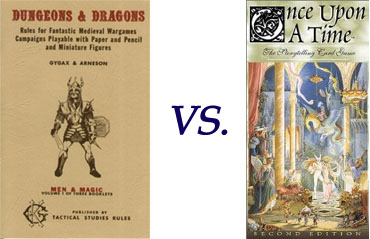
For the first couple decades after D&D, virtually all roleplaying games looked fundamentally similar: There was a GM who controlled the game world, there were players who each controlled a single character (or occasionally a small stable of characters which all “belonged” to them), and actions were resolved using diced mechanics.
Starting in the early ’90s, however, we started to see some creative experimentation with the form. And in the last decade this experimentation has exploded: GM-less game. Diceless games. Players taking control of the game world beyond their characters. (And so forth.) But as this experimentation began carrying games farther and farther from the “traditional” model of a roleplaying game, there began to be some recognition that these games needed to be distinguished from their progenitors: On the one hand, lots of people found that these new games didn’t scratch the same itch that roleplaying games did and some responded vituperatively to them as a result. On the other hand, even those enthusiastic about the new games began searching for a new term to describe their mechanics — “story game”, “interactive drama”, “mutual storytelling”, and the like.
 In some cases, this “search for a label” has been about raising a fence so that people can tack up crude “KEEP OUT” signs. I don’t find that particularly useful. But as an aficionado of Scott McCloud’s Understanding Comics, I also understand the power of proper definitions: They allow us to focus our discussion and achieve a better understanding of the topic. But by giving us a firm foundation, they also set us free to experiment fully within the form.
For example, people got tired of referring to “games that are a lot like Dungeons & Dragons“, so they coined the term “roleplaying game” and it suddenly became a lot easier to talk about them (and also market them). It also allowed RPGs to become conceptually distinct from “wargames”, which not only eliminated quite a bit of confusion (as people were able to separate “good practices from wargames” from “good practices for roleplaying games”), but also allowed the creators of RPGs to explore a lot of new options.
Before we begin looking at how games like Shock: Social Science Fiction, Dread, Wushu, and Microscope are different from roleplaying games, however, I think we first need to perfect our understanding of what a roleplaying game is and how it’s distinguished from other types of games.
WHAT IS A ROLEPLAYING GAME?
Roleplaying games are defined by mechanics which are associated with the game world.
Let me break that down: Roleplaying games are self-evidently about playing a role. Playing a role is about making choices as if you were the character. Therefore, in order for a game to be a roleplaying game (and not just a game where you happen to play a role), the mechanics of the game have to be about making and resolving choices as if you were the character. If the mechanics of the game require you to make choices which aren’t associated to the choices made by the character, then the mechanics of the game aren’t about roleplaying and it’s not a roleplaying game.
To look at it from the opposite side, I’m going to make a provocative statement: When you are using dissociated mechanics you are not roleplaying. Which is not to say that you can’t roleplay while playing a game featuring dissociated mechanics, but simply to say that in the moment when you are using those mechanics you are not roleplaying.
 I say this is a provocative statement because I’m sure it’s going to provoke strong responses. But, frankly, it just looks like common sense to me: If you are manipulating mechanics which are dissociated from your character — which have no meaning to your character — then you are not engaged in the process of playing a role. In that moment, you are doing something else. (It’s practically tautological.) You may be multi-tasking or rapidly switching back-and-forth between roleplaying and not-roleplaying. You may even be using the output from the dissociated mechanics to inform your roleplaying. But when you’re actually engaged in the task of using those dissociated mechanics you are not playing a role; you are not roleplaying.
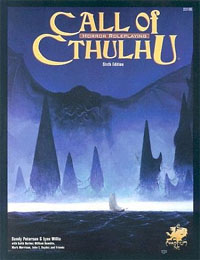
I think this distinction is important because, in my opinion, it lies at the heart of what defines a roleplaying game: What’s the difference between the boardgame Arkham Horror and the roleplaying game Call of Cthulhu? In Arkham Horror, after all, each player takes on the role of a specific character; those characters are defined mechanically; the characters have detailed backgrounds; and plenty of people have played sessions of Arkham Horror where people have talked extensively in character.
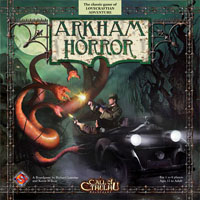 I pick Arkham Horror for this example because it exists right on the cusp between being an RPG and a not-RPG. So when people start roleplaying during the game (which they indisputably do when they start talking in character), it raises the provocative question: Does it become a roleplaying game in that moment?
On the other hand, I’ve had the same sort of moment happen while playing Monopoly. For example, there was a game where somebody said, “I’m buying Boardwalk because I’m a shoe. And I like walking.” Goofy? Sure. Bizarre? Sure. Roleplaying? Yup.
Let me try to make the distinction clear: When we say “roleplaying game”, do we just mean “a game where roleplaying can happen”? If so, then I think the term “roleplaying game” becomes so ridiculously broad that it loses all meaning. (Since it includes everything from Monopoly to Super Mario Brothers.)
Rather, I think the term “roleplaying game” only becomes meaningful when there is a direct connection between the game and the roleplaying. When roleplaying is the game.
It’s very tempting to see all of this in a purely negative light: As if to say, “Dissociated mechanics get in the way of roleplaying and associated mechanics don’t.” But it’s actually more meaningful than that: The act of using an associated mechanic is the act of playing a role.
As I wrote in the original essay on dissociated mechanics, all game mechanics are — to varying degrees — abstracted and metagamed. For example, the destructive power of a fireball is defined by the number of d6’s you roll for damage; and the number of d6’s you roll is determined by the caster level of the wizard casting the spell. If you asked a character about d6’s of damage or caster levels, they’d have no idea what you were talking about (that’s the abstraction and the metagaming). But they could tell you what a fireball was and they could tell you that casters of greater skill can create more intense flames during the casting of the spell (that’s the association).
So a fireball has a direct association to the game world. Which means that when, for example, you make a decision to cast a fireball spell you are making a decision as if you were your character — in making the mechanical decision you are required to roleplay (because that mechanical decision is directly associated to your character’s decision). You may not do it well. You’re not going to win a Tony Award for it. But in using the mechanics of a roleplaying game, you are inherently playing a role.
WHAT IS A STORYTELLING GAME?
So roleplaying games are defined by associated mechanics — mechanics which are associated with the game world, and thus require you to make decisions as if you were your character (because your decisions are associated with your character’s decisions).
Storytelling games (STGs), on the other hand, are defined by narrative control mechanics: The mechanics of the game are either about determining who controls a particular chunk of the narrative or they’re actually about determining the outcome of a particular narrative chunk.
Storytelling games may be built around players having characters that they’re proponents of, but the mechanical focus of the game is not on the choices made as if they were those characters. Instead, the mechanical focus is on controlling the narrative.
 Wushu offers a pretty clear-cut example of this. The game basically has one mechanic: By describing a scene or action, you earn dice. If your dice pool generates more successes than everyone else’s dice pools, you control the narrative conclusion of the round.
Everyone in Wushu is playing a character. That character is the favored vehicle which they can use to deliver their descriptions, and that character’s traits will even influence what types of descriptions are mechanically superior for them to use. But the mechanics of the game are completely dissociated from the act of roleplaying the character. Vivid and interesting characters are certainly encouraged, but the act of making choices as if you were the character — the act of actually roleplaying — has absolutely nothing to do with the rules whatsoever.
That’s why Wushu is a storytelling game, not a roleplaying game.
 More controversially, consider Dread. The gameplay here looks a lot like a roleplaying game: All the players are playing individual characters. There’s a GM controlling/presenting the game world. When players have their characters attempt actions, there’s even a resolution mechanic: Pull a Jenga block. If the tower doesn’t collapse, the action succeeds. If the tower does collapse, the character is eliminated from the story.
But I’d argue that Dread isn’t a roleplaying game: The mechanic may be triggered by characters taking action, but the actual mechanic isn’t associated with the game world. The mechanic is entirely about controlling the pace of the narrative and participation in the narrative.
I’d even argue that Dread wouldn’t be a roleplaying game if you introduced a character sheet with hard-coded skills that determined how many blocks you pull depending on the action being attempted and the character’s relevant skill. Why? Because the resolution mechanic is still dissociated and it’s still focused on narrative control and pacing. The mechanical decisions being made by the players (i.e., which block to pull and how to pull it) aren’t associated to decisions being made by their character. The fact that the characters have different characteristics in terms of their ability to be used to control that narrative is as significant as the differences between a rook and a bishop in a game of Chess.
GETTING FUZZY
Another way to look at this is to strip everything back to freeform roleplaying: Just people sitting around, pretending to be characters. This isn’t a roleplaying game because there’s no game — it’s just roleplaying.
Now add mechanics: If the mechanics are designed in such a way that the mechanical choices you’re making are directly associated with the choices your character is making, then it’s probably a roleplaying game. If the mechanics are designed in such a way that the mechanical choices you’re making are about controlling or influencing the narrative, then it’s probably a storytelling game.
But this gets fuzzy for two reasons.
 First, few games are actually that rigid in their focus. For example, if I add an action point mechanic to a roleplaying game it doesn’t suddenly cease to be a roleplaying game just because there are now some mechanical choices being made by players that aren’t associated to character decisions. When playing a roleplaying game, most of us have agendas beyond simply “playing a role”. (Telling a good story, for example. Or emulating a particular genre trope. Or exploring a fantasy world.) And dissociated mechanics have been put to all sorts of good use in accomplishing those goals.
Second, characters actually are narrative elements. This means that you can see a lot of narrative control mechanics which either act through, are influenced by, or act upon characters who may also be strongly associated with or exclusively associated with a particular player.
When you combine these two factors, you end up with a third: Because characters are narrative elements, players who prefer storytelling games tend to have a much higher tolerance for roleplaying mechanics in their storytelling games. Why? Because roleplaying mechanics allow you to control characters; characters are narrative elements; and, therefore, roleplaying mechanics can be enjoyed as just a very specific variety of narrative control.
On the other hand, people who are primarily interested in roleplaying games because they want to roleplay a character tend to have a much lower tolerance for narrative control mechanics in their roleplaying games. Why? Because when you’re using dissociated mechanics you’re not roleplaying. At best, dissociated mechanics are a distraction from what the roleplayer wants. At worst, the dissociated mechanics can actually interfere and disrupt what the roleplayer wants (when, for example, the dissociated mechanics begin affecting the behavior or actions of their character).
 This is why many aficionados of storytelling games don’t understand why other people don’t consider their games roleplaying games. Because even traditional roleplaying games at least partially satisfy their interests in narrative control, they don’t see the dividing line.
Explaining this is made even more difficult because the dividing line is, in fact, fuzzy in multiple dimensions. Plus there’s plenty of historical confusion going the other way. (For example, the “Storyteller System” is, in fact, just a roleplaying game with no narrative control mechanics whatsoever.)
It should also be noted that while the distinction between RPGs and STGs is fairly clear-cut for players, it can be quite a bit fuzzier on the other side of the GM’s screen. (GMs are responsible for a lot more than just roleplaying a single character, which means that their decisions — both mechanical and non-mechanical — were never strictly focused on roleplaying in the first place.)
Personally, I enjoy both sorts of games: Chocolate (roleplaying), vanilla (storytelling), and swirled mixtures of both. But, with that being said, there are times when I just want some nice chocolate ice cream; and when I do, I generally find that dissociated mechanics screw up my fun.
2020 ADDENDUM: TABLETOP NARRATIVE GAMES
If we can move beyond arguing that vanilla ice cream is actually chocolate ice cream, we have the opportunity to step back and recognize that these are both different types of ice cream. I propose that both roleplaying games and storytelling games are tabletop narrative games.
Now, here’s the cool thing: Recognizing that these are different things within a broader paradigm will make it easier for us to explore that paradigm. Much like having a different word for different colors makes it easier to distinguish those colors, clearly seeing the distinctions between associated mechanics and narrative control mechanics will not only make it easier for us to develop better games of those types, it will also likely make it easier for us to discover completely new types of games.
Compare this to video games, for example. Grand Theft Auto started as a maze-chase game. When they iterated on that design, nobody launched a holy war insisting that this was the One True Way of making maze-chase games. They said, “Oh. Hey. Look at this cool new type of game.” Instead of spending twenty years arguing that Grand Theft Auto 3 was a maze-chase game just like Pac-Man (and how dare you suggest otherwise?!), they identified the new form as an open-world game and spent twenty years making lots and lots of open-world games (that were in no way still trying to be Pac-Man).
Video games and board games do this all the time. And we have better and more varied video games and board games as a result. Wouldn’t it be great if tabletop narrative games could reap the same benefits?











Excellent analysis.
Agreed with Mr Rients – excellent analysis. I wound up with a different result in doing the math outlined in the post…
Yes, roleplaying can be so broadly defined as to make the term meaningless – Monopoly was an example used. The distinction, however, hinges on a false relationship of character role and story. Story comes from the collected actions of the characters in a situation – if applied to the pieces going around the Monopoly board, there is a story… but very little role function. My hat is no different from your car or her dog. So yes, Monopoly is not an RPG… but it has many of the base elements from your analysis that makes it a story game.
Story game, on the other hand, is defined in the analysis through narrative control. But isn’t that what happens when I roll against a THAC0 table, in a sense? Wushu, Shock and Dread – I agree with your conclusions that mechanics come into play only based on player choices… But don’t I also do that when I say “I hit him in the face with my axe”?
I’ve been finding that Robin Laws’ beat analytical terminology (from Hamlet’s Hit Points) works better in my experience. The mechanics offered in almost all of the examples here are Procedural – the dice rolls and traits describe a competency at accomplishing a task. The story is focused on what the characters are doing. Shock, however, focuses on the rationale of why the character does something – it’s a Dramatic game system.
Ironically, what the system covers the player doesn’t need to – if I have a mechanic that covers my Cautious approach to a situation, I as a player don’t need to be cautious in my play-style: I just let the dice handle it.
Hm. I wonder if there might be room to discuss how board games fit in. Sure, with Heroquest and Castle Ravenloft and Arkham Horror, you have a situation where you can put as much or as little role playing in as you wish–but ultimately that has little impact on the outcome of the game unless you choose sub optimal strategy based on an invented rationale that is not related to the play style. Even more so with Monopoly, Stratego, and Chess.
One way to get at that is to categorize games by what drives them. If the story is the overarching purpose of your shared time, that’s different than if playing roles is the main focus, or exercising mechanics is the main focus. An approach that targets focus instead of trying to pin down the whole play style allows those fuzzy areas to be less awkward in the categorizing process.
This from someone who still cannot understand the proliferating nuances of how to categorize music…
Great post!
But I don’t agree that Dread is not a roleplaying game.
RPGs require you to make decisions as if you were your character. Dread does this.
RPGs are defined by associated mechanics. Dread does this as well. Your answers on your initial questionnaire affect how many blocks you pull. If you are good at something, you pull less. Bad, you pull more.
But you made the point that Dread’s main mechanic isn’t associated because it is focused on narrative control and pacing.
I don’t agree it is focused on narrative control. At least not any more than Hit Points in D&D. When you’re playing, it feels like you are 100% playing your character. And in fact, you can only describe the actions your character takes. You can’t narrate details outside of your character.
Is Dread’s mechanic focused on pacing? Yes. But the pacing is tied to the emotional dread in the game world. It’s again, not unlike hit points. Hit Points scale so you can fight harder monsters but also scale so that in later editions of D&D, a balanced encounter takes around 1 hour. Hit Points are used as a pacing mechanism. But they are associated to a certain degree. As you become more experienced, Hit Points reflect that experience. But Dread’s Jenga tower is also associated. It reflects the world’s dread.
But possible the best example of why Dread is an RPG… when you play it… it feels like an RPG. At Gen Con, I see people who have absolutely no interest in Story Games play Dread and love it. From their perspective, it feels no different than simply playing their character in D&D. There is a reason why so many people on En World love Dread but would never play a Story Game. I think the experience of play should be a factor in discussing this topic.
Otherwise, I really appreciate how intelligently written this post and your other posts are.
But isn’t that what happens when I roll against a THAC0 table, in a sense?
Short answer: No.
Long answer: Deciding to take an action is not the same thing as exercising, obtaining, or determining narrative control. If I tell you a story about going fishing last week, it doesn’t follow that I was engaged in narrative creation while fishing. Similarly, if I tell you a story about the events in a roleplaying game, it doesn’t follow that I was engaged in narrative creation while roleplaying. (Although I might have been, it’s not inherent in the game.)
If I’m playing a storytelling game, OTOH, I am engaged in narrative creation while playing the game. It’s inherent in the mechanics — and thus the playing — of the game.
There seems to be a natural tendency to conflate the concept of “fictional” with the concept of “creating a story”. But stories don’t need to be fictional and roleplaying games open up a realm in which fictional actions can be taken outside the act of story creation.
To put it another way: Take the roleplaying out of it. If I tell you a story about this amazing game of Monopoly I played, it doesn’t mean that “roll 2d6 and move that number of spaces around the board” suddenly became a narrative control mechanic.
What about games that use metagame mechanics to entice you to roleplay your character? Like Aspects in FATE. Does that change whether a game is an RPG or STG?
When it comes to playing a game, specifically when you are rewarded for winning, many people won’t roleplay the negative aspects of their character if it means losing. It also doesn’t feel natural to purposefully lose. If you were actually roleplaying your character, winning or losing wouldn’t matter. All that would matter is being who you are… because you don’t have a choice. I think it is a myth that most people make choices as if they were their character in traditional RPGs. Many people (not all but also not a minority) instead use their character as an avatar, where they are essentially playing themselves but in a different body.
A classic example, you’re playing a character with low charisma or a low intelligence, but you conveniently ignore those aspects of your character when roleplaying. Or you have a drawback, but pretend it doesn’t exist. Is that just bad roleplaying? Or is there something else going on?
Some people need external motivation and rewards. Some people don’t. For the people who do, if a game’s reward system doesn’t reward roleplaying your character fully… then they won’t do it. They will do whatever gives them a reward. And in games like D&D, you aren’t rewarded for roleplaying your character over winning the game. The people who don’t need rewards, will roleplay and actually make decisions as if they were their character. But often traditional games punish them for that behavior, especially if it means roleplaying flaws.
So games like FATE use aspects to entice you to actually make decisions as if you were your character by rewarding you for roleplaying flaws. They do so by tying winning to roleplaying. Roleplay honestly and lose a little now… so you can earn FATE points and win big later. It doesn’t feel natural. It feels metagamey. It’s common in Story Games. Yet the end result is that you are actually encouraged to make decisions as if you were your character… which is at the core of what traditional RPGs seem to be about.
A classic example, you’re playing a character with low charisma or a low intelligence, but you conveniently ignore those aspects of your character when roleplaying.
Doesn’t matter. It’s still roleplaying even if your character is inconsistent and your acting poor.
If you get up on a stage and perform Hamlet, you’re acting — even if you’re screwing up the lines, don’t know your blocking, and are unable to convey emotion. Focusing on the quality of the output is, IMO, a dead end if you’re trying to distinguish between different types of games.
I’m not particularly familiar with FATE, but I would say this: Invoking an aspect feels like it’s primarily a roleplaying mechanic (just like “using a skill”). Compelling an aspect, on the other hand, isn’t — most blatantly, if the player is the one trying to convince the GM to let them compel the aspect you have a perfect case of the player’s decision-making process being dissociated from their character.
The more interesting case to consider here is when the GM compels the aspect and takes control of the character away from the player. (Or, at the very least, forces them to make a dissociated choice regarding whether or not to spend a Fate point.) This ties back into the age-old debate about whether or not PCs should be affected by social skills (and how this differs from a magical compulsion like charm person).
This is, in many ways, a separate issue. Or rather several issues:
(1) People play roleplaying games in order to roleplay a character. Roleplaying a character means making choices as you character. If the game starts making those choices for you, it’s as if the game is playing itself… so what’s the point?
(2) GMs already exercise vast control in the game whereas the players only really have control over one thing: The decisions their characters make. If the GM starts taking control of their characters, too, why are the players even there?
(3) People can have a strong sense of “who their character is”. When the mechanics force their character to make choices that “they wouldn’t make”, it ruins the character. (There’s also the related issue of the “uncanny valley”: Characters can be complex and subtle creations. Expecting mechanics to duplicate that subtlety is unreasonable.)
That, in short, is why people dislike these mechanics. But I suspect that it’s only tangentially related to the RPG/STG divide: I suspect that roleplayers will, on average, be more sensitive to these issues. I suspect that fans of STGs are significantly less concerned by this issue because (a) GMs generally have less control and (b) they generally view characters as merely one part of a larger game environment.
Excellent; very cogently stated.
I find it funny that with major game movements like storygames and D&D 4e, a lot of the gaming industry has veered wildly away from “actual roleplaying,” which sometimes seems like a conscious design choice, but then you talk to some of the designers and it seems like they just don’t understand what roleplaying is and what makes immersion possible in the first place. It’s strange that this has to be explained, I feel like “but isn’t this what we’ve all been doing with most RPGs from say 1980 through 2008? Why is it a mystery?” But it is, I reckon, for some reason it’s in danger of its “secret being lost” like Greek fire.
Where do you think the stunting mechanic from Exalted fits into this spectrum?
I wonder where you would place my diceless Santiago Joe game. I’d say it’s a role playing game – but the game mechanics actually force you to keep the story moving.
So it might be a STG after all. I’m genuinely curious.
You can find it at
http://www.darkdungeon2.com/2010/01/santiago-joe-rpg-free-diceless-fast.html
Er, for free.
My problem with this is that it’s assigning a rigorous quality to something that’s intrinsically contingent.
Based on your initial essay (which I accept was a good faith attempt to grapple with exactly why 4e ticked you off) any mechanic which does not have an explanation in ‘fantasy physics’ is dissociated.
But in fact, the process of ‘association’ happens in play and always has. An AD&D fighter rolls a dice, and misses. This can either be a disassociated ‘miss, next’ or it can be an associated ‘I duck under the wild swings of the orc and stab at his belly – but just miss, withdrawing and taking up a defensive posture’. Personally I find the tactical texture of 4e is as or more conducive to this process of association than the ‘blander’ mechanics of earlier systems.
Moving to 3e, where do you put char-op? Is that a dissociated or associated activity? And what happens when the obligation to fit everything into an existing matrix of fantasy physics actively works against (say) a loose, freewheeling swashbuckling game?
You say it yourself – roleplaying is what we do when we’re playing a roleplaying game. Conflating it, as you seem to, with the rigorous idea of ‘I am immersed in my role at this instant’ is a little deceptive.
“Miss, next” isn’t dissociated. Like I said above, looking at the quality of output is a dead end because, as you say, it’s contingent on the participants. Going further and attempting to use the word “dissociation” to mean “lack of quality” is just a complete misuse of the term.
Re: Char Op. Character creation is always dissociated. Character advancement is almost always dissociated (although a few exceptions do exist). (Do I even need to comment on the absurdity of implying that 4E doesn’t feature Char Op?)
Re: Your final paragraph. I’d appreciate if you didn’t just make up crap and then claim that I said it. I’m afraid it’s particularly absurd when what you’re claiming I said is, in fact, directly contradicted by what I actually said in the essay you’re replying to.
So… I’ve been marketing Happy Birthday Robot and Do: Pilgrims of the Flying Temple as storytelling games and I’m curious if you’d agree.
In the HBR, players take turns collaboratively building one sentence of a story at a time. The mechanics organically control the length and pace of the story and there is no character ownership.
In Do, players do have characters, but the game play is centered on building a story one sentence at a time. That sentence is about your character doing something in the fiction, sure, but you as a player are writing the story. Again, the mechanics control the length and pace of the story.
In both cases, I was very deliberate about making a game where you tell a story, not play a role, even if you control one character as your protagonist.
Justin,
Shock: (particularly its latest incarnation, Human Contact) cares about when you’re roleplaying quite a bit. To be sure, there are times when your interest is in being a member of the audience, but even that is often done in character. I’ve done that by making subtle and legal shifts in the way Shock:s rules work.
So, when I played with my friends in high school, and it wasn’t my turn because my character wasn’t there at the time, but I was giving suggestions or whatever, surely that didn’t preclude the whole game from roleplayingdom. And the fact that my character was particularly effective because of my personal relationship with the GM, likewise, right?
What Shock: does is take that out of the realm of social contract, where friendships can be made and broken, and puts it in the mechanical realm. Sure, I’m rolling dice to see if my suggestion takes root, but it’s just as effective (though more reliably so) than hanging out with the GM so much that he takes my OOG comments and integrates them into this week’s game.
Similarly, when I make a decision in D&D because it makes my character more mechanically effective despite knowing that it’s contrary to what the character would do, it’s still a roleplaying game. It’s almost as dysfunctional as the social pressure I just described. I’m making that decision because I want to keep playing, and a suboptimal character in D&D has less to do and is more likely to get killed, which removes me, the player, from play.
GURPS is even worse: the value of Ads and Disads are divorced from the character’s actual situation; it’s almost impossible to accurately represent a character with those elements because what you’re doing is efficiently spending points, not effectively doing what the character would do. Again, that’s because you have to make strategic decisions in order to keep playing, not because it makes for a fun character to play.
Shock: is designed to be a game with which to generate personal, political science fiction. I don’t particularly care if it “is” a roleplaying game or not. It does what it does. You play characters. You also build stuff about the world. That’s because the jobs that “players” and “GMs” do are abstracted into rules and responsibilities, rather than players. The rules are actually pretty similar. It’s the arrangement of them according to person that’s different.
So, what you’re really saying is, “Here are a lot of things people like to do. Some like to spend as much time as possible pretending to be someone. Others like to help set up the situation for those someones, and some people really just like the situations.”
That statement is pretty noncontroversial. But it’s what you’re saying, minus the definitions. You’ll note that McCloud has backtracked a lot on his definitions over time, by the way; they raise more questions than they answer and prevent a clear understanding of how to use and engage in a particular phenomenon. He’s downright ashamed of his definition of art.
This really bothers me, frankly. One area I’m really interested in is, creating characters as we discover them. The character-creation-as-resource-management is a holdover from wargaming days. I don’t think it’s inherent to roleplaying games — in fact I know it’s not, because people mess with it all the time. What are the exceptions you know about?
I think some of Jusin’s points are being missed here. Roleplaying and Storytelling can exist in the same game, and usually do. Roleplaying is a thing that you do. You can do it in Monopoly, as he point’s out. That doesn’t make Monopoly an RPG.
To put it really simply: If you’re rolling dice (or whatever system you use) to see what happened, you’re roleplaying. If you’re rolling dice (or whatever) to see who get’s to write the next part of the story (although there can be more to it than that), then you’re story telling. Analysing an attack roll is roleplaying. If it was storytelling, then it shouldn’t matter whether you hit or not- that was never what you were rolling for.
Justin, am I getting your point at all?
I think what distinguishes the two types of *games* is which is the main objective of the mechanics. As Justin pointed out, in FATE, invoking an aspect is roleplaying, while compelling one is not. It seems perfectly natural, and fun, to have both in the same game, and it never occurred to me to be bothered by it, or to even have a name for it.
Also, don’t confuse “acting in character” with “roleplaying”. They’re not the same thing, at least in this conversation. You can play a role all day long without “speaking in character”.
My thoughts on Justin’s numberd comments:
1) This is fine if that’s what you came for, knowing that’s the game. It would drive me nuts if anyone started making decisions for my D&D character, but I’m really not so bothered when the GM wants to compel one of my aspects in FATE. In fact, I would hope to be thrilled. This requires letting go ownership of your character, to some degree, and slipping into story-telling. I have less experience with that, but it has gone well enough for me, and I understand lots of players enjoy it quite a bit.
The game isn’t really “playing itself” since everyone, including yourself, usually has some say in what is happening to you character. But, at this point, you really are telling a story, and not so much roleplaying.
2) In FATE, at least, you get rewarded for this in the form of FATE chips. Also, the GM usually can’t do it without your permission (unless you’ve run out of FATE chips). I’m betting similar games have similar solutions to this. Making this work requires a fair amount of maturity and a LOT of communication.
3) To continue with FATE: there are two ways a GM can compel an aspect: they can have something unfortunate happen to the character, which is really just the GM’s job anyway. The fact that you have aspects is only an easy way for GMs to think of exactly *what* unfortunate thing is going to happen to the character at any given time. The second is to have the character do an unfortunate thing. In FATE, these must be agreed upon by the character, or ideally suggested by the character.
The latter is much trickier, especially if there’s no way for the player to veto it. I’ve had GMs in tradional RPGs pull that on me, and they got a strong “WTF” response from me. That doesn’t fly, unless it’s part of the rules, and, IMO, should be rewarded in some way.
@Dan: “Justin, am I getting your point at all?”
I think so. Where you say:
“If you’re rolling dice (or whatever system you use) to see what happened, you’re roleplaying.”
I would tweak that a little. I think your intention is right, but it may be a little unclear: You often roll to “see what happens” in games that aren’t roleplaying games. For example, you roll in Risk to see if your invasion was successful or not.
I think the important distinction between game types is when you look at the mechanical decisions made while playing the game. If you can make mechanical decisions as if you were your character (because those mechanics are associated with the game world), then it’s a roleplaying game mechanic. (For example, when you decide to cast a fireball in D&D, you are making that decision as if you were your character.)
If, OTOH, the mechanical decisions you’re making during the game are NOT being made as if you were your character, then it’s not a roleplaying game mechanic. To take an extreme example, let’s say I had a house rule at my table that said, “If you pay me $10, your character will be healed back to full hit points.” Your decision to pay me $10 cannot be made as if you were your character; thus you are not roleplaying when you make that decision and that mechanic is not a roleplaying game mechanic.
If the mechanical decisions you’re making during the game are about narrative control, then it’s a storytelling game mechanic. (It’s also not a roleplaying game mechanic, since you can’t make narrative control decisions as if you were your character. You might be able to make them about your character, but that’s not the same thing.)
As I mention in the original essay, this isn’t some sort of bizarre purity test. It’s not like you drop a single narrative control mechanic into an RPG (like action points, for example) and it suddenly stops being an RPG.
Nor, of course, is this to say that you can’t roleplay without using mechanics. Obviously you can. People do it all the time. But, as you say Dan, you can do that in any game. It doesn’t tell you anything about what type of game it is.
“Similarly, when I make a decision in D&D because it makes my character more mechanically effective despite knowing that it’s contrary to what the character would do, it’s still a roleplaying game.”
I don’t see how that’s dissociated in the slightest. You are making the decision to optimize your character for effectiveness and survival, which precisely parallel’s the character’s decision to train and study and try very, very hard not to die… rather than pursuing adventuring on a more casual basis, doing what comes naturally, and slacking off on the boring parts. You know that the latter course would increase the chances of some disastrous outcome, and your character knows that too. It’s the same decision.
This makes a lot of sense, I’ve often proposed certain story telling games to people as about “everyone being the GM”.
The reason the division is woolly is because roleplaying games have almost always had storytelling games in them, someone always sets up the world and the possible conflicts, then puts the player characters in there to see what happens.
Many GMs have had an implicit narrative control game about trying to manoeuvre the players into certain interesting story situations. Effectively assuming that the players are a simple force of entropy on a story. I think white wolf’s early games are storytelling games in that sense only, in that the text talks about the ST trying to manuveur around the players to set up scenes as the primary way to achieve stories.
I think it’s a pretty poor storytelling game (especially as only one player gets to play) and a much better roleplaying game (as they shifted towards a more open GMing style).
Also slightly nitpicky, you can make narrative control choices as a character. It happens every time a character plans:
They have a narrative they are hoping to enforce on the game-world, just as you as a player do. In the simplest form, they hope things will go their way, but they may have more complex details they want to get right.
This is associated by having rolls decide how much a character is in control of the outcome of their action. It’s not that the GM asks for rolls to see whether particular parts of the action went skilfully or poorly, then decides whether you will succeed on the basis of that, instead, the difficulty of the action in the resolution system is the difficulty of achieving that end via that action.
In this way, narrative control and roleplaying fuse, so long as players have to use that narrative control only within the reach of the character.
Shock sits more on the storytelling side for a different reason; not because players temporarily have a GM like role, because when people play a protagonist character they’re not doing that, they just go at it. It’s the same principle as sometimes GMing, sometimes character generating or world generating, sometimes playing.
The reason is that the protagonist turns are so chopped up based on particular scenes, that they are like islands of in-character decision-making in a sea of hopefully insightful thematic storyness. In each player’s protagonist turn, chances are, only they are roleplaying in the sense you define in this post, with the rest of the table GMing for them. If you are there just for those moments you’ll have surprisingly long waits, whereas if you’re interested in all the rest of the stuff too you’ll be perfectly happy.
Justin, what is your goal with this particular definition of roleplaying?
Of roleplaying? Reading a dictionary.
Of roleplaying game? To find a precise definition the common usage of the term. Simply saying “games where people roleplay a character” is simply inaccurate. No one calls Arkham Horror or Risk roleplaying games, despite the fact that both of those are games where people can roleplay a character.
Why am I drawing a distinction between STGs and RPGs? Because it’s a distinction that already exists in the world. Designers of STGs like Fiasco, for example, are explicitly trying to achieve something different from what RPGs accomplish. And a lot of the backlash against 4E is because of failure to understand what distinguishes an RPG from other games.
So, as far as conversation goes: When people accept that the distinction exists, useful conversation happens. When people bull-headedly insist that narrative control mechanis and roleplaying mechanics are the same thing, flame wars happen.
As far as personal tastes go: Understanding what you like is useful for correctly identifying other things you’d like. More importantly, I personally find that I usually have a much higher appreciation of something if I correctly understand it and what it’s trying to accomplish. For example, if I try to watch Amelie as if it were an action film, it’s not going to work. And if I try to watch Die Hard as if it were a French comedy, it’s not going to work.
This is even more true, IME, when the entertainment isn’t passive. When I tried to play an STG as if it were RPG, I usually ended up with a shitty game. Similarly, a lot of early Forge theory is based around the premise that existing RPGs suck because they were trying to play them as STGs. Once I understood that STGs and RPGs were two different things, I was able to understand that the way you prep, run, and play an STG requires a different set of techniques and a different set of skills. Employing the correct techniques and skills improved the experience.
And finally, as far as game designers are concerned, understanding what people enjoy and why they enjoy it will allow you to design better games.
These are all good goals.
But given these first two goals, “[t]o find a precise definition [of] common usage of the term” and “[to draw] a distinction that already exists in the world,” do you have any plans for addressing the problematic areas you point out in the Getting Fuzzy section of your post? Because until those are clarified, you have neither a precise definition nor a distinction.
And given the rest, how does defining two separate categories of games serve them any better than drawing a distinction between character-coupled player choices and other sorts of player choices?
@Jason (from comment #7)
FATE is an interesting system, and one I like quite a lot. I don’t know if you’ve had much experience with it since writing your comment, but I’d like to offer a little insight on mechanics & how I think they relate to roleplaying & storytelling.
The more interesting case to consider here is when the GM compels the aspect and takes control of the character away from the player. (Or, at the very least, forces them to make a dissociated choice regarding whether or not to spend a Fate point.) […] This is, in many ways, a separate issue. Or rather several issues:
(1) People play roleplaying games in order to roleplay a character. Roleplaying a character means making choices as you character. If the game starts making those choices for you, it’s as if the game is playing itself… so what’s the point?
Though the Fate point system is definitely a dissociated one, I’d say the end result of a GM compel is not to make choices for a PC, but to present a choice. Not just to the player, but to their character as well. If Fate points represent something of the PC, I’d say it’s their personal will. If their will is taxed (no Fate points), they are unable to resist the allure of acting on impulse. If they’re not at that point yet, the PC is essentially faced with a situation where they must decide if this particular internal struggle is “worth it” to take the effort to say no.
(2) GMs already exercise vast control in the game whereas the players only really have control over one thing: The decisions their characters make. If the GM starts taking control of their characters, too, why are the players even there?
Though mostly through dissociated mechanics, FATE does give players more control than in many RPGs (or at least the Dresden Files RPG, which uses FATE, does) in areas where other systems would give them little power. The building of the campaign setting, usually a modern city in DFRPG, is a collaborative process between the GM & players, who co-create NPCs and locations they want to see in-game. Once regular sessions are happening, players have the ability to spend Fate points to make “declarations” and propose possible facts about the world to the GM. Sometimes these are accompanied by a skill roll, sometimes not. A player might spend a Fate point to say, “Harvard’s Widener Library is infamous in the right circles for its collection of occult literature,” or, “The goblins in this bar are taking turns passing the time by getting stinking drunk on stomach-turning black ale.” The GM is encouraged to say yes. A skill roll example would be to spend a Fate point and say, “Someone forgot to securely lock an upper window,” then roll the relevant skill to see if their character can manage to locate this suggestion. I think FATE tries to build in some give-and-take to make the compel system seem fair.
(3) People can have a strong sense of “who their character is”. When the mechanics force their character to make choices that “they wouldn’t make”, it ruins the character. (There’s also the related issue of the “uncanny valley”: Characters can be complex and subtle creations. Expecting mechanics to duplicate that subtlety is unreasonable.)
If a compel is forcing a FATE character to do something wildly out of character, then the GM needs to better understand the system (or the player needs to write better aspects). Aspects are ideally written such that they can be used to a player’s benefit or detriment. If someone was playing as Captain Kirk, he might have the aspect “Incurable Ladies’ Man.” A player could use this to their advantage to succeed in seducing some alien female at a key moment by invoking the aspect. This is Captain Kirk! Getting on well with the ladies is what he does; unlikely success makes sense.
On the flip side, in a scene where such a goal might be situationally inappropriate (with a female ambassador in tense negotiations, say), the GM might offer the player a compel for this aspect of Kirk’s. If he succumbs to this temptation, he’s not acting out of character — he’s acting fully in character, just in a way that’s going to cause conflict! More often, these compels come at junctures where the player would choose differently than their character might, because of the player’s meta-awareness. The player knows hitting on that foxy Vulcan delegate is only going to cause a headache; Kirk himself might not care.
All this said, I’m not sure how I’d categorize the Fate point mechanic when it comes to compels. I can see it making sense in either the roleplaying or storytelling camp, depending on context. I’m inclined to say that FATE uses storytelling technique to encourage higher-caliber roleplaying — for the group I game with, many of us had some of our best real in-character immersion, decision-making, and roleplaying with the DFRPG.
The player-offered self-compel takes on a different light in play, too. Usually, those moments emerged when a player realized their PC was in a prime spot to make their lives entertainingly more difficult in a perfectly in-character way. Pointing out the possible compel to the GM helped make sure they got the full mechanical benefit of roleplaying their aspect, in a way against their character’s best interests.
Thanks for your articles on these topics! I’ve certainly enjoyed reading your take.
Wow, I thought misuba’s comment was the best one:
“how does defining two separate categories of games serve them any better than drawing a distinction between character-coupled player choices and other sorts of player choices?”
This is something I genuinely would like to see peoples’ answers to. Is it really worth dividing up the (let’s just call it) “pen and paper game” community to divide these games into two types based purely on this one mechanical distinction?
I hear “story-gamers” in one corner crying “Why can’t we just call them RPGs with character-coupled player choices versus RPGs without character-coupled player choices”. And I hear a sub-section of the population (the majority? the minority? do we even know?) crying out “because when you decouple your choices from your character’s choices you are no longer role playing!”
@JohnM
My take on that question would be that one division is primarily focused around mechanics, while the other seems more about a genre label or category. And when it comes to the usefulness of categories, I’d say they’re handy mental boxes that can do a lot of good expectation-setting. Having the categories of crime noir and heist flick in cinema, for example, gives me a better baseline to evaluate the movies that fall in those camps. Heat and Ocean’s Eleven make pretty poor crime noir movies; if that’s what I expect & want out of them, I’ll be disappointed. That’s also not being fair to what those movies are trying to be. The genre labels also exist separately from the technical filmmaking tools, which could have a lot of overlap between a crime noir and a heist flick — just like mechanics between tabletop games could.
I think the use of “RPG” as shorthand for the gamut of tabletop games that involve characters, roleplay, storytelling, etc., is a foregone conclusion at least in the near term. It’s just another example of synecdoche, which I find to be a common situation in new media. Back in the day, my folks referred to playing any kind of videogame as “playing Nintendo”, whether it was a PlayStation or Genesis or whatever. And if the RPG scene has a similar nomenclature mixup, that’s fine by me. For casual use, describing a lot of these edge cases as falling under the RPG label doesn’t rub me the wrong way. But then again, I’m one of those story-gamers who doesn’t mind liberally mixing associative & dissociative mechanics!
When it comes time to analyze & critique a game, though, I absolutely think cleaner definitions between “true” role-playing games and storytelling games, as well as other tabletop games, are useful. It wouldn’t be the first time where the name of a class of things is also the name of a specific item among those things. Fine for everyday discussion (if a bit confusing), but also open to refinement among critical enthusiasts. And in a couple decades time, language may very well have caught up to this debate and given us some cleaner terms.
Wonderful critical thinking.
This was a really awesome essay, and provides a lot of clarity to something murky.
It also led me to look up Wushu, which I hope to try out soon. It is a storytelling game, but it’s a storytelling game with lots of awesome roleplaying involved and mechanics so minimal that they won’t stand in the way of doing whatever you can dream up.
Of course, I’m also a fan of Amber Diceless, which I think still qualifies as a roleplaying game, but as an extremely freeform roleplaying game in which there are some narrative control elements.
[…] I decided to look for articles about RPG’s and found “Roleplaying Games vs Storytelling Games“. He makes an argument here that roleplaying games are based on associated mechanics, which […]
Another fantastic post.
“Is it really worth dividing up the (let’s just call it) “pen and paper game” community to divide these games into two types based purely on this one mechanical distinction?”
Dear God Yes. I think the distintion is as important as the difference between man and monkey.
On a practical level, when I do computer search for “roleplaying games” I should NEVER get any hits back for computer games.
When I spend money on something like “Spirit of the Century” or “Cosmic Patrol” when I think I’m getting an RPG but I’m really getting a storytelling game I should be able to get a refund no questions asked.
I think the distinction written is concise and clear enough to enable me to make more intelligent decisions about what games I want to buy and how I want to spend the little free time on this earth that I have.
I also think it raises the bar by enabling gamers to have more intelligent discussions about games.
And lord knows that’s needed….
[…] Comme indiqué plus tôt, le jeu de rôle a de manière évidente à voir avec jouer un rôle. Jouer un rôle renvoie à faire des choix comme si on était le personnage. Et ces choix sont faits dans le cadre d’une conversation. […]
Can you please do this for “wargames”? 🙂
I disagree with the article. Seems as though RPGs were redefined in the last 10 years or so. Recently as I’m browsing through the playstation store on my PS4, I’m like WTF? How is call of duty a role playing game? It wasn’t defined as this until like 2012, so the past 30 or so years of me thinking I knew what an rpg is, is now being redefined by a bunch of first person shooter games who were always first person shooters in the first place. I don’t understand how you say some games are story telling games when 95% of all games tell a story.
So you’re telling me RPG games that have been categorized for 30 years as RPG’s from dragon knight to World of Warcraft aren’t actually RPGs, which is why the article is completely wrong. Well I hate to tell you but there is always a story, it could have 3 different set endings… it’s the same thing. People didn’t play RPG’s to create or interact with the story, they played it cus it was an in depth strategical game.
So then there’s the argument “oh, it’s character creation that makes it an rpg”. I say that’s bull. Tony Hawk 2 is an RPG now? Come on. Stop categorizing any random game as an RPG. The younger gamer population is confused. You have to have classic RPG mechanics for it to be an RPG. Roll the dice, hit, miss, dodge, parry, now it’s your turn.
[…] Alexandrier unterscheidet in einem anderen Artikel, der sich inhaltlich stark mit zweien der meinen deckt, zwischen „associated“ und […]
This is great and helpful. Had a friend point me here after wrestling with this same stuff at cons recently (seems close to impossible to find a game without storytelling mechanics these days.. even got in a an “original old-school Traveller” game that had multiple layers of this stuff added in).
Teeny tiny quibble, re: “If you asked a character about d6’s of damage or caster levels, they’d have no idea what you were talking about (that’s the abstraction and the metagaming).” Given unique level names in 0E-1E, that might not be true. In OD&D (encounter charts, keys, etc.) the NPCs are identified universally by these names, “Heroes”, “Seer”, “Thaumaturgist”, etc., so it seems like those are in-game recognitions. Also Druid level names “Initiate of the 1st Circle”, etc., and it may be the case that in-game characters could say, “Theurgist? That is a 4th-rank wizard”. Probably more words that that’s worth.
I love Roleplaying Games most. in storytelling games Usually, each player takes care of one or more characters in the developing story.
Re: Disassociated/associated/literal mechanics, it’s a source of amusement to me that for some time in Exalted 2e (a game building on the *Storyteller* system) there was an interpretation of the setting and the mechanics that effectively rendered everything not just associated but literal.
Intelligent characters were argued to be able – by experimentation with the use of their powers, whose limiting resources (“motes” of magical essence) had an in-setting existence – to divine their own statistics, experience totals, entire character sheets, and even whether a character in the setting was (in what was at first a completely *disassociated* mechanic) an Extra stunt actor or someone of plot relevance.
People went so far as to question whether characters might understand that they *were* characters in a story influenced by players, thanks to Extras and the disassociated “stunt” mechanic returning tangible in-game benefits (like extra motes) for vivid description of character actions by players. Could PCs break through the fourth wall?
It led to some quite bizarre sorts of theories, and some very strangely-played games, and was fundamentally a rather mad reductio ad absurdum way to read a setting and game originally designed for very traditional role-playing. After backlash and a recognition that this was probably not the way to take the line, the nodding in-fiction winks to mechanics have since been discarded to avoid putting readers on this slippery slope, “motonic physics” were removed from the setting, and much has generally been unliteralised.
(I personally *hated* this literalist approach, and groaned whenever I saw it raised in forum discussions or in the books; nevertheless, I admit I think it could actually be a really intriguing way to establish a game or setting with a unique blended playstyle – just don’t jam it into an established line I already like on its own merits, please).
In part, I think this approach probably derived from definitions like the ones you’re trying to establish in this post being poorly understood by fans and even developers, and a lack of comprehension of how mechanics can mingle across the genres, leading to (as it were) strong role-playing interpretations of what were meant to be a leavening of storygame mechanics.
Interesting post, but I’m not convinced. Firstly, because scene framing is doubtless disassociated, and basically every player (in my experience) contributes to framing scenes in some way or other, though the GM certainly does more of it in traditional games (I think you even wrote an article about encouraging players to frame scenes for their characters in RPGs?).
Secondly, because the way a lot of people approach their characters in traditional games has very little to do with playing a role, and more to do with playing a game. I think what you might be reaching towards here has something to do with what the old Forge-types called ‘stance’, where you have actor, pawn, director, etc.
@Luke: Note that the definition here is based ENTIRELY on what people actually do while playing the game.
When I was a younger roleplayer the SAS – Storytelling Adventure System, famous due to ‘Vampire the Masquerade’ was really a step forwards. Away from hack & slash roleplayers, who merely pushed tin miniatures across cardboard maps to loot slain monsters in their drunken stupor, or dopehead delusions. Nowadays too many think ‘monetizing’ game sessions would always fruition. I go back to our own style, and feel no regrets about it. Thanks for the article and the many RPG systems, which I would have otherwise missed on. 😉 My website is cost-free audio stories, including some fantasy & Shadowrun kinda Cyberpunk minimalism.
We Spaniards have a problem in translation, because both, “narrative” and “storytelling” are usually translated with the same word: “narrativo”.
That’s why I prefer to use the term “conversational”. Roleplaying games and Storytelling games are “conversational” games, because the main dynamic of the games are conversations.
In fact, there already were “conversational adventures” in early computer games, a clear direct inspiration from roleplaying games. Games such us “The Original Adventure”, or even “The Hobbit” for ZX Spectrum (then, with the advance of computer graphics, these kind of games evolved to “graphic adventures”).
You can find a lot of these computer games at Archive org, mainly at:
https://archive.org/search.php?query=creator%3A%22The+Guild+Adventure+Software%22
but there are (were) a lot more.
Thanks for sharing another valuable insight. I was right with you until the ice cream analogy.
I’ve long thought that STGs haven’t proven as popular as RPGs because they ask too much of the average player. Rather than chocolate vs vanilla, it’s like making ice cream vs just eating it.
I don’t think it’s any coincidence that my preference for RPGs over STGs correlates with my energy level, or that you need a table full of GMs to play the latter!
I think the word “narrative” is too close to the term “storytelling”.
I prefer the term “conversational”, rescued from those old “conversational games” in 8 bit computers, like “The Hobbit”.
The dynamic of the game resembles a lot to a table top role playing game (with the evident restriction of language understanding of the computer), where the player tells what he wants to do, and the computer (as DM) tells the results of your actions.
https://www.youtube.com/watch?v=D9qrZC7WUio
The fact that this very clear essay has had so many interpretations just reminds me of the difficulty of communication. Let me try an example that might help to further outline the differences between RPGs and STGs.
You have defined “railroading” in an RPG (I paraphrase) as when the GM negates player agency regarding their character. The GM may have the narrative control of their world, but they should always honor the players’ choices and not change them into what the GM thinks will be more “fun”. Just determine the consequences and continue
In an STG, the narrative control mechanics mean that a player gets to determine where the story is headed in that moment, which might well negate some other player’s choice! But because that is a core mechanic, it’s not railroading, since negating another player’s choice is a rule of the game. In this way, STGs are like structured improv. But improv has many unwritten rules to maximize its effectiveness. One of these is the fabled “Yes, and…”, which basically says that negating another actor’s improv choice is bad form and derails the scene. This corresponds to other comments noting that you need a certain type of group for STGs to work well.
This finally leads to a potential answer to your observation that STGers have affinity towards RPGs, but RPGers less often have those feelings about STGs. The reason may be that RPGs are “easier” in that all you need to do is engage with the rules. No acting is required, because the associated mechanics of RPGs imply a roleplay outcome (you “swung your sword”), but you can certainly act if you want. Ironically, this might get harder in a “rulings over rules” game because a player might become overwhelmed with choices if they are told they can do “anything”.
But when you get narrative control in an STG, it’s your time to be clever, and not everyone is up for that. Good improve is hard, and I imagine a lot of STGs are little different. If you aren’t good at continuing a story, STGs could be a slog. I imagine some STGs might structure the choices in some way, but that’s now heading towards a “Choose Your Own Adventure” model, which can be fun but is still distinct from an RPG.
This article, 10 years late, in conversation: https://lumpley.games/2021/08/23/a-theory-point-rpg-essentialism-rpg-exceptionalism/#comments
[…] a feature. A story can include non-story content. I’m reminded of the Alexandrian’s definition of roleplaying as associated mechanics. An RPG can include dissociated mechanics, but when you use them, in […]
I hope it’s not too late to comment, but here is my take on the whole issue.
First, I often use the term “Social Fiction Game” to signify broadly the same that I think Justin wants to signify when he says “Narrative Tabletop Games”. I find that “social fiction” is a good term (that involves the creation of fiction by a social group of people, or in other words, that the fiction is created socially) to describe those kinds of games; and most people can grasp what that means more readily than if I use the word “narration” or “narrative” or “sotrytelling” or whatever. “Fiction”, also, is broader, so it includes things like “Aye, Dark Overlord!”.
I find the concept of associate and dissociate mechanics thought provoking, and usefull to draw some kind of distinction. I also find that you are implying that Houses of the Blooded, for example, isn’t a roleplaying game. And that GMs don’t play a “roleplaying game” (although they do roleplay some of the time they are GMing).
And I disagree with both conclusions.
I feel I have to explain myself regarding this “HotB” issue: in that game, what’s on the line when we roll dice isn’t the character getting what they want or not (and, by proxy in most RPGs, what I, the Player, want), but who gets to narrate the outcome of the PCs action. So, it’s primary means of “gaming” (or it’s primary resolution mechanic, you may say) isn’t associated, because what the roll of dice define is not associated with the game world in any way.
(I also should point out that I buy the Big Model of annalizing RPGs: that when we gather to roleplay, what we do is explore some fiction usually by proxy of our characters (not true for the GM though, and I’m not ready to say that she isn’t playing a RPG), and that the means we use to decide what happens next are the “rules” of the game. Most games need associated rules to explore that fiction consistently, but the model recognizes that there are three broad categories of “fun” that we have when we roleplay: one is that we have fun when we face fictional challenges and Step On Up, another is that we have fun when we are experiencing a Story that is emerging Now as we play (i.e.: Story Now), and the other category is that we have fun when we simply explore one (or more) aspects of the fiction because we are enjoying our Right to Dream, be it the world itself, the characters, the specific situation in which the characters are right now, the way those situations change and evolve (i.e.: the very rules we use to determine what happens next), and/or the specific details of those other abstract aspects of the fiction.)
I don’t agree that both RPGs and STGs are Tabletop Narrative Games. When playing an RPG, the goal of the game is not to tell a story; the goal may be to slay monsters and obtain treasure, or to level up your character, or explore a game world, etc. If there is a ‘story’ that comes out of playing, it emerges organically as a result of playing the game and pursuing the games goals; in essence it is a byproduct of play (and may not even occur during play, but afterwards when discussing the game). Much like going fishing is not a storytelling game. Just because when you are done fishing, you have a story to tell about what happened, does not make fishing a storytelling game. The goal is to catch fish, or relax, or whatever the goal was; but the goal was not to tell a story. In a STG the goal of the game is to tell a story.
@Bookwizard999: I suspect your objection here is rooted in a limited understanding of what the word “narrative” means. In this case we are using it in the sense of “a spoken account of connected events.”
I suspect you’re only familiar with the term in the specific sense of spoken accounts which are stories.
Many games include a mechanic that is something like, “when your character does [thing that’s mechanically suboptimal, but makes sense as something they would do because it ties into their flaws/etc], gain [OOC resource that doesn’t make sense] as a consequence.” The Mortal in Monsterhearts, for example, has a move where they receive experience whenever they ignore some blatant problem with their Lover. Are they becoming wiser by doing this? No. Is my character thinking “Boy, it’s totally fine that he beats me up, because it’s not his fault, he’s stressed from his parents” in order to gain experience? Also no. But this is a dissociated mechanic that *encourages* roleplaying (as a DV victim). And while PbtA games have a lot more of these, they do show up in plenty of other games as “roleplaying experience” and the like.
I also don’t think these sorts of posts are helpful in general, because ultimately words are defined descriptively, not prescriptively. It doesn’t matter if it doesn’t “make sense” for a given game to be called a role-playing game, people either call it a role-playing game or they don’t. Like how a hot dog isn’t a sandwich but a single folded piece of bread with peanut butter in the middle is.
The argument that dictionaries shouldn’t exist and aren’t helpful is amazing.
> The argument that dictionaries shouldn’t exist and aren’t helpful is amazing.
The purpose of a dictionary is to tell people how words are actually used, not to prescribe how people use the word. When Merriam-Webster provides a definition of literally “in effect : virtually —used in an exaggerated way to emphasize a statement or description that is not literally true or possible”, this is to fulfill the core function of a dictionary: explain what a word means, when I don’t know what the word means in advance and can’t figure it out by the context it is used in. It is not to satisfy people annoyed that people use “literally” to mean figuratively. Similarly, the definition of the term “role-playing game” is set by what games people refer to as role-playing games in normal conversation, daily use, etc.
Completely agree with that. Which is why the definitions provided here are so valuable for accurately describing how these words are actually used.
> Completely agree with that. Which is why the definitions provided here are so valuable for accurately describing how these words are actually used.
But they aren’t, though. When I want to find Microscope, the game book, searching for “microscope rpg” instantly locates it on Amazon.com (well, so long as I confine myself to “books”); searching for “microscope stg” does not. When I attempt to use Duckduckgo to find “microscope storytelling,” it quickly questions if I meant Micro*soft* storytelling – and, indeed, doesn’t find it for several results even when I make it clear I don’t (unlike Microscope roleplaying or Microscope RPG). When I search for Microscope on rpg.net, several of the results are related to “role-playing games” in the sense of “top five role-playing games” or “role-playing games you want to play.” It has won awards specifically for “role-playing games,” and trumpets them on its storefront pages. Etc.
People call games like Microscope, which very clearly do not exist anywhere close to the definition of role-playing game used here, “role-playing games” all the time. Therefore, they are.
Just did an Amazon search for “Microscope storytelling game” and it popped right up.
Also the top result on DuckDuckGo for “Microscope storytelling game.” (It’s two down the list if you drop the word “game” in an effort to deliberately look obtuse on the internet.)
Must strongly agree with comrade Crimson Wool here, Sir Alexander. To speak of these innovations in miniature wargames–focus on individual units and close quarters combat in ‘dungeons’–as a new kind of game is misleading at best. The latest offering from Messrs. Gygax and Kaye is not a ‘role-playing game’ but a wargame, just as it says on the cover.
Re: usefulness of dictionary definitions
Just because a dictionary is descriptive of usage, making technical distinctions that usage elides is still useful. It does no one any good to point out that one of the dictionary definitions of “camel” is “a dromedary” in a post discussing the differences between camels and dromedaries.
I am not sure if I agree with this definition of rpg and story games. You say that role playing games are about role playing and story games are about making stories but when I play dnd I always just end up sitting there starring at a piece of graph paper while a monster kills me. But when I play games like kingdom by Ben Robbins I do almost nothing but actually control a character. But this might just be because of my how my GM does his job and thus you might actually by right
Helperman wrote: “You say that role playing games are about role playing and story games are about making stories…”
To be clear: No. I didn’t.
Helperman wrote: “But when I play games like kingdom by Ben Robbins I do almost nothing but actually control a character. But this might just be because of my how my GM does his job”
Kingdom doesn’t have a GM.
So, yeah, something’s wonky there.
I consider that the word “narrative” and “storytelling” are too close (they are both translated with the same word in Spanish, although maybe we lost some nuances in translation)
Instead of “tabletop narrative games”, I prefer to use another term, already used in computer games: “Conversational games”.
Or, as I’ve heard recently, “TableTop Talk Games” (TTTG)
Both refer to the oral dynamic at the table, not entering if one of them is more “simulationist” and the other mor “narrativist”, both of them are played using practicaly the same dynamic an the table.
Well, Helperman…. Since 2000’s WotC leaned too much to using battlemaps in their games, creating a necessity to players so they buy battlemaps and minis….
But that is not the way roleplaying games were designed to be played originally.
TSR published a panphlet in 1981 about “Understanding Dungeons & Dragons” , where they expained explicitly that:
“there is no playing board, no piece to move from space to consecutive space, and no play money. The players themselves are the game”.
You can check it in this PDF:
https://www.dropbox.com/s/wqnleujnuibyaou/Understanding%20D%26D%20Fantasy%20Adventure%20Game.pdf?dl=0
Also, if you see the TV commercials of D&D back in 1981 and 1984, the players are sitting in a table with no board, no minis….
Dropping in from the future with the unhappy news that, in more than a decade since you posted this blog, confusion around the identity of roleplaying games has not improved. Things are decidedly worse.
I am surrounded by a TTRPG “community” which insists that the definition of a roleplaying game is “collaborative storytelling,” and that the only reason to reject this model is to regress to wargames. To abandon story is to abandon imagination entirely, if prevailing attitudes are to be believed. As such, mechanics are at their best when they are dissociated story-crafting mechanics. Associated mechanics are not seen as different tools for a different job, but simply a less-advanced or failed attempt at doing what dissociated story mechanics do. The only reason for an associated mechanic to be liked by a player or chosen by a designer is if they simply don’t know any better.
“Roleplay” no longer means the playing of a role, it means disengagement from game mechanics, or in other words switching into freeform mode. Mechanics are an oracle to consult when the storytellers are stumped or want to spice things up, but are meant to be discarded whenever anyone has a better idea. The total abandonment of game rules in favor of freeform collaborative storytelling, then, is seen as the ideal state of TTRPGs, with game-ness existing as a temporary fallback at best, or a corruption of the medium at best. Indeed, it has been explicitly argued to me that a work need not be a game to be a roleplaying game, and that the best roleplaying games are the ones which are not games.
In total it amounts to a culture war of Story VS Rules, and like all culture wars, it drafts everything around it into one camp or the other. There is no such thing as descriptive language anymore; terms like “roleplay,” “game,” or “story” are no longer words to convey meaning but simply names and shibboleths to signal which side of the war you’re on. You do not get to opt out of the culture war; anything you say puts you on one side or the other, depending on how many of the terms you used can be tallied in one direction or the other. Should you try to define your terms, or establish that “roleplaying game” means a game of roleplaying and not various other things, you are deemed a purity tester who thinks only your favorites count as REAL roleplaying games.
The future is bleak for fans of games of roleplaying. I wish I could have seen your blog post years ago to help me know myself and prepare, rather than spending years fumbling my way through writing roughly the same thing repeatedly as I struggled to sort my thoughts. Still, even if it’s later than I’d have liked, I am glad to have found your post. At least I know someone else out there gets it. Thanks for that.
@unboxed cereal
The situation continues in 2025. I, too, repeatedly find myself in discussions where, even as I insist that I am not passing judgment but only seeking an accurate taxonomy, my interlocutors become outright hostile at the mere suggestion of a distinction. I’ve pretty much had it with them. The most charitable interpretation is that they are simply incapable of understanding the difference; the least charitable, and perhaps more likely, is that they wish to disguise the nature of STGs, which universally do worse than RPGs on the market, by sneaking them in under the same label. Either way, they are clearly allergic to definitions and consider categorization to be violence.
At this point, I am convinced that experienced tabletop gamers who allegedly “don’t get it”, whether or not that’s true, will never get it. They either can’t or won’t. It’s the same as the D&D 4e players who still don’t understand what makes its mechanics dissociated, or, understanding, don’t see why it matters. To both the STG denialist and the 4e enthusiast, a coherent fictional world explored through the vehicle of a PC is either unimportant, unattainable, or undesirable. The one would rather make up a story whole cloth; the other, to play a mechanically entertaining board game while draping over it a narrative covering.
And I must once more state, lest I be baselessly attacked yet again (not that these disclaimers have done much to prevent it in the past), that I do not mind that other people enjoy STGs and other dissociated games. They are free to do so. I have enjoyed them, too. It is for the sake of clear communication and deeper analysis that these distinctions must be made. I refuse to allow insipid denialism to twist the language. Words matter. Mechanics matter. If they didn’t, the denialists wouldn’t be so deliberately obtuse about this.
I know this article & the 2012 “Dissociated Mechanics – A Brief Primer” have been around for a while, but they were both new to me. Thanks for sharing your thoughts about these with detail and nuance!
I rambled into my notebook for a good while after reading these, gently turning over the thoughts (rotisserie chicken-style) until perfectly roasted. Let it suffice to say that my plate was filled and leftovers are in the fridge! (…maybe I should go eat some lunch, eh?)
Using “Dread” as an example was particularly interesting to me. Based on the description here, the block-pulling mechanism has unique upsides: there’s a powerful physical & visual connection to the game’s rising tension. The context of the teetering block tower (and thus, how precarious the character’s next action will be) is effective because it’s something the players interact with in the real world, but the fact that players know the impact it has on future actions is also what makes it dissociative.
With that in mind, if it operated entirely as a player-unknown system – the GM somehow connives to hide the tower behind their screen, then a mysterious clattering precedes each untimely demise – then I think the whole experience would function as a more traditional roleplaying game. Perhaps one that feels a bit arbitrary, since danger is growing according to rules the players are unaware of, but it’s one where you don’t really step outside of your character’s decision-making process.
I wouldn’t advocate for changing Dread in this way (the game’s design seems quite clever to me as-is) but the idea that the roleplay/storytelling distinction could change by shifting the real-world abstraction behind the screen is interesting to me. A bit of an echo of what you said toward the end of the article, about the distinctions becoming much fuzzier from the GM’s side of the screen.
Anyway, that’s enough rambling from me. The conversations I have about the games I play will be richer thanks to this categorization, so thanks again for the thoughtful write-ups!